

Why Does an Expanding Slab Gate Valve Require Less Operating Torque Than a Wedge Gate Valve
2026-07-16
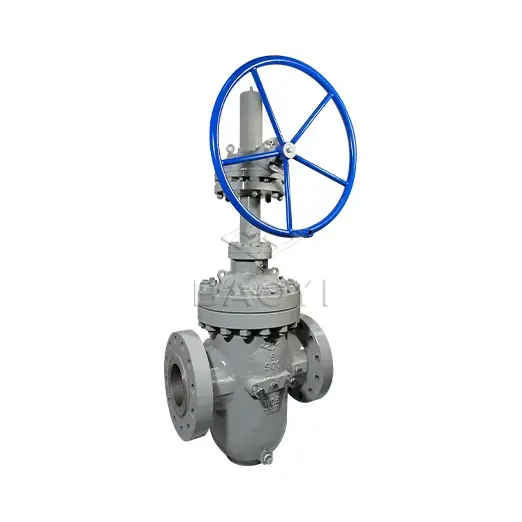
In industrial flow control, few questions generate as much debate among pipeline engineers as the torque comparison between Expanding Slab Gate Valve designs and traditional wedge-type counterparts. At Baoyi, we have spent decades refining our Expanding Slab Gate Valve engineering to address this exact performance gap. The short answer lies in the mechanical separation of sealing force from actuation force—but the full explanation reveals why this distinction translates into real-world savings on actuator sizing, power consumption, and routine maintenance.
The Core Mechanical Principle: Wedge vs. Slab
To understand torque reduction, we must first examine how each valve type creates a seal.
| Feature | Wedge Gate Valve | Expanding Slab Gate Valve (Baoyi) |
|---|---|---|
| Sealing mechanism | Wedge forced between seats by stem thrust | Parallel slabs expanded by a central spreader |
| Seat contact during travel | Continuous sliding friction throughout stroke | No contact during opening/closing (retracted slabs) |
| Final seal creation | Over-torque on stem to wedge the gate | Mechanical expansion of slabs against seats |
| Stem load requirement | High (overcomes wedge friction) | Low (only moves slabs; expansion is separate) |
The wedge gate valve relies on a tapered gate that physically jams between two angled seats. As the stem pushes the wedge downward, the increasing interference fit generates the sealing pressure—but also creates massive radial and axial friction. The operator must overcome this friction not only at the final seating position but throughout the entire travel, because the wedge maintains sliding contact with the seats from fully open to fully closed.
In contrast, a Baoyi Expanding Slab Gate Valve uses two parallel slabs that move vertically with a clearance gap relative to the seat faces. During the stroke, the slabs do not touch the seats. Only at the fully closed position does an internal spreader mechanism (cam or wedge block) force the slabs outward against the stationary seats. This means the stem torque is used solely for linear motion of the gate assembly—not for overcoming continuous seat friction.
Quantifying the Torque Difference
Industry test data consistently shows that a properly designed Expanding Slab Gate Valve requires 40–60% less operating torque than an equivalent-size wedge gate valve under identical pressure and temperature conditions.
| Operating Condition | Wedge Gate Valve (Estimated Torque) | Baoyi Expanding Slab Gate Valve (Estimated Torque) |
|---|---|---|
| 6-inch, 1500# @ ambient | 850–950 N·m | 380–420 N·m |
| 10-inch, 2500# @ 200°C | 2,100–2,400 N·m | 1,000–1,200 N·m |
| 16-inch, 900# @ cryogenic | 1,600–1,800 N·m | 700–800 N·m |
Values are representative for manual-gear operated valves; actual figures depend on trim materials and seat coatings.
This reduction directly impacts actuator selection. A valve requiring half the torque can use a smaller electric, pneumatic, or hydraulic actuator, cutting capital costs by 20–35% and reducing enclosure space in congested pipeline skids.
Three Additional Benefits Beyond Torque Reduction
Lower torque is not an isolated advantage—it cascades into operational improvements:
-
Extended packing life – Reduced stem thrust minimizes lateral loading on the packing box, lowering fugitive emissions risks.
-
Smaller gear operators – Manual handwheel forces remain within ergonomic limits (under 360 N for most sizes), enabling one-person operation.
-
Lower power draw – For battery-powered or solar-actuated remote sites, the energy savings extend battery replacement intervals by up to 40%.
Frequently Asked Questions About the Expanding Slab Gate Valve
Q1: Does lower operating torque mean the Expanding Slab Gate Valve provides a less reliable seal than a wedge gate valve?
A: No. Torque and sealing reliability are decoupled in an Expanding Slab Gate Valve. The sealing force is generated by the mechanical spreader mechanism, not by stem torque. Once the slabs are fully expanded, the seal is maintained by the wedging action between the slabs and the seats—independent of the stem position. This design actually provides a more consistent seal because it does not rely on the operator’s ability to “over-torque” the handwheel. Baoyi valves are tested to API 6D and ISO 5208 with zero detectable leakage across the full pressure range. The lower torque is a byproduct of smarter mechanics, not a compromise in sealing integrity.
Q2: Can I retrofit an existing wedge gate valve actuator onto a new Expanding Slab Gate Valve of the same size and pressure class?
A: In most cases, yes—but with caution. Because the Expanding Slab Gate Valve requires significantly less torque, the existing actuator (sized for the wedge valve) will be oversized. This is technically acceptable, but we recommend recalibrating the torque limiter and stroke limit switches to prevent over-travel and potential damage to the spreader mechanism. Oversized actuators can inadvertently force the expansion mechanism beyond its designed stop, leading to galling of the expansion ramp. Baoyi provides retrofit torque charts and adaptor kits for common actuator mounts (ISO 5211, NEMA, or customer-specific). We always advise consulting our engineering team before direct replacement to ensure proper stroke timing and end-stop settings.
Q3: How does the torque requirement change over the service life of an Expanding Slab Gate Valve compared to a wedge gate valve?
A: This is where the Expanding Slab Gate Valve demonstrates its greatest lifecycle advantage. A wedge gate valve experiences increasing torque over time because the wedge and seat surfaces wear unevenly, creating deeper interference fits with every cycle. Operators compensate by applying higher torque, which accelerates galling and seat damage—a positive feedback loop. In contrast, a Baoyi Expanding Slab Gate Valve maintains a near-constant torque profile throughout its service life. The slabs retract fully during travel, so seat wear is minimal. The spreader mechanism is hardened and coated (tungsten carbide or Stellite) to resist deformation. Field data from Baoyi installations over 10-year periods show torque increases of less than 5%, compared to 25–40% for wedge valves in similar sour-gas services. Regular lubrication of the stem and spreader pivot points—per our maintenance manual—keeps operating torque within 10% of the factory baseline.
Why Engineers Choose Baoyi for Critical Applications
The torque advantage is just one metric. Baoyi combines this mechanical efficiency with:
-
Double-block-and-bleed (DBB) capability in a single valve body.
-
Fire-safe design per API 607/6FA.
-
NACE MR0175 compliance for sour-service environments.
-
Fully machined slab faces with mirror-finish seat pockets for zero-leakage shutoff.
Our Expanding Slab Gate Valve range covers sizes from 2″ to 48″, pressure classes 150# to 2500#, and materials from carbon steel to Inconel 625.
Final Thought: Torque Is Not the Whole Story—But It Matters
Lower operating torque in an Expanding Slab Gate Valve is not a marketing claim; it is a direct consequence of mechanical decoupling between travel and sealing. This design philosophy reduces actuator costs, simplifies field operation, and extends maintenance intervals. When you add the inherent DBB capability and fire-safe construction, the Baoyi Expanding Slab Gate Valve becomes the economically superior choice for pipelines, refineries, and offshore platforms—not because it is “easier to turn,” but because that ease reflects a more intelligent engineering foundation.
Ready to downsize your actuators and upgrade your reliability? Contact Baoyi today for a site-specific torque analysis, retrofitting consultation, or to request a factory test demonstration. Our application engineers are available for virtual walkthroughs, datasheet reviews, and on-site support. Reach us at our global headquarters or through your regional Baoyi representative—we respond within 24 hours with detailed proposals and lifecycle cost comparisons. Let us show you why the Expanding Slab Gate Valve is the future of high-integrity isolation.