

Why Do Oil and Gas Pipelines Rely on Ball Valves for Safe Operation?
2026-09-08
1. What Makes a Ball Valve Different From Other Pipeline Valves?
A Ball Valve uses a spherical ball with a bore through its center to control flow. When the ball is rotated 90 degrees, the bore aligns with the pipeline, allowing flow. When the ball is rotated 90 degrees back, the bore is perpendicular to the pipeline, blocking flow. The quarter-turn operation is fast—a Ball Valve can be closed in under 2 seconds. The sealing is provided by seats that press against the ball, creating a tight seal. The ball itself is typically chrome-plated or coated with a hard material to resist wear from particles in the flow. In a typical pipeline application, the Ball Valve is selected over gate valves (which are slow), globe valves (which have high pressure drop), and plug valves (which can be difficult to operate). The speed and sealing capability make the Ball Valve the preferred choice for emergency shutdown applications.
Critical safety feature: In a pipeline emergency, seconds matter. A gate valve can take 30 to 60 seconds to close fully. A Ball Valve closes in under 2 seconds. This difference is critical in preventing a small leak from becoming a major spill.
The Ball Valve design also provides a full bore flow path, meaning there is no pressure drop when the valve is fully open. This is important in long-distance pipelines where pressure loss must be minimized. Zhejiang Bolaisi Valve Co., Ltd. manufactures Ball Valves in sizes from 2 to 48 inches, with pressure ratings up to Class 2500. We produce both floating ball and trunnion mounted designs, depending on the size and pressure requirements.
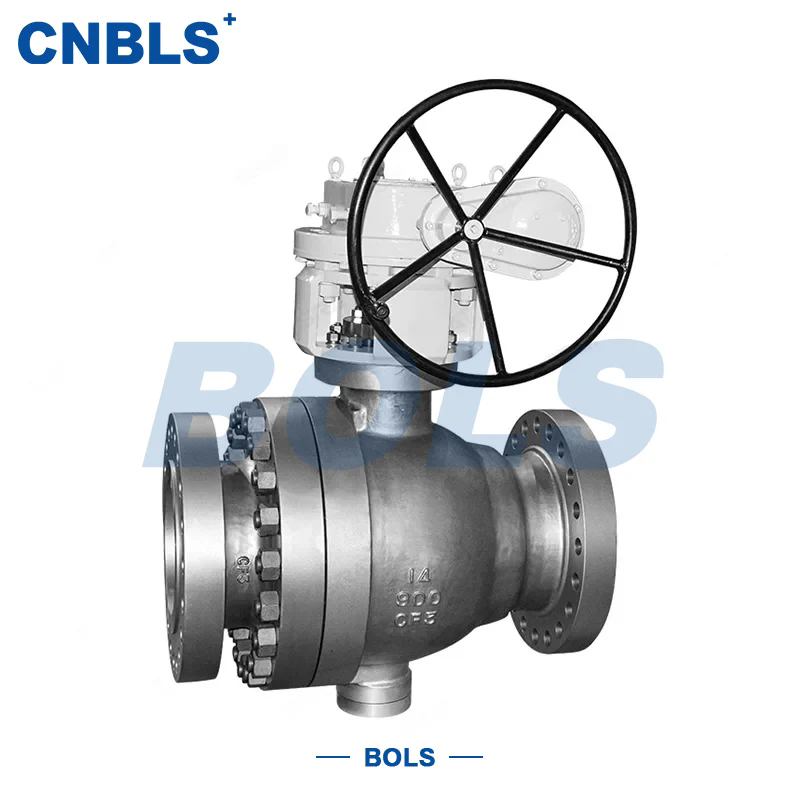
2. What Are the Key Differences Between Floating and Trunnion Ball Valves?
The selection between a floating ball and a trunnion mounted Ball Valve is one of the most important decisions in pipeline valve specification. In a floating ball design, the ball is held in position by the seats. The ball floats between the seats, and the upstream pressure pushes the ball against the downstream seat, creating a seal. This design works well for smaller valves (up to 8 inches) and lower pressures. In a trunnion mounted design, the ball is fixed in position with a top and bottom trunnion. The seats are spring-loaded and move against the ball. This design is used for larger valves and higher pressures because the trunnions absorb the pressure load, reducing the operating torque. The table below compares the two designs.
| Feature | Floating ball valve | Trunnion mounted ball valve |
| Ball support | Seats only (ball floats) | Top and bottom trunnions (fixed) |
| Seal mechanism | Pressure pushes ball against seat | Spring-loaded seats move against ball |
| Maximum size | Up to 8 inches | 2 to 48 inches |
| Maximum pressure | Class 900 | Class 2500 |
| Operating torque | Moderate (increases with pressure) | Low (trunnions carry the load) |
| Typical applications | Small pipelines, manifolds, process lines | Large transmission pipelines, high pressure |
In our factory, we manufacture trunnion mounted Ball Valves for large diameter pipelines, with seat designs that provide bubble-tight shutoff even at high pressure differentials. We also offer fire-safe designs that maintain sealing integrity after exposure to fire.
3. What Sealing Technologies Ensure Leak-Free Operation in Critical Applications?
The sealing performance of a Ball Valve is determined by the seat material, the seat design, and the surface finish of the ball. The seat material must be compatible with the fluid, resistant to wear, and capable of maintaining a seal over a wide temperature range. For oil and gas applications, the most common seat materials are PTFE (for low and moderate temperatures), reinforced PTFE (for higher pressures), and PEEK (for high temperatures and abrasive fluids). The seat design also affects the sealing performance. A lip seal design provides a bi-directional seal, while a pressure-energized seat uses the line pressure to improve the seal. The table below shows the seat material options and their operating limits.
| Seat material | Temperature range (°C) | Pressure range | Suitable fluids | Sealing performance |
| PTFE (virgin) | -40 to +120 | Up to Class 600 | Clean gas, oil, water | Excellent (bubble-tight) |
| Reinforced PTFE (glass-filled) | -40 to +150 | Up to Class 900 | Hydrocarbons, sour gas | Very good (low creep) |
| PEEK | -40 to +250 | Up to Class 1500 | High temperature, abrasive | Good (harder, more wear resistant) |
| Metal seat (stellite or tungsten) | -40 to +425 | Up to Class 2500 | High temperature, steam, slurry | Good (metal to metal seal) |
| Urethane | -20 to +80 | Up to Class 300 | Water, wastewater, mild chemicals | Good (flexible, low wear) |
In our factory, we select the seat material based on the service conditions and the customer's operational requirements. For sour gas applications, we use a PTFE seat with a corrosion-resistant ball coating. For high temperature applications, we use a PEEK seat or a metal seat. Zhejiang Bolaisi Valve Co., Ltd. provides a full material selection guide for each Ball Valve application.
4. What Are the Operational Factors That Affect Ball Valve Reliability?
The reliability of a Ball Valve depends on factors that are often overlooked in the specification: the operating frequency, the cycling speed, and the environmental conditions. A Ball Valve that is operated frequently (multiple times per day) requires a different seat material than a valve that is operated once per year. A valve in a cold climate requires a seat material that remains flexible at low temperatures. A valve in an offshore environment requires a corrosion-resistant coating. The most common failure mode in Ball Valves is seat wear, which leads to leakage. In our experience, the seat wear rate can be reduced by a factor of 10 by selecting the appropriate seat material and by maintaining the valve in accordance with the manufacturer's recommendations. We recommend a valve inspection schedule that includes checking the seat condition and the actuator operation.
Frequently Asked Questions About Ball Valves in Pipeline Service
Summary for Pipeline Operators and Engineers
Ball valves are the preferred choice for oil and gas pipelines because they provide fast operation, reliable sealing, and full bore flow. The selection between floating and trunnion designs depends on the size and pressure rating. The seat material selection depends on the temperature, pressure, and fluid compatibility. By understanding these factors, operators can select Ball Valves that provide decades of reliable service. Our factory has supplied Ball Valves for pipelines in over 40 countries, and we provide full technical support for installation and maintenance.
Zhejiang Bolaisi Valve Co., Ltd. manufactures Ball Valves in a wide range of sizes and pressure classes. We provide full documentation, including material test reports, pressure test records, and operational guidelines. Our engineering team can help you select the right Ball Valve for your application.