

Why Are Globe Valves Widely Used in Heating and Hot Water Supply Systems?
2026-09-03
Every heating system designer faces the same choice: which valve type to specify for hot water supply branches. Ball valves offer full flow and a simple quarter-turn operation. Gate valves are inexpensive and cause minimal pressure drop. Yet, when you look at actual HVAC specifications for commercial buildings, district heating networks, and industrial hot water systems, the most common valve you will find is the globe valve. Not because it is the cheapest or the simplest, but because it performs the one function that heating systems demand more than any other: precise flow regulation at partial opening.
1. What Flow Characteristics Make a Globe Valve Ideal for Heating Systems?
In a heating or hot water supply system, the valve is rarely fully open. It is typically set at 30 to 70 percent opening to balance the flow between different zones or to modulate the heat output. A Globe Valve has a linear or equal percentage flow characteristic that provides a predictable relationship between the valve stem position and the flow rate. This linearity means that a 10 percent change in valve opening produces a 10 percent change in flow, which is essential for accurate temperature control. In contrast, a gate valve has a flow characteristic that changes very little until the valve is nearly closed, making it unsuitable for throttling. A ball valve is better, but its characteristic is still more abrupt than a globe valve. The S shape of the flow passage through a Globe Valve creates the pressure drop that enables this precise control. In our factory, we manufacture Globe Valve units with a Cv (flow coefficient) that is designed specifically for the 30 to 70 percent opening range, which is the operating window for most heating applications. Our Huadu Valve Group Co., Ltd. uses computational fluid dynamics to optimize the disc and seat geometry, ensuring that the flow characteristic remains linear even at low openings.
Real-world operating range: In a typical fan coil unit or radiator branch, the globe valve operates at 40 to 60 percent opening. At this setting, the valve provides the exact pressure drop needed to balance the system.
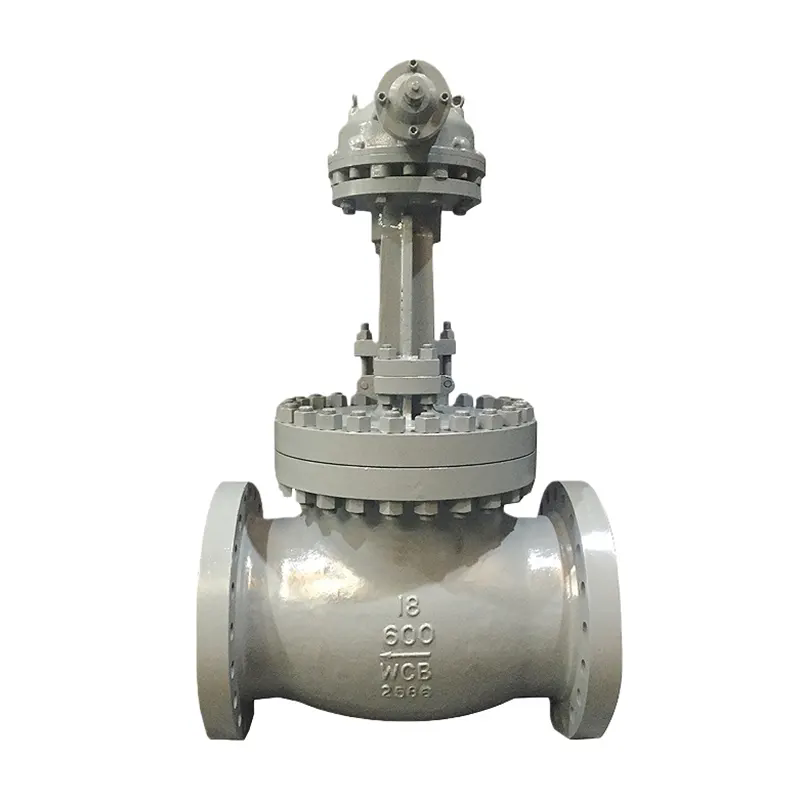
2. How Does the Globe Valve Design Handle the Unique Demands of Hot Water Systems?
Hot water systems present three specific challenges that affect valve selection: thermal expansion of the piping, the presence of dissolved gases, and the need for tight shutoff during maintenance. A Globe Valve addresses all three. The metal-to-metal or PTFE seal disc is capable of maintaining a Class IV shutoff (0.01 percent of rated flow) even at elevated temperatures up to 200°C. The threaded or flanged connection allows the valve to be removed for maintenance without cutting the pipe, which is important when the system is under thermal expansion stress. And the robust stem and packing gland design prevents leakage even under pressure fluctuations of 2 to 3 bar that are common in district heating networks. In our factory, we have tested Globe Valve units under thermal cycling conditions of 20 to 120°C for 10,000 cycles, and the seat leakage remained within Class IV specifications. This durability is one of the reasons why specifiers continue to choose globe valves despite the availability of alternatives.
3. What Are the Technical Parameters That Matter for Globe Valve Selection?
When selecting a Globe Valve for a heating or hot water application, there are four key parameters that determine whether the valve will perform as expected. The table below summarizes these parameters and provides the typical values for our standard product line.
| Selection parameter | Why it matters | Typical range for heating systems | Our standard specification |
| Flow coefficient (Cv) | Determines the valve size needed for the required flow at the available pressure drop | 3.0 to 150 (for DN15 to DN100) | Matched to heating system design tables |
| Pressure rating | Must exceed the maximum system pressure, including pump shutoff head | PN16 (16 bar) to PN40 (40 bar) | PN25 (25 bar) for most applications |
| Temperature rating | Must exceed the maximum supply water temperature | 100°C to 150°C (for hot water) | 200°C (standard), 350°C (high temperature option) |
| Leakage class (shutoff) | Determines whether the valve can seal completely when closed | Class IV (0.01% of rated Cv) | Class IV standard, Class VI optional |
When selecting a Globe Valve, it is also important to consider the valve body material and the trim material. For hot water systems, we recommend cast iron bodies for non-corrosive water and bronze or stainless steel for systems with aggressive water chemistry. In our factory, we offer Globe Valve units with a stainless steel stem and a hardened stainless steel seat ring, which provides wear resistance at the frequent throttling positions.
4. How Does Installation and Maintenance Experience Compare to Other Valve Types?
The installation and maintenance requirements for a Globe Valve are different from those for a ball valve or gate valve. The table below compares the practical aspects of installation and maintenance for the three valve types in a heating system context.
| Installation/maintenance aspect | Globe Valve | Ball Valve | Gate Valve |
| Installation orientation | Must be installed with the stem vertical (or within 45° of vertical) | Any orientation | Stem should be vertical or horizontal |
| Space required for maintenance | Moderate (stem can be removed without unbolting the valve) | Low (quarter-turn, ball access) | High (bonnet removal requires overhead clearance) |
| Packing adjustment | Can be adjusted in service (while the system is pressurized) | Difficult (requires stem removal) | Can be adjusted in service |
| Seat replacement | Can be done without removing the valve body from the pipe | Requires valve removal for full port designs | Requires bonnet removal and valve disassembly |
The ability to replace the seat disc and the stem packing without removing the Globe Valve from the pipe is a significant advantage in commercial buildings where interrupting the heating system is disruptive. In our factory, we design Globe Valve units with a renewable seat and a self-aligning disc, which simplifies field maintenance.
Frequently Asked Questions About Globe Valves in Heating Systems
Summary for HVAC System Designers and Facility Managers
The Globe Valve remains the most widely used valve type in heating and hot water systems because its design characteristics match the operating requirements of these applications. The linear flow characteristic enables precise temperature control. The renewable seat and packing allow for cost-effective maintenance. The robust construction withstands the thermal cycling and pressure fluctuations that are common in these systems. While ball valves offer lower pressure drop and gate valves offer full flow, neither provides the throttling precision or the serviceability of a globe valve.
Huadu Valve Group Co., Ltd. manufactures Globe Valve units specifically for heating and hot water applications. Our valves are available in cast iron, bronze, and stainless steel body materials, with a range of pressure and temperature ratings. Each valve is pressure tested and calibrated before shipment.