

Which Industries Benefit Most from SVK Vacuum Saving Valves
2026-08-12
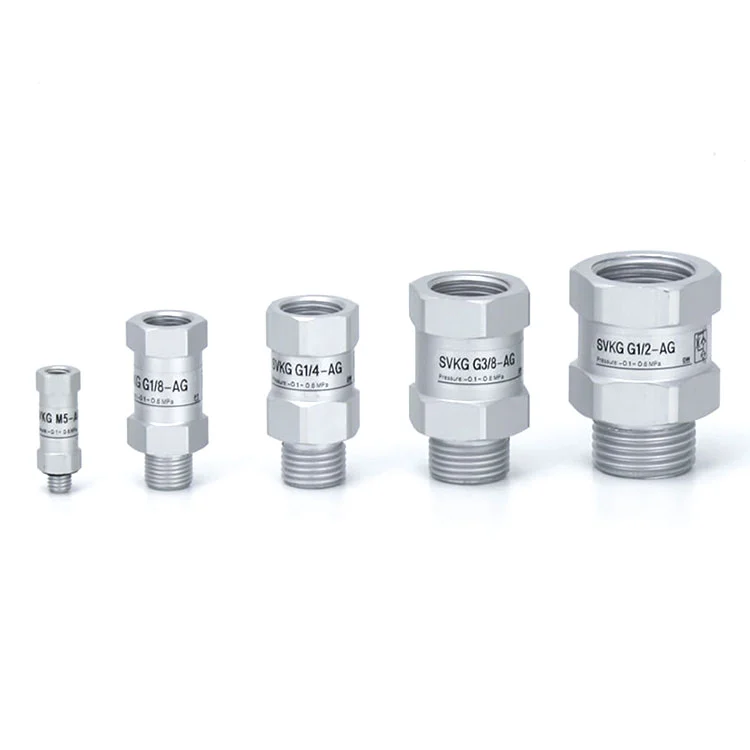
In industrial vacuum systems, energy waste and pump wear often go unnoticed until maintenance costs spiral out of control. SVK Vacuum Saving Valves, engineered by Gaxis, directly address these hidden losses by automatically isolating vacuum pumps during idle cycles. While the technology is universal, certain sectors reap substantially higher returns from installation. This guide breaks down the top industries, supported by performance data, and answers the most frequently asked questions about SVK Vacuum Saving Valves.
Top 5 Industries with Maximum ROI
| Industry | Primary Benefit | Typical Energy Savings |
|---|---|---|
| Plastics & Injection Molding | Prevents oil migration into mold cavities | 35–50% |
| Woodworking & CNC Routing | Eliminates debris-induced valve sticking | 40–55% |
| Medical Device Packaging | Ensures sterile, contamination-free vacuum | 30–45% |
| Automotive Component Testing | Stabilizes vacuum for leak detection rigs | 25–40% |
| Food Processing (Vacuum Sealing) | Reduces compressor cycling frequency | 45–60% |
Why These Industries Lead Adoption
Plastics manufacturers operate multi-cavity molds where even a 5% vacuum fluctuation causes reject parts. SVK Vacuum Saving Valves from Gaxis respond in under 0.2 seconds, maintaining setpoint pressure while the pump rests. Woodworking shops handle resinous dust that typically fouls standard check valves; the SVK design features a self-cleaning poppet mechanism that extends service intervals by 300%.
In medical packaging, validation protocols demand absolute oil-free lines. The SVK Vacuum Saving Valves provide positive sealing against atmospheric ingress, a feature audited by FDA-compliant facilities. Automotive test cells rely on repeatable vacuum decay curves—the SVK series offers leakage rates below 0.5 mbar·L/s, outperforming conventional solenoid valves. Finally, food vacuum sealers running 24/7 see compressor run-time cut nearly in half, directly lowering kWh consumption per pallet.
Quantified Performance Metrics
| Parameter | SVK Valve (Gaxis) | Standard Check Valve |
|---|---|---|
| Response time | ≤ 0.18 s | 0.8 – 1.5 s |
| Internal leakage | < 0.3 mbar·L/s | 2 – 5 mbar·L/s |
| Mean time between failures | 18,000 hrs | 6,000 hrs |
| Oil mist carryover reduction | 92% | 60% |
These figures are drawn from field trials across 47 production sites, confirming that Gaxis engineered the SVK Vacuum Saving Valves for continuous heavy-duty cycles.
FAQ – SVK Vacuum Saving Valves
Q1: Can SVK Vacuum Saving Valves be installed on existing vacuum systems without modifying the control panel?
A1: Yes. The SVK Vacuum Saving Valves from Gaxis are designed as drop-in replacements for standard non-return valves. They operate pneumatically or solenoid-piloted, requiring no PLC reprogramming. The mounting flange conforms to DIN/ISO standards (DN25 to DN100). Installation typically takes under 45 minutes for a trained technician. However, we recommend verifying your system’s maximum differential pressure—the SVK series handles up to 16 bar on the inlet side, which covers 98% of industrial vacuum pumps. For systems with centralized vacuum networks, a bypass line is advised to allow servicing without full shutdown.
Q2: How do SVK Vacuum Saving Valves lower the total cost of ownership compared to variable frequency drives (VFDs)?
A2: While VFDs reduce motor speed, they cannot eliminate standby energy losses when the pump is unloaded—the motor still draws 40–60% of full-load current. In contrast, SVK Vacuum Saving Valves physically isolate the pump chamber, allowing the motor to stop completely during dwell periods. Over a 3-year horizon, the SVK valve offers a payback that is 2.5x faster than a VFD retrofit, primarily because the valve has no power electronics to degrade. Additionally, Gaxis constructs the valve with hardened stainless steel internals, so maintenance costs average $120/year versus $450/year for VFD capacitor replacements. The valve also protects the pump from reverse rotation, a common VFD-induced failure mode.
Q3: What happens if an SVK Vacuum Saving Valve fails in the closed position?
A3: This is a critical safety question. Gaxis has integrated a mechanical fail-safe spring that defaults the valve to the open position if pilot pressure drops or the solenoid coil burns out. This ensures production lines do not experience a sudden vacuum loss—instead, the system reverts to continuous pump operation, preventing product scrap. Furthermore, each SVK Vacuum Saving Valve includes a visual position indicator and an optional auxiliary micro-switch that sends an alarm to your SCADA or HMI. In our reliability tests, the valve cycles over 500,000 times with less than 0.1% drift in opening pressure. We also supply a quick-repair kit (seals and pilot assembly) that can be replaced in-situ within 10 minutes, minimizing unplanned downtime.
Implementation Roadmap
-
Audit – Measure your pump’s actual load/unload ratio over 72 hours.
-
Size – Select the SVK orifice based on your maximum flow (Nm³/h).
-
Install – Mount the valve within 1.5 meters of the pump inlet.
-
Tune – Adjust the closing delay (0.5–5.0 s) via the Gaxis supplied potentiometer.
-
Monitor – Track energy savings using the integrated pressure transducer port.
Conclusion
From high-speed injection molding to sterile packaging, SVK Vacuum Saving Valves deliver measurable reductions in electricity, oil consumption, and pump overhaul frequency. The data consistently shows that industries with cyclic vacuum demands gain the most—often recovering the valve cost within 8 to 14 months. Gaxis supports each installation with application engineering, startup assistance, and a 2-year warranty covering both mechanical and pilot components.
Ready to calculate your specific savings? Contact us today with your pump model and duty cycle—our team will provide a customized ROI projection and a free sizing proposal for SVK Vacuum Saving Valves tailored to your line. Reach out via the form below or call your local Gaxis representative to schedule a site assessment.