

Which Fluorine Lined Flange Ball Valve Size and Pressure Class Is Best for Chemical Service
2026-08-27
Selecting the correct Fluorine Lined Flange Ball Valve for aggressive chemical environments is not a one-size-fits-all decision. The wrong size leads to inefficient flow control, while an incorrect pressure class invites catastrophic leakage or premature failure. For over a decade, JOEPAI has supplied engineered fluoropolymer-lined valves to chemical plants, pharmaceutical manufacturers, and petrochemical facilities worldwide. This guide cuts through the confusion and delivers a systematic method to match valve dimensions and pressure ratings to your specific service conditions.
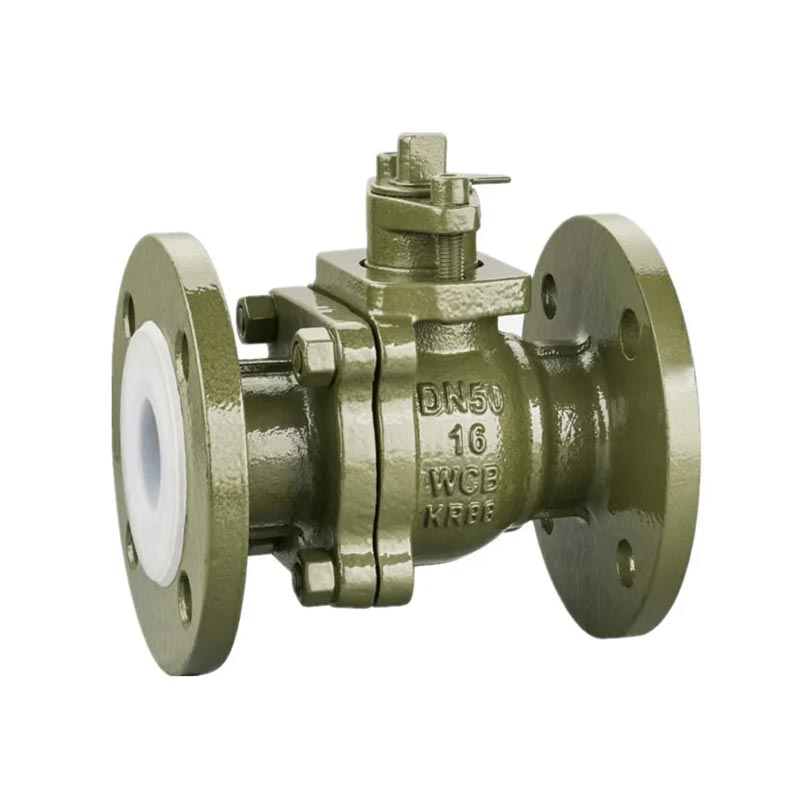
The Two Critical Parameters: Size and Pressure Class
Every Fluorine Lined Flange Ball Valve carries two primary ratings: nominal pipe size (NPS or DN) and pressure class (typically Class 150, 300, or PN10–PN40). These are not independent. A valve’s bore diameter determines flow capacity (Cv), while the flange rating dictates the maximum allowable working pressure (MAWP) at a given temperature. In chemical service, both must also account for liner material—usually virgin PTFE or modified PFA—which softens as temperature rises, derating the pressure boundary.
Step-by-Step Selection Framework for Chemical Service
| Selection Step | Critical Factor | Why It Matters |
|---|---|---|
| 1. Define flow requirements | Required Cv / flow velocity | Oversizing causes poor throttling; undersizing creates cavitation and erosion. |
| 2. Determine design temperature | Continuous & peak operating °C | Liner decompression and flange bolt creep accelerate above 180°C. |
| 3. Identify pressure extremes | Operating pressure + surge events | Must remain below the temperature-corrected pressure class. |
| 4. Check flange standard | ASME B16.5 vs. EN 1092-1 | Mismatched bolt circles and facing finishes cause leak paths. |
| 5. Evaluate chemical compatibility | Specific media (acids, solvents, chlorine) | Some fluoropolymers swell in certain halogenated compounds. |
Recommended Size and Class Combinations by Application
Based on JOEPAI field data from 200+ chemical installations, the following table provides proven starting points. Always verify with your process engineer.
| Chemical Service Type | Typical Pipe Size Range | Recommended Pressure Class | Preferred Liner Material |
|---|---|---|---|
| Concentrated sulfuric acid (98%) | DN50 – DN200 | Class 150 (ASME) | PFA (perfluoroalkoxy) |
| Hydrochloric acid (any concentration) | DN25 – DN150 | Class 300 (ASME) | Virgin PTFE with encapsulated seat |
| Caustic soda (50% NaOH, <100°C) | DN40 – DN250 | PN16 (EN) | Modified PTFE + anti-static design |
| Chlorinated solvents (e.g., methylene chloride) | DN15 – DN100 | Class 150 | PFA with secondary diaphragm seal |
| High-purity pharmaceutical water (WFI) | DN20 – DN80 | PN10 | Electropolished PFA, zero dead-leg |
General rule from JOEPAI engineering: For most liquid chemical duties under 200°C, a Class 150 Fluorine Lined Flange Ball Valve in DN80–DN150 covers 70% of typical plant needs. For steam-jacketed lines or gas service with pressure spikes, step up to Class 300 regardless of line size.
3 Common Pitfalls When Sizing Fluoropolymer-Lined Valves
-
Ignoring thermal derating – A Class 150 valve rated at 19 bar at 38°C drops to approximately 12 bar at 180°C. Always consult the temperature-pressure chart from JOEPAI’s technical data sheet.
-
Oversizing for future expansion – A valve that is one or two sizes too large operates at low opening percentages, causing seat wear and unstable control. Size for current maximum flow plus 15% margin only.
-
Mixing flange facing finishes – A raised-face flange (RF) on the valve paired with a flat-face (FF) pipe flange creates uneven gasket compression. JOEPAI offers both RF and FF options with serrated or smooth finishes to match your piping spec.
Fluorine Lined Flange Ball Valve FAQ
Q1: Can I use a Class 150 Fluorine Lined Flange Ball Valve for chlorine gas service at 15 bar and 60°C?
A: No. Chlorine gas is highly oxidizing and penetrates standard PTFE liners under pressure. Even though 15 bar is within Class 150’s 60°C rating (approx. 17 bar), the permeation rate through PTFE is unacceptable for safety. JOEPAI recommends a Class 300 valve with a densified PFA liner and a metallic envelope gasket. Additionally, you must specify a fire-safe design and a degassing port to prevent liner blistering. Always perform a helium leak test post-installation.
Q2: How do I calculate the correct Cv for a Fluorine Lined Flange Ball Valve in a slurry-containing acid stream?
A: Start with the standard liquid Cv formula: Cv = Q × √(SG / ΔP), where Q is flow in GPM, SG is specific gravity, and ΔP is pressure drop in psi. Then apply a correction factor of 0.85 to 0.90 because fluoropolymer liners have higher surface roughness than metal-seated valves, which reduces effective Cv at the same opening. For abrasive slurries, JOEPAI suggests selecting one nominal size larger (e.g., DN100 instead of DN80) and using a full-port (full-bore) design to minimize velocity and erosion, then recalculate Cv with the derated coefficient.
Q3: What is the maximum torque requirement for a motorized Fluorine Lined Flange Ball Valve at Class 300, DN150, under 180°C?
A: At 180°C, the PFA liner expands and increases the friction between the ball and the seats. Typical breakaway torque for this configuration ranges from 350 to 450 N·m (dry) and 280–380 N·m (lubricated media). However, thermal cycling can double the running torque due to differential expansion of the stainless steel body versus the fluoropolymer liner. JOEPAI always recommends adding a 40% safety margin to the actuator sizing (i.e., specify 500–630 N·m) and choosing a failsafe spring-return actuator. For accurate site-specific values, request a torque calculation report from JOEPAI’s application engineers using your actual cycle frequency and ambient temperature data.
Final Verdict: The Best Choice for Most Chemical Plants
For general chemical service (acids, bases, salts, alcohols, and mild solvents) with operating temperatures between –20°C and +150°C and pressures up to 16 bar, the JOEPAI Fluorine Lined Flange Ball Valve in DN80, Class 150, with a PFA liner and stainless steel 316 body offers the optimal balance of cost, availability, and reliability. If your process exceeds 16 bar or involves wet chlorine, hydrogen peroxide, or anhydrous HCl, move immediately to Class 300 with a reinforced PFA liner and a belleville spring washer package to maintain bolting preload under thermal transients.
Need a Specific Sizing for Your Process Conditions?
Every chemical line has unique variables—temperature spikes, particulate content, cycling frequency, and even ambient weather affect valve performance. JOEPAI does not believe in generic answers. Our technical team provides free, no-obligation sizing reports with 3D flow simulations and torque analysis tailored to your P&ID.
Contact us today with your media, temperature, pressure, and line size, and we will deliver a formal valve datasheet within 24 hours. Email [email protected] or use the live chat on our product page to speak directly with a fluoropolymer valve specialist. Your safety and uptime are our only metrics.