

Which Fire Strainer Design Fits Pipelines With Limited Installation Space?
2026-10-22
An installation engineer is retrofitting a fire pump room in a 20-year-old building. The existing pipe layout has a straight run of only 800 mm between the pump discharge flange and the first elbow. The specification calls for a DN150 Fire Strainer. The engineer's first choice is a Y-type strainer. The Y-type requires 450 mm of straight pipe for the body and another 350 mm of clearance for the screen removal. The total required length is 800 mm, but the available space is exactly 800 mm with no allowance for the flange and the gasket. The engineer cannot fit the Y-type strainer. The engineer evaluates alternative designs. This guide explains which fire strainer designs fit pipelines with limited installation space.
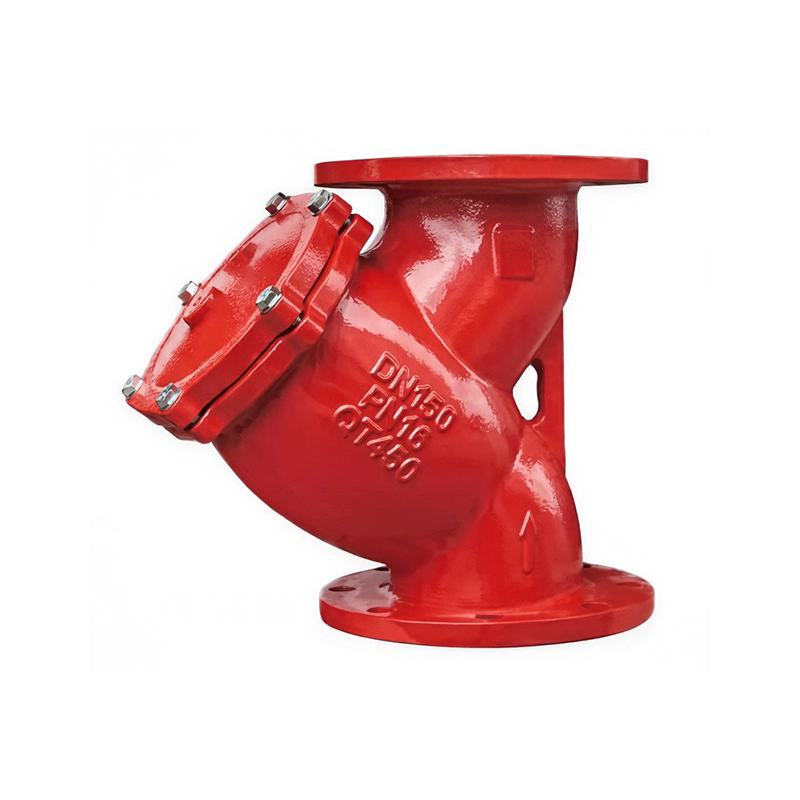
1. How Much Space Does Each Fire Strainer Design Require?
The installation space requirement for a Fire Strainer depends on the body length and the screen removal direction. The Y-type strainer has an angled body that requires straight pipe on both sides and clearance below the screen cap. The T-type strainer has a straight-through body with the screen in a perpendicular branch. The basket strainer has a large body with a top-opening cover. The table below compares the space requirements for a DN150 strainer at PN16.
| Design | Face-to-face length (mm) | Screen removal direction | Required clearance (mm) | Total length required (mm) |
| Y-type | 450 | Angled, downward | 350 | 800 |
| T-type | 350 | Perpendicular, upward | 300 | 650 |
| Basket | 400 | Vertical, upward | 400 | 800 |
| Short-pattern Y-type | 300 | Angled, downward | 250 | 550 |
| Angle-type | 250 | Inline, horizontal | 150 | 400 |
In our factory, we manufacture Fire Strainer units in Y-type, T-type, basket, and angle-type configurations. The short-pattern Y-type and the angle-type are specifically designed for installations with limited straight pipe. Fuxeon Fire-Fighting Technology Co.,Ltd. has been manufacturing fire strainers for over 12 years.
2. Why Does the Y-Type Strainer Fail in Tight Spaces?
The Y-type Fire Strainer is the most common design in fire protection systems. It is compact in the axial direction, but it requires clearance below the body for the screen removal. The screen is inserted from the angled branch, and the cap must be removed to pull out the screen. If the strainer is installed close to the floor or close to another pipe, the screen cannot be removed for cleaning. The table below shows the clearance requirements for different Y-type orientations.
| Installation orientation | Screen removal direction | Minimum clearance from obstruction (mm) | Suitable for low-clearance space |
| Horizontal pipe, branch down | Downward | 350 | No (requires floor clearance) |
| Horizontal pipe, branch up | Upward | 350 | No (requires ceiling clearance) |
| Vertical pipe, branch horizontal | Horizontal | 350 | Yes (if side clearance available) |
| Short-pattern, branch down | Downward | 250 | Marginal |
| Angle-type, inline | Horizontal (in line with pipe) | 150 | Yes |
Installation engineer's note: The most common mistake in tight spaces is to install a Y-type strainer with the branch pointing upward and then discover that the ceiling or the pipe rack prevents the screen from being removed. The strainer is installed, but it cannot be maintained. In our factory, we recommend that the installation engineer verify the screen removal clearance before selecting the strainer. We provide a clearance template that can be placed against the pipe to check the available space. Fuxeon Fire-Fighting Technology Co.,Ltd. provides this template with every strainer order.
3. Which Design Is Best for Retrofits With Less Than 600 mm of Straight Pipe?
When the available straight pipe is less than 600 mm, the standard Y-type and basket strainers are not suitable. The engineer must choose a design with a shorter face-to-face length or a different screen removal direction. The angle-type strainer is the most compact option. It has a face-to-face length of 250 mm and the screen is removed in line with the pipe, so it does not require perpendicular clearance. The short-pattern Y-type is the second option. It has a face-to-face length of 300 mm and requires 250 mm of perpendicular clearance. The table below shows the recommended design for different available lengths.
| Available straight pipe (mm) | Recommended design | Face-to-face length (mm) | Required perpendicular clearance (mm) |
| > 800 | Standard Y-type or basket | 450 / 400 | 350 / 400 |
| 650 – 800 | T-type | 350 | 300 |
| 550 – 650 | Short-pattern Y-type | 300 | 250 |
| 400 – 550 | Angle-type | 250 | 150 |
| < 400 | Custom compact design | 200 | 100 |
In our factory, we manufacture the angle-type Fire Strainer with a face-to-face length of 250 mm for DN150. The screen is removed by loosening the cap on the side of the body and pulling the screen out horizontally. The strainer can be installed directly between two elbows without any straight pipe. Fuxeon Fire-Fighting Technology Co.,Ltd. also offers a custom compact design for spaces smaller than 400 mm.
4. What Maintenance Access Should Be Considered Beyond the Strainer Itself?
The installation space must account for the maintenance access to the strainer and the adjacent components. The engineer should consider three things. The first is the space for the operator to stand and use tools. The second is the space for the removed screen and cap to be placed temporarily. The third is the space for the flushing water to drain. The table below shows the recommended maintenance access dimensions.
| Maintenance activity | Required space | Typical dimension |
| Operator standing space | In front of the strainer cap | 600 x 600 mm |
| Tool swing space | Around the cap | 300 mm radius |
| Screen placement | Flat surface near the strainer | 500 x 500 mm |
| Drainage | Floor drain within 1 m | N/A |
In our factory, we provide a maintenance access guide with every Fire Strainer. The guide includes the recommended clearances for the operator, the tools, and the screen. Fuxeon Fire-Fighting Technology Co.,Ltd. recommends that the installation engineer include these dimensions in the pump room layout drawing.
Frequently Asked Questions About Fire Strainer Design for Limited Installation Space
Summary for Installation Engineers
The choice of Fire Strainer design for limited installation space depends on the available straight pipe length and the screen removal clearance. The standard Y-type requires 800 mm of total length. The T-type requires 650 mm. The short-pattern Y-type requires 550 mm. The angle-type requires 400 mm. The installation engineer should verify the screen removal clearance and the maintenance access before selecting the strainer. The angle-type is the most compact option for retrofits with less than 550 mm of straight pipe. Fuxeon Fire-Fighting Technology Co.,Ltd. has been manufacturing fire strainers for over 12 years and provides clearance templates and maintenance access guides for our customers.
Fuxeon Fire-Fighting Technology Co.,Ltd. manufactures Fire Strainer units in Y-type, T-type, basket, short-pattern Y-type, and angle-type configurations. We provide face-to-face dimensions, clearance templates, and pressure drop curves for all of our products.