

Where Should You Install a Breather Valve on a Fixed-Roof Tank for Optimal Performance
2026-08-19
Proper placement of a Breather Valve on a fixed-roof storage tank is not a matter of guesswork—it is a critical engineering decision that directly impacts safety, emission control, and operational efficiency. For facilities relying on atmospheric or low-pressure storage, the installation location determines how effectively the Breather Valve responds to thermal in-breathing and out-breathing events. At Baoyi, we have observed that even correctly sized valves underperform when mounted in suboptimal positions. This guide walks through the engineering rationale, practical mounting rules, and common pitfalls to ensure your Breather Valve delivers maximum service life and regulatory compliance.
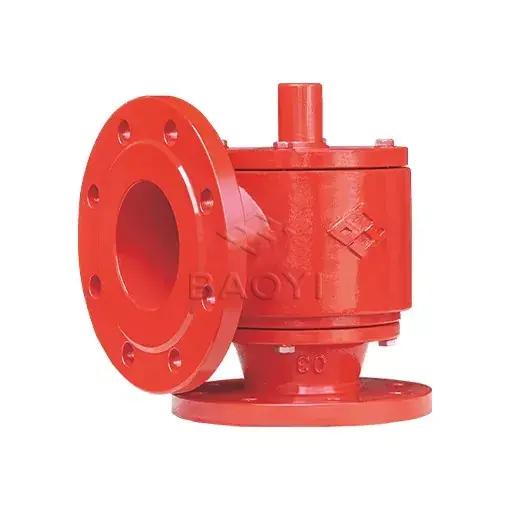
Key Factors Determining Breather Valve Placement
| Factor | Impact on Installation | Recommended Practice |
|---|---|---|
| Vapor space volume | Larger volume requires faster response | Mount as close to the roof center as possible |
| Nozzle orientation | Affects flow resistance | Vertical installation on top nozzle preferred |
| Liquid splash / sloshing | Risk of liquid carryover | Elevate or shield the inlet above maximum liquid level |
| Ice or fouling | Moving parts may jam | Avoid low spots or areas with moisture accumulation |
| Maintenance access | Frequent testing required | Install with clear platform or ladder access |
| Piping connection length | Excessive pipe adds pressure drop | Keep inlet piping straight and under 10× diameter |
The Optimal Location: Roof Center, Top Nozzle
For most fixed-roof tanks, the single best location for a Breather Valve is the center of the roof deck, mounted vertically on the highest available nozzle. This position offers three distinct advantages:
-
Uniform vapor distribution – The center collects the average tank pressure without bias from wind or localized heating.
-
Shortest flow path – Reduces pressure drop during emergency venting, allowing the Breather Valve to reach full capacity within milliseconds.
-
Minimal liquid entrainment – Away from tank walls where condensation runs down, and above the fill height to prevent sloshing impact.
Baoyi engineers typically recommend a vertical stem orientation because most Breather Valve designs (especially pilot-operated and weighted-pallet types) rely on gravity for proper seating. Horizontal mounting increases seat wear and hysteresis, cutting calibration intervals by up to 40%.
When to Avoid the Roof Center (And Where to Go Instead)
There are two exceptions where the center nozzle is not ideal:
-
Tanks with internal floating roofs (IFR) – The roof legs and drainage channels occupy the center; in this case, mount the Breather Valve on a reinforced corner nozzle but always specify a drip ring and rain shield to prevent water ingress.
-
Tanks under nitrogen blanketing – The blanketing regulator often uses a separate nozzle. Place the Breather Valve at least 3 meters away from the blanketing inlet to avoid short-circuiting, with the valve slightly offset to the leeward side for balanced pressure sensing.
3 Common Installation Mistakes That Ruin Performance
| Mistake | Consequence | Baoyi Solution |
|---|---|---|
| Mounting without a thermal siphon break | Condensate blocks the pallet | Specify steam-jacketed or heated Breather Valve models |
| Installing directly above a fill pipe | High-velocity gas impingement | Add a 90° elbow deflector or relocate the nozzle |
| Using flexible connections between valve and nozzle | Misalignment causes stem binding | Use rigid flanged connections with shim adjustment |
Breather Valve FAQ – Common Questions from Plant Engineers
Q: Can I install the same Breather Valve on both a fixed-roof and a floating-roof tank?
A: No. A Breather Valve for a fixed-roof tank is designed for higher pressure set points (typically 1–2.5 psi) and larger flow capacities because the entire roof moves with pressure changes. Floating-roof tanks use much lower set points (around 0.5 psi) and smaller orifices. Using a fixed-roof rated Breather Valve on a floating roof will delay opening, potentially exceeding the tank’s design pressure. Always check the tank’s API 650 or API 620 designation before selection.
Q: How much straight pipe is required upstream of a Breather Valve to ensure accurate pressure sensing?
A: The industry rule of thumb—and one we at Baoyi validate through computational fluid dynamics—is a minimum of 5 pipe diameters of straight, unobstructed pipe between the tank nozzle and the Breather Valve inlet. If an elbow, tee, or reducer is necessary, extend that to 10 diameters. Shorter runs create turbulence that falsely elevates the sensed pressure, causing the Breather Valve to chatter (rapid open-close cycling), which wears out the seat in weeks rather than years.
Q: Does the Breather Valve need a rain hood or cover if installed outdoors?
A: Absolutely. A Breather Valve without a weather cover is prone to two failures: (1) rainwater seeps through the vent gap and mixes with stored product, corroding the internal spring; (2) ice forms on the pallet in winter, preventing the valve from opening. Baoyi supplies all outdoor Breather Valve units with an integral weather shield as standard, but if your tank has a side-mounted nozzle, you must also install a drip ring above the valve to deflect runoff from roof drains.
Final Checklist Before You Drill That Nozzle
-
□
Verify the nozzle elevation is above the tank’s maximum working liquid level plus foam allowance.
-
□
Confirm the valve’s flanged rating matches the tank nozzle (ASME Class 150 or 300).
-
□
Check that the Breather Valve is accessible from a fixed platform—OSHA requires safe access for bimonthly inspections.
-
□
Ensure the vent outlet is oriented away from walkways, electrical equipment, and ignition sources.
-
□
For multiple valves on one tank, space them symmetrically and set each Breather Valve with staggered pressure settings (e.g., 1.0 psi and 1.5 psi) to avoid resonance.
Why Trust Baoyi for Your Fixed-Roof Tank Venting?
With over 18 years in the pressure-relief industry, Baoyi designs Breather Valve solutions that comply with API 2000, ISO 28300, and EHEDG sanitary standards. Every unit is flow-tested at our accredited lab, and we provide site-specific installation drawings with each order. Our technical team does not just sell valves—we audit your tank geometry, venting load calculations, and local climate data to recommend the exact mounting configuration that minimizes fugitive emissions and maximizes uptime.
Contact Us
Optimizing your Breather Valve location is the single most cost-effective upgrade you can make this quarter. For a free installation review, including 3D nozzle placement recommendations and a customized isometric drawing, reach out to our engineering support team at Baoyi today. Visit our website, email us directly, or call your regional representative—we will respond within 24 hours with a site-specific proposal. Let us help you vent with confidence.