

What Role Does Lift Height Play in Safety Valve Discharge Capacity?
2026-10-10
A pressure vessel safety assessment engineer is reviewing the relief system for a steam drum. The Safety Valve is rated for a discharge capacity of 12,000 kg/h at 10 percent overpressure. The valve has a lift height of 2.5 mm and an effective orifice area of 1,200 mm². During the audit, the engineer discovers that the actual lift height is only 1.8 mm because the adjusting ring is set incorrectly. The discharge capacity drops to 8,600 kg/h, which is 28 percent below the required capacity. The vessel would be unprotected in an overpressure event. This guide explains why lift height is the primary determinant of discharge capacity and how to verify it.
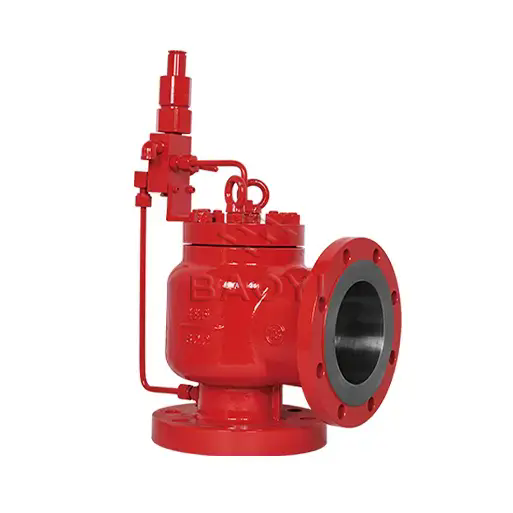
1. How Is Lift Height Defined and Measured in a Safety Valve?
Lift height is the distance that the disc moves away from the nozzle seat when the Safety Valve is fully open. It is measured at the point of maximum disc travel, which occurs when the valve is flowing at its rated capacity. The lift height determines the annular flow area between the disc and the nozzle. The effective discharge area is not the full nozzle area. It is the area of the curtain formed by the lift height and the nozzle circumference. The formula for the curtain area is A = π x D x L, where D is the nozzle diameter and L is the lift height. The table below shows the relationship between lift height and effective discharge area for a 25 mm nozzle.
| Lift height (mm) | Curtain area (mm²) | Nozzle area (mm²) | Area ratio (curtain/nozzle) |
| 0.5 | 39 | 491 | 0.08 |
| 1.0 | 79 | 491 | 0.16 |
| 1.5 | 118 | 491 | 0.24 |
| 2.0 | 157 | 491 | 0.32 |
| 2.5 | 196 | 491 | 0.40 |
| 3.0 | 236 | 491 | 0.48 |
In our factory, we measure the lift height of every Safety Valve on a flow test bench. The lift is measured with a dial indicator while the valve is flowing at its rated capacity. The measured lift must be within ±0.1 mm of the design value. Baoyi Group Co., Ltd. has been manufacturing Safety Valve units for over 18 years.
2. How Does Lift Height Affect Discharge Capacity?
The discharge capacity of a Safety Valve is proportional to the effective discharge area, which is the curtain area. If the lift height is reduced, the curtain area is reduced, and the discharge capacity drops. The relationship is not linear because the flow coefficient also changes with the lift. At low lift, the flow is restricted by the disc geometry and the flow coefficient is low. At full lift, the flow coefficient reaches its maximum value. The table below shows the discharge capacity for a 25 mm nozzle valve with a set pressure of 10 bar and saturated steam service.
| Lift height (mm) | Curtain area (mm²) | Flow coefficient (K) | Discharge capacity (kg/h) | Percent of rated capacity |
| 1.0 | 79 | 0.65 | 3,200 | 32% |
| 1.5 | 118 | 0.72 | 5,300 | 53% |
| 2.0 | 157 | 0.78 | 7,600 | 76% |
| 2.5 | 196 | 0.82 | 10,000 | 100% |
| 3.0 | 236 | 0.83 | 12,200 | 122% |
The rated capacity of the valve is based on the full lift height of 2.5 mm. If the lift is reduced to 1.5 mm, the capacity drops to 53 percent of the rated value. This is why the lift height must be verified during installation and maintenance. In our factory, we test every Safety Valve at full lift and record the discharge capacity. Baoyi Group Co., Ltd. provides a flow test certificate with every valve.
3. What Factors Can Reduce Lift Height in Service?
The lift height can be reduced by four factors. The first is incorrect adjustment of the adjusting ring. The adjusting ring controls the position of the disc guide and the lift stop. If the ring is set too low, the disc cannot reach full lift. The second is fouling or corrosion on the disc guide. If the guide is dirty, the disc may stick before reaching full lift. The third is spring relaxation. If the spring loses tension over time, the disc may not lift fully at the set pressure. The fourth is backpressure. If the backpressure in the discharge line is too high, it can prevent the disc from reaching full lift. The table below shows the effect of these factors on lift height.
| Factor | Typical effect on lift height | Detection method | Corrective action |
| Incorrect adjusting ring | -20 to -50% | Visual inspection; lift measurement | Re-adjust ring per manual |
| Fouling on guide | -10 to -30% | Disassembly and inspection | Clean guide and disc |
| Spring relaxation | -5 to -15% | Set pressure test | Replace spring |
| Excessive backpressure | -10 to -40% | Pressure measurement in discharge line | Reduce backpressure or use balanced bellows |
Field verification tip: The lift height can be checked without removing the valve from the line by using a lift lever or a dial indicator on the spindle. If the lift is less than 90 percent of the design value, the valve should be removed and serviced. In our factory, we provide a lift measurement kit with every Safety Valve order.
4. How Is Lift Height Specified for Different Media and Set Pressures?
The required lift height depends on the medium and the set pressure. For compressible fluids such as steam and gas, a higher lift is required to achieve the same mass flow rate because the fluid expands as it passes through the orifice. For incompressible fluids such as water, a lower lift is sufficient because the density is constant. The table below shows the recommended lift height for different media and set pressures.
| Medium | Set pressure range | Recommended lift height | Typical application |
| Saturated steam | 1 – 10 bar | 2.5 – 3.0 mm | Boilers, steam drums |
| Saturated steam | 10 – 40 bar | 3.0 – 4.0 mm | Power plants |
| Air and gas | 1 – 20 bar | 2.0 – 3.0 mm | Compressors, receivers |
| Water | 1 – 20 bar | 1.5 – 2.0 mm | Pumps, pipelines |
| Liquid with solids | 1 – 10 bar | 2.0 – 2.5 mm | Slurry service |
In our factory, we select the lift height based on the medium and the set pressure. For steam service, we use a higher lift to accommodate the expansion of the steam. For water service, we use a lower lift to reduce the risk of chatter. Baoyi Group Co., Ltd. provides a lift height recommendation for each application.
Frequently Asked Questions About Lift Height and Safety Valve Discharge Capacity
Summary for Pressure Relief Engineers
The lift height is the primary determinant of the discharge capacity of a Safety Valve. The effective discharge area is the curtain area, which is proportional to the lift height. A reduction in lift height directly reduces the discharge capacity. The lift height can be reduced by incorrect adjustment, fouling, spring relaxation, or backpressure. Regular inspection and maintenance are required to ensure that the valve achieves full lift when needed. Baoyi Group Co., Ltd. has been manufacturing Safety Valve units for over 18 years and provides full flow test certificates and lift height verification for our products.
Baoyi Group Co., Ltd. manufactures Safety Valve units with adjustable lift height, balanced bellows options, and a range of orifice sizes. We provide flow test certificates, lift measurement kits, and field adjustment guides for all of our products.