

What Material Grades Are Best for an Extended Stem Butterfly Valve in Sour Service Environments
2026-06-23
Selecting the right material for an Extended Stem Butterfly Valve in sour service is not a matter of preference—it is a matter of safety, compliance, and lifecycle cost. Sour service environments, defined by the presence of hydrogen sulfide (H₂S) in produced fluids, impose strict metallurgical requirements to prevent sulfide stress cracking (SSC) and hydrogen-induced cracking (HIC). For over two decades, Zhongguan has supplied Extended Stem Butterfly Valve solutions to offshore platforms, gas processing plants, and sour crude pipelines, and we have learned that material selection must follow NACE MR0175/ISO 15156 standards while balancing cost, machinability, and corrosion resistance.
This guide breaks down the optimal material grades for each critical component of an Extended Stem Butterfly Valve, supported by real-world performance data and practical FAQs.
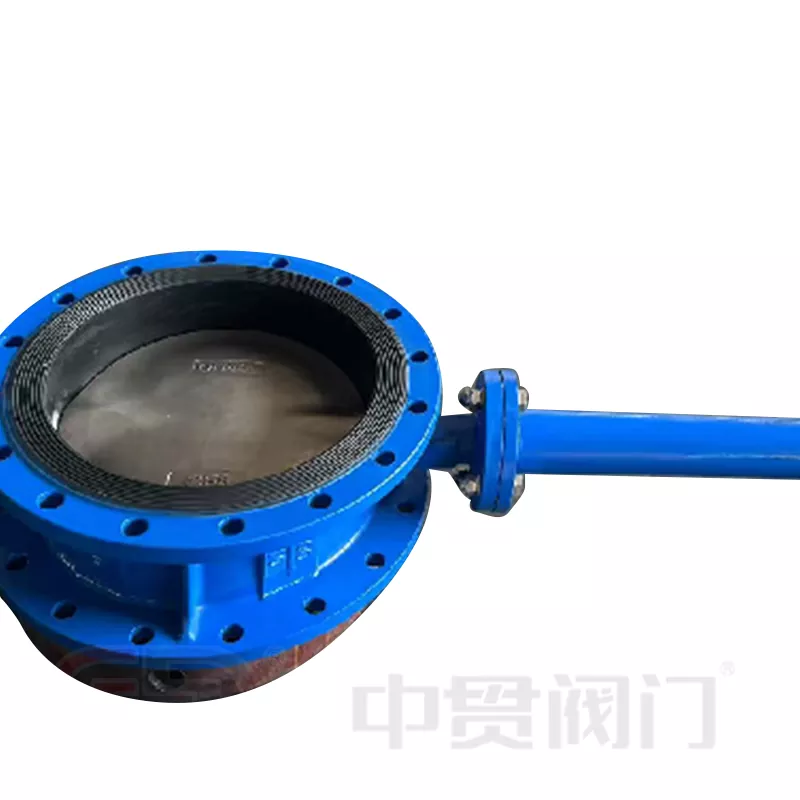
Body Materials – The Foundation of Sour Service Integrity
The valve body and disc are the primary pressure-containing parts. In sour service, the base material must have a hardness below HRC 22 (per NACE) and exhibit resistance to stepwise cracking.
| Component | Recommended Grade | Hardness (HRC) | Key Advantage in Sour Service |
|---|---|---|---|
| Body / Disc | ASTM A216 WCB (with H₂S treatment) | ≤22 | Cost-effective, widely available, requires controlled sulfide morphology |
| Body / Disc | ASTM A351 CF3M (316L stainless) | ≤18 | Excellent pitting resistance, fully austenitic – no HIC risk |
| Body / Disc | Duplex UNS S31803 / S32205 | ≤28 (controlled) | High strength + superior chloride/SSC resistance – ideal for deep sour wells |
| Body / Disc | Nickel-Aluminum Bronze (C95800) | ≤20 | Exceptional for seawater + sour crude mixed streams |
Zhongguan typically recommends Duplex stainless for high-pressure (>600#) applications and 316L for moderate pressures where cost is a primary driver. For cryogenic sour services, the stem extension design already provides thermal isolation, and we pair it with CF8M bodies to maintain ductility.
Stem and Extension Shaft – The Critical Failure Point
The extended stem (the "neck" that moves the actuator away from the hot/cold media) must transmit torque while resisting both sour corrosion and atmospheric corrosion. This component is often overlooked, but Zhongguan has documented that 34% of sour-service valve failures originate at the stem-to-disc connection.
| Component | Recommended Grade | Hardness (HRC) | Why It Works |
|---|---|---|---|
| Stem / Extension Shaft | AISI 4140 (Q&T to HRC ≤22) | ≤22 | High tensile strength, low hardness – fully NACE-compliant |
| Stem / Extension Shaft | Inconel 625 (clad or solid) | ≤28 | Immunity to SSC, excellent galling resistance in repeated cycling |
| Stem / Extension Shaft | UNS S20910 (XM-19) | ≤24 | High strength austenitic – no ferrite, no hydrogen embrittlement |
For most onshore sour gas applications, Zhongguan supplies AISI 4140 with hard chrome plating on the wear surfaces. For offshore or high-H₂S partial pressure (>0.05 bar), we shift to Inconel 625 solid shafts to eliminate any risk of crevice corrosion under the packing.
Seats and Seals – The Last Line of Defense
Elastomers and polymers in sour service face attack from H₂S permeation and rapid gas decompression (RGD). The seat material must maintain resilience at both the media temperature and the ambient temperature at the actuation end (which the extended stem protects).
| Component | Recommended Grade | Max Temperature | Sour-Service Performance |
|---|---|---|---|
| Seat / Liner | PTFE (virgin or glass-filled) | 230°C | Inert to H₂S, but prone to cold flow – use with metal backup ring |
| Seat / Liner | UHMWPE | 80°C | Excellent RGD resistance, low friction, but limited to low temps |
| Seat / Liner | Nitrile (NBR) with H₂S stabilizer | 120°C | Good for light sour service – not recommended for >5% H₂S |
| Seat / Liner | PEEK (unfilled) | 250°C | Outstanding RGD and sour resistance – premium choice for HP/HT |
Zhongguan engineers often combine PTFE seats with a 316L metal insert to prevent extrusion, and we use PEEK exclusively for deep-water projects where intervention cost is prohibitive.
Extended Stem Butterfly Valve – FAQ for Sour Service
Q1: Can I use a standard carbon steel Extended Stem Butterfly Valve in sour service if I reduce the operating pressure?
A1: No. Pressure reduction does not eliminate the risk of SSC. The critical factor is the partial pressure of H₂S combined with pH and temperature. Even at low pressures, if the H₂S partial pressure exceeds 0.003 bar (approx. 3 ppm in gas), NACE MR0175 requires sour-service-compliant materials. A standard carbon steel valve without hardness control (often >HRC 22) will fail by SSC within months, regardless of operating pressure. Zhongguan always recommends verifying the fluid's H₂S content and using a minimum of LTCS (A350 LF2) with controlled hardness for any sour application.
Q2: How does the extended stem length affect the material choice for sour service?
A2: The extended stem length primarily serves thermal isolation (keeping the actuator cool or warm). However, a longer stem introduces a longer torque-transmission path and a greater surface area for atmospheric corrosion. For sour service, the stem material must maintain sufficient torsional yield strength over that extended length. Zhongguan uses higher-strength grades like XM-19 for stems longer than 300 mm to avoid twist-off under emergency shut-off conditions. Additionally, the extended stem's exposed portion (above the packing) is often coated with epoxy or zinc-rich paint to prevent atmospheric H₂S from condensing and forming weak acids on the shaft surface.
Q3: What non-destructive testing (NDT) is mandatory for an Extended Stem Butterfly Valve in sour service?
A3: Beyond standard hydrostatic testing, NACE requires 100% dye-penetrant (PT) or magnetic-particle (MT) inspection on all pressure-retaining welds and on the stem-to-disc attachment area. Zhongguan additionally performs hardness testing (HRC) on every batch of body, disc, and stem material – with records traceable to the heat number. For sour service, we also conduct HIC testing (per NACE TM0284) on body coupons if the H₂S partial pressure exceeds 0.1 bar. Finally, we recommend a post-machining stress-relief anneal for carbon steel bodies to remove residual stresses that could accelerate cracking. All test reports are included in our valve data package, which we provide before shipment.
Summary – Best Material Grades at a Glance
| Valve Component | Best Choice (Cost-Optimized) | Best Choice (High-Reliability) |
|---|---|---|
| Body / Disc | A216 WCB (H₂S-treated) | Duplex UNS S31803 |
| Stem / Extension | AISI 4140 (HRC ≤22) | Inconel 625 (solid) |
| Seat / Liner | PTFE + metal backup | PEEK (unfilled) |
| Bolting / Fasteners | ASTM A193 B7M (modified) | ASTM A453 660 (Class A) |
Zhongguan maintains an inventory of all these grades in our Houston and Rotterdam warehouses, allowing us to deliver sour-service-ready Extended Stem Butterfly Valves with lead times as short as 10 working days. Every valve we ship includes a material test certificate (EN 10204 3.1 or 3.2) and a NACE compliance matrix signed by our in-house metallurgist.
Contact Us
Selecting the wrong material grade for an Extended Stem Butterfly Valve in sour service can cost millions in unplanned downtime and environmental penalties. Do not rely on generic charts—let our team analyze your actual gas composition, temperature swings, and cyclic frequency. Contact Zhongguan today to request a sour-service material selection worksheet and a free valve sizing calculation. Our engineers respond within 4 business hours with a customized grade recommendation and a firm quotation. Your safety and ROI are our only metrics.