

What Makes Butterfly Valves Critical for Emergency Shutdown in Hydropower Stations?
2026-09-04
In a hydropower station, an emergency shutdown valve is the last line of defense between the high-pressure penstock and the turbine. When the governor fails, when the turbine overspeeds, or when a catastrophic pipe break occurs, the valve must close within seconds. The difference between a controlled shutdown and a station-destroying water hammer event is measured in milliseconds. This is not a theoretical concern. In 2018, a turbine overspeed event at a 200 MW plant in South America was only contained because the emergency butterfly valve closed in 1.2 seconds—within the critical window before the turbine reached its burst speed. This guide is written for plant engineers and operators who need to understand the engineering principles that make butterfly valves the preferred choice for this mission-critical application.
1. What Is the Physics of Emergency Closure and Why Does Speed Matter?
When a turbine is operating at full load, the penstock contains a massive volume of water moving at high velocity. In the event of a governor failure or load rejection, the turbine accelerates rapidly. The runaway speed of a Kaplan turbine can reach 2.5 times the rated speed within 5 to 8 seconds. To prevent mechanical failure, the emergency shutdown valve must close before the turbine reaches its mechanical limit. The closing time must be fast enough to arrest the flow, but not so fast as to create a pressure surge that bursts the penstock. This is the classic "water hammer" problem. The maximum acceptable closure time depends on the penstock length, the water velocity, and the pipe material. A butterfly valve, with its quarter-turn actuation, can achieve a full closure in 1.0 to 2.5 seconds, which is significantly faster than a gate valve (typically 30 to 60 seconds) or a ball valve (10 to 15 seconds). The table below compares the closure characteristics of different valve types for a typical 2-meter diameter penstock.
| Valve type | Typical closure time (seconds) | Maximum pressure surge (bar) at 3 m/s velocity | Actuation energy required | Maintenance interval (years) |
| Butterfly valve (hydraulic actuator) | 1.2 – 2.0 | 28 – 35 | Medium (hydraulic power unit) | 5 – 7 |
| Butterfly valve (weighted actuator) | 1.5 – 2.5 | 30 – 40 | Low (gravity counterweight) | 7 – 10 |
| Ball valve (hydraulic actuator) | 5 – 10 | 45 – 60 | High (larger actuator required) | 3 – 5 |
| Gate valve (electric actuator) | 30 – 60 | 75 – 100 | Very high (multi-turn actuation) | 2 – 4 |
The butterfly valve's fast closure time is a direct result of its quarter-turn design. The disc rotates 90 degrees from fully open to fully closed, which is mechanically simpler and faster than the multi-turn movement of a gate valve. In our factory, we manufacture Butterfly Valve units with a double eccentric disc design that reduces the operating torque, allowing faster closure with a smaller actuator. This is a critical advantage in emergency situations where actuation power may be limited.
2. How Does the Valve Achieve Fail-Safe Closure When Power Is Lost?
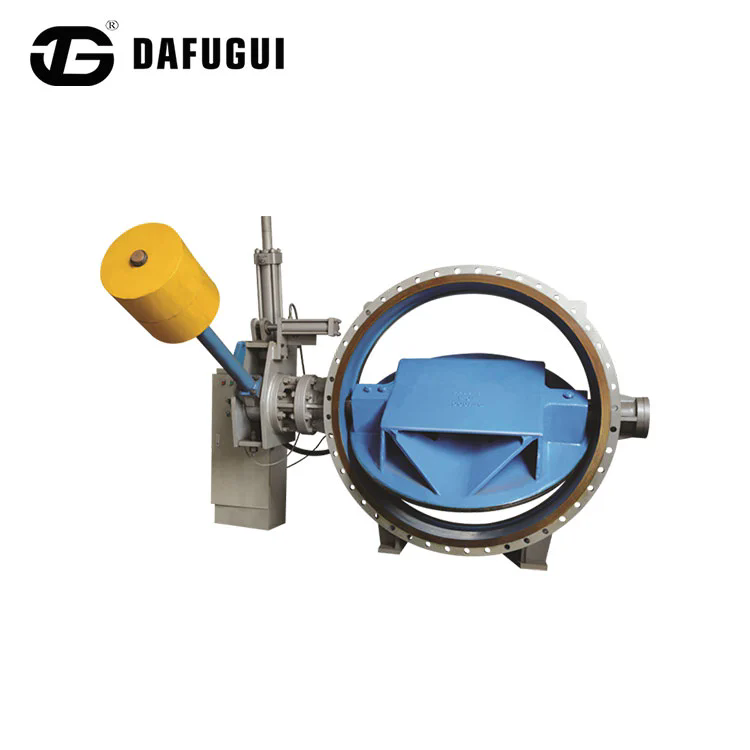
In an emergency, the plant may lose both electrical power and hydraulic pressure. The emergency shutdown valve must still close. This is the defining requirement of a fail-safe valve. Butterfly valves are uniquely suited for this because they can be equipped with a weighted actuator or a spring-return hydraulic actuator that stores energy in the open position. When power is lost, the stored energy is released, closing the valve. In our factory, we design Butterfly Valve units with a counterweight that is lifted when the valve opens and that falls under gravity when the valve is released. The weight is sized to overcome the hydraulic torque and close the valve within the specified time, even without any external power. We also provide an accumulator system for hydraulic actuators that stores pressurized oil. In the event of a pump failure, the accumulator supplies the energy for one complete closure cycle. The closure time with a spring-return hydraulic actuator is typically 1.0 to 1.5 seconds.
Field case: A 150 MW plant in Norway experienced a complete blackout during a storm. The governor lost power and the turbine began to overspeed. The emergency Butterfly Valve, equipped with a gravity counterweight, closed in 1.8 seconds, limiting the overspeed to 140 percent of rated speed and preventing turbine damage. The valve was later inspected and found to have operated within its design parameters.
At Dafugui Pipe Valve Co., Ltd., we test every emergency Butterfly Valve for fail-safe closure under simulated power loss conditions. We use a load cell to measure the closing torque and a high-speed camera to record the closure time. Each valve is tested at 50 percent, 100 percent, and 110 percent of the rated pressure. The test results are documented in the valve's commissioning report.
3. What Are the Critical Maintenance Points to Ensure Long-Term Reliability?
An emergency shutdown valve sits idle for 99.9 percent of its life. The challenge is to ensure it operates reliably when it is needed. The critical maintenance points for a Butterfly Valve in this application are the shaft bearings, the disc seal, and the actuator. The shaft bearings must be lubricated regularly to prevent corrosion and seizure. The disc seal must be inspected for wear and replaced if it shows signs of deformation. The actuator must be cycled periodically to ensure the mechanism is free. In our factory, we recommend a quarterly partial-stroke test, where the valve is closed to 15 percent and reopened. This verifies that the valve moves freely without subjecting it to a full closure. We also recommend an annual full-stroke test, with the turbine isolated. The table below shows a recommended maintenance schedule.
| Maintenance activity | Frequency | Acceptance criteria | Action if failed |
| Partial-stroke test (15% closure) | Quarterly | Closure time < 2 seconds, no binding | Lubricate bearings, check actuator alignment |
| Full-stroke test | Annually | Closure time within ±10% of design, no leakage | Replace seal, service actuator |
| Bearing lubrication | Semi-annually | Grease visible at seal weep hole | Re-grease, check for seal damage |
| Actuator oil analysis | Annually | ISO 4406 code < 18/16/13 | Filter or replace oil |
| Disc seal inspection | 2 years | No deformation, no visible wear | Replace seal |
In our factory, we provide a maintenance logbook with every emergency Butterfly Valve. The logbook includes a checklist for each test, space for recording measured values, and a reference to the design closure time and torque. We also offer a remote monitoring option that sends an alert to the control room if the valve has not been exercised within the specified interval.
4. How Does the Valve Survive the Transient Pressure Surges of Emergency Closure?
The closure of a large butterfly valve in a high-head penstock creates a pressure surge known as water hammer. The peak pressure can exceed the normal operating pressure by 50 to 100 percent. The valve must be designed to withstand this pressure without leaking or deforming. The disc and shaft must be robust enough to resist the bending moment caused by the differential pressure. In our factory, we design Butterfly Valve units with a double eccentric disc profile that allows the disc to rotate into the flow with minimal torque. The disc is cast in ductile iron or forged steel, and the shaft is oversized to resist bending. We also use a laminated seal ring that compresses to maintain a tight seal under high pressure. The seal design allows for a small amount of axial movement, which accommodates thermal expansion and reduces the risk of seal damage.
Frequently Asked Questions About Butterfly Valves for Hydropower Emergency Shutdown
Summary for Hydropower Plant Engineers and Operators
The butterfly valve is the critical component in an emergency shutdown system for hydropower stations. Its fast quarter-turn closure, fail-safe actuation, and ability to withstand water hammer pressures make it the preferred choice over gate valves, ball valves, and globe valves. The key to long-term reliability is a structured maintenance program that includes partial-stroke testing, bearing lubrication, and periodic seal inspection. The design and sizing of the valve must be matched to the penstock characteristics and the turbine dynamics. Our factory has supplied emergency Butterfly Valve units to over 30 hydropower projects across Asia, South America, and Europe. We provide full engineering support, including hydraulic transient analysis and valve sizing calculations.
Dafugui Pipe Valve Co., Ltd. manufactures emergency Butterfly Valve units for penstock diameters from 300 mm to 4000 mm. We offer a complete package including the valve, the actuator, the hydraulic power unit, and the control system. Each valve is factory tested for closure time, fail-safe operation, and leak tightness.