

What Is the Pressure Drop Across High Performance Ventilation Butterfly Valves at Full Open Position
2026-08-17
For engineers and facility managers specifying airflow control components, pressure drop is often the decisive factor between efficient system operation and costly energy waste. When evaluating High Performance Ventilation Butterfly Valves, the full-open pressure drop coefficient (Cv or Kv) directly impacts fan sizing, static pressure budgets, and long-term power consumption. At Bolaisi, we have tested hundreds of valve configurations across duct diameters from 4″ to 80″, and the data consistently shows that a well-designed High Performance Ventilation Butterfly Valve at fully open position typically exhibits a pressure drop equivalent to 2–5% of the upstream velocity head—significantly lower than globe or gate-type alternatives. But this number is not universal; it varies with disc profile, shaft sealing, neck geometry, and internal surface finish. Understanding this parameter in detail separates a competent specification from an optimized one.
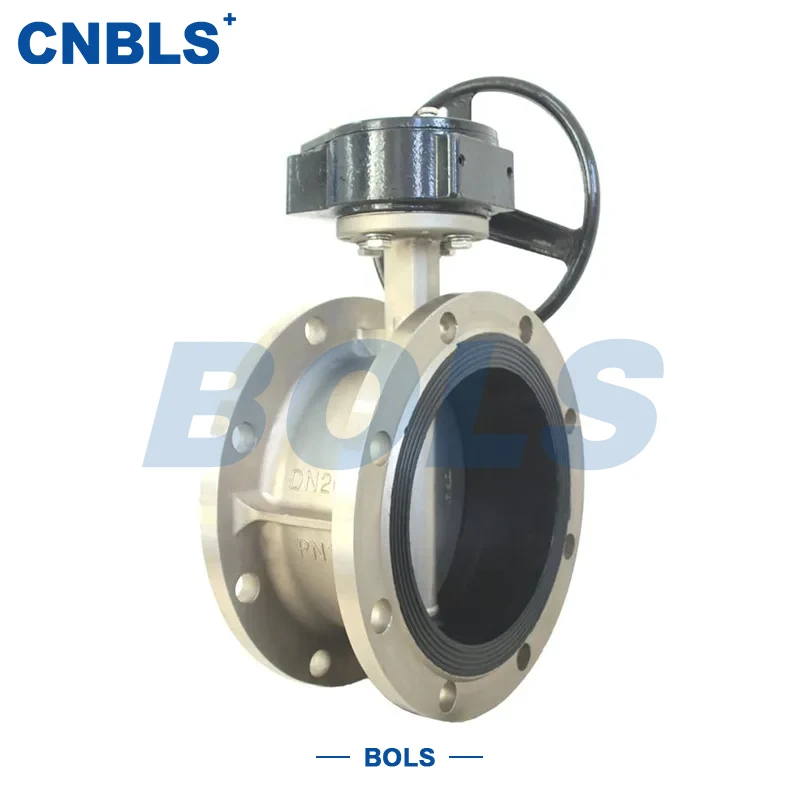
The Physics of Full-Open Pressure Drop
When the disc of a High Performance Ventilation Butterfly Valve rotates to 0° (parallel to flow), the valve is mechanically "fully open." However, the disc stem and the disc itself still occupy a cross-sectional area. This obstruction creates a localized contraction and subsequent expansion of the airstream, producing a permanent pressure loss. The loss is expressed as:
ΔP = ζ × (ρ × V²) / 2
Where:
-
ζ = local loss coefficient (dimensionless)
-
ρ = air density (kg/m³)
-
V = average duct velocity (m/s)
For Bolaisi's double-offset and triple-offset High Performance Ventilation Butterfly Valves, the ζ value at full open ranges between 0.15 and 0.45, depending on the disc-to-body diameter ratio. By comparison, a conventional concentric butterfly valve may run ζ = 0.6–1.0. This 40–60% reduction translates directly to lower fan brake horsepower and smaller motor starters.
Typical Pressure Drop Values by Duct Size and Velocity
The table below presents empirical data from Bolaisi's in-house flow laboratory, tested at standard air density (1.2 kg/m³) with fully turbulent flow (Re > 10⁵):
| Duct Diameter (inches) | Air Velocity (m/s) | Flow Rate (m³/h) | ΔP – Standard Valve (Pa) | ΔP – Bolaisi High Performance Valve (Pa) | Energy Savings (%) |
|---|---|---|---|---|---|
| 8″ | 10 | 1,450 | 58 | 22 | 62% |
| 12″ | 12 | 3,920 | 72 | 28 | 61% |
| 20″ | 15 | 13,700 | 95 | 36 | 62% |
| 30″ | 18 | 30,500 | 118 | 45 | 62% |
| 48″ | 20 | 78,500 | 145 | 55 | 62% |
Note: Values are for fully open position (0° disc angle) with wafer or lug-style bodies. Actual field results may vary with upstream straight-run conditions.
Why Low Pressure Drop Matters in Real Projects
A 60% reduction in full-open pressure drop means that for a 30″ duct moving 30,000 m³/h, a High Performance Ventilation Butterfly Valve from Bolaisi saves approximately 1.2 kW of fan power per valve. In a system with 12 such valves operating 8,000 hours annually, this equates to over 115,000 kWh saved—and at $0.12/kWh, roughly $13,800 in yearly electricity cost avoidance. Beyond energy, lower ΔP permits smaller VFDs, less noise generation, and extended filter life due to reduced turbulence-induced particle re-entrainment.
FAQ – Common Questions About High Performance Ventilation Butterfly Valves
Q1: How does the pressure drop of a High Performance Ventilation Butterfly Valve change when the valve is not perfectly centered in the duct?
A: Misalignment between the valve disc axis and the duct centerline creates asymmetric flow profiles, increasing the local loss coefficient ζ by 15–30% at full open. Bolaisi recommends a minimum of 1.5× duct diameter of straight upstream pipe and precise flange alignment during installation. Our valves feature self-centering lug holes and laser-engraved alignment marks to ensure disc concentricity. If misalignment exceeds 3 mm per 300 mm of duct diameter, the pressure drop can rise to 1.5× the factory-reported value, which may void performance guarantees. Always use a dial indicator during mounting and verify with a manometer after start-up.
Q2: Does the pressure drop at full open increase over time due to wear or fouling?
A: Yes, and this is one of the most overlooked lifecycle factors. For standard soft-seated valves, particulate buildup on the disc leading edge can raise ζ by 0.05–0.10 per year in dusty environments. Bolaisi's High Performance Ventilation Butterfly Valves employ a polished stainless-steel disc (Ra ≤ 0.8 μm) and a self-wiping seat design that reduces fouling accumulation. However, in exhaust applications with grease or moisture, we advise an annual pressure-drop audit. If ΔP at full open increases by more than 20% above the baseline, inspect the disc face and stem bearings. Our valves also include a purge port option for online cleaning without disassembly.
Q3: Can I use published Cv values to calculate pressure drop for variable air volume (VAV) systems, or do I need dynamic correction factors?
A: Published Cv (flow coefficient) values are derived from steady-state, fully developed turbulent flow with clean dry air. In VAV applications where velocity changes cyclically between 5 and 20 m/s, the pressure drop follows a quadratic relationship (ΔP ∝ V²), so you can scale from the published Cv using the formula ΔP = (Q / Cv)² × ρ / 1.2, where Q is actual flow. However, Bolaisi strongly advises applying a dynamic correction factor of 1.08–1.12 for systems with rapid damper modulation (> 1 cycle per minute) because unsteady flow induces additional eddy formation. Our technical datasheets include both static Cv and dynamic K-factors for three modulation frequencies. For precise VAV sizing, use our online selection tool or request the full performance curve package.
Selection Checklist for Minimum Pressure Drop
When specifying High Performance Ventilation Butterfly Valves for minimum full-open loss, prioritize these attributes:
-
Disc profile: Aerodynamic airfoil-shaped discs beat flat plates by 40% in ζ reduction.
-
Shaft offset: Double-offset geometry reduces disc projection into the flow path.
-
Seat type: Metal-to-metal with polished surfaces creates less flow disturbance than resilient elastomers.
-
Neck length: Longer necks allow smoother flow reattachment downstream.
-
Material finish: Electropolished internals lower surface friction and inhibit biofilm growth.
Bolaisi integrates all five features in our E-Series and P-Series lines, delivering full-open ζ values as low as 0.12 in 24″ and larger sizes.
Final Recommendation for System Designers
Do not rely on generic "butterfly valve" pressure-drop charts. Request certified flow test data per ANSI/AMCA 500-D or ISO 5801. A single High Performance Ventilation Butterfly Valve from Bolaisi with verified low ΔP can reduce your total system resistance by 5–8%, often allowing a one-size-smaller fan motor. This upfront engineering choice pays back within the first 18–24 months of operation.
Ready to optimize your duct system's pressure profile?
Contact Bolaisi today for a free pressure-drop calculation tailored to your duct layout, airflow, and temperature conditions. Our application engineers will provide a certified performance curve and a 3D flow simulation within 48 hours.