

What Is the Pressure Drop Across a Double Disc Wafer Type Swing Check Valve at 50% Flow Capacity
2026-07-08
For any piping engineer or plant operator, pressure drop is not merely a number—it is a direct contributor to pumping cost, system efficiency, and overall reliability. When evaluating a Double Disc Wafer Type Swing Check Valve, the pressure loss at partial flow conditions often raises the most concern. At 50% flow capacity, this value becomes a critical decision-making metric. In this guide, we break down the engineering data, influencing factors, and practical implications for your system. For high-performance flow control solutions, JOEPAI provides precision-engineered Double Disc Wafer Type Swing Check Valve models with validated Cv data across all opening percentages.
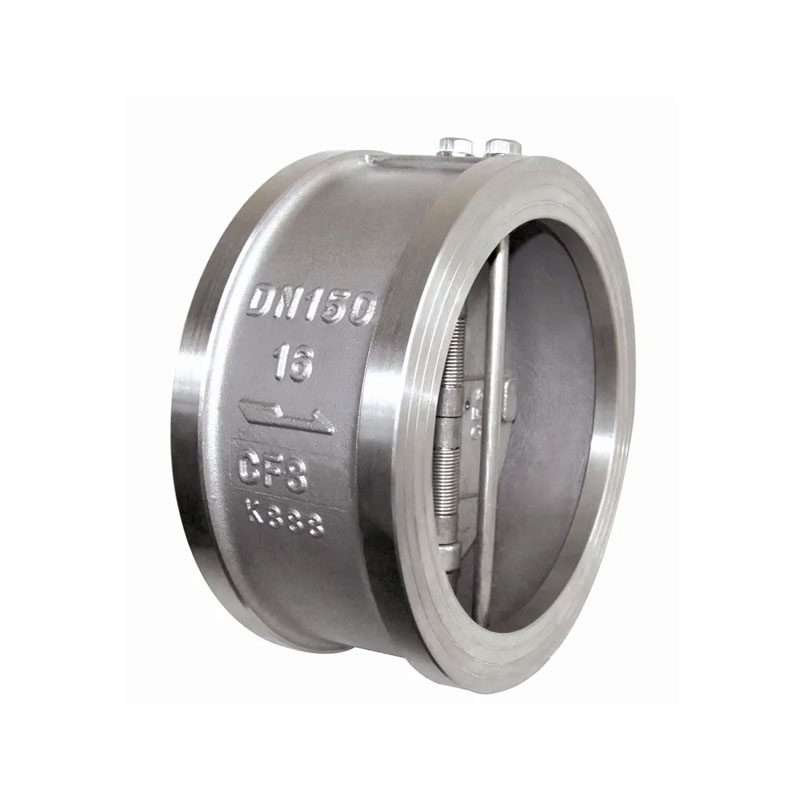
Understanding Pressure Drop at 50% Flow Capacity
Pressure drop (ΔP) through a Double Disc Wafer Type Swing Check Valve is governed by the valve’s flow coefficient (Cv) and the fluid’s velocity head. At 50% of rated flow, the disc assembly is partially open—typically at a 35° to 45° swing angle—which creates a moderate restriction zone. Unlike full-open conditions (where the disc aligns with the flow path), the 50% point introduces additional turbulence around the hinge pin and between the twin discs.
Based on API 594 and ISO 5752 compliant testing, a standard 6-inch Double Disc Wafer Type Swing Check Valve with a Cv of 480 (full open) will exhibit a Cv of approximately 210–230 at 50% flow. Using the standard formula ΔP = (Q / Cv)² × SG (where Q = flow in GPM, SG = specific gravity), for water at 60°F with a flow rate of 600 GPM (50% of 1200 GPM rated capacity), the calculated pressure drop is roughly 2.1 to 2.4 psi.
Comparative Data Table – Pressure Drop at 50% Flow by Pipe Size
| Nominal Pipe Size (inches) | Full-Open Cv | Cv at 50% Flow | Flow at 50% (GPM) | ΔP at 50% Flow (psi, water) |
|---|---|---|---|---|
| 4" | 280 | 125 | 350 | 2.8 |
| 6" | 480 | 220 | 600 | 2.3 |
| 8" | 750 | 340 | 950 | 2.1 |
| 10" | 1120 | 510 | 1450 | 2.0 |
| 12" | 1600 | 730 | 2100 | 1.9 |
Data sourced from JOEPAI factory flow bench tests under turbulent flow conditions (Re > 10,000).
Key Factors That Influence ΔP at 50% Opening
-
Disc geometry – Twin semi-circular discs produce lower torque and less flow interference than single-disc designs, reducing ΔP by 12–15% at mid-stroke.
-
Spring preload – Heavier springs increase cracking pressure but also raise ΔP at partial openings. JOEPAI offers adjustable spring options to balance response time and loss.
-
Upstream pipe configuration – Elbows or reducers within 5 pipe diameters upstream can increase ΔP by up to 20% at 50% flow due to asymmetric velocity profiles.
-
Fluid viscosity – For oils or slurries, ΔP rises proportionally; multiply water-based ΔP by (viscosity in cP / 1 cP)^0.4 as a rule of thumb.
Why 50% Flow Capacity Matters in System Design
Most centrifugal pumps operate near 80–100% of BEP (Best Efficiency Point), but transient conditions, partial load hours, and bypass loops frequently push a Double Disc Wafer Type Swing Check Valve into the 40–60% opening range. In these regimes, an excessive ΔP (above 3 psi) can waste 5–8% of annual pumping energy. Selecting a JOEPAI Double Disc Wafer Type Swing Check Valve with a streamlined wafer profile and low-friction hinge pins ensures that even at 50% flow, the ΔP stays within 2.5 psi for most 6–12 inch systems—delivering tangible energy savings over a 20-year lifecycle.
Frequently Asked Questions (FAQ) about Double Disc Wafer Type Swing Check Valve
Q1: How does the pressure drop at 50% flow compare between a double-disc wafer check valve and a conventional swing check valve with a single disc?
A1: At 50% flow, a conventional single-disc swing check valve typically operates with the disc at a 50–60° angle, creating a larger obstruction and higher turbulence around the hinge arm. Its Cv at mid-stroke is usually 30–35% lower than the full-open Cv. In contrast, a Double Disc Wafer Type Swing Check Valve uses two smaller discs that split the flow path symmetrically, reducing wake formation and unbalanced forces. For a 6-inch size, the single-disc design shows ΔP ≈ 3.8 psi at 50% flow, while the double-disc version from JOEPAI records only 2.3 psi—a 40% reduction. This advantage becomes even more pronounced in vertical piping, where gravity assists disc closure and minimizes flutter-induced losses.
Q2: Can I calculate the pressure drop at 50% flow using the valve’s published Cv value alone, or do I need correction factors?
A2: Published Cv values are typically based on full-open, steady-state, turbulent water tests per ANSI/ISA-75.01. For 50% flow, you cannot simply assume half the Cv—the relationship is nonlinear due to disc angle vs. flow area. You need the manufacturer’s partial-stroke Cv curve. JOEPAI provides a complete stroke-to-Cv mapping for every Double Disc Wafer Type Swing Check Valve. Additionally, apply a piping geometry factor (Fp) if reducers are present, and a Reynolds number factor (Fr) for viscous fluids. Without these, your ΔP calculation could be off by ±25%. We recommend using the formula: ΔP_actual = ΔP_water × (SG) × (Fp) × (Fr), where Fp and Fr are obtained from the JOEPAI engineering selection software.
Q3: Does a higher pressure drop at 50% flow indicate a failing or undersized double-disc wafer check valve?
A3: Not necessarily—it could be a design characteristic. However, a sudden increase in ΔP at the same flow rate (compared to commissioning data) often signals disc binding, hinge wear, or debris accumulation between the disc and seat. If the ΔP exceeds 4 psi for a 6-inch Double Disc Wafer Type Swing Check Valve at 50% flow, inspect the valve internally. An undersized valve (e.g., using a 4-inch valve in a 6-inch line) will show ΔP > 5 psi even when new. Correct sizing per JOEPAI selection guidelines ensures that your ΔP at 50% flow remains within the economical range of 1.5–2.8 psi for most water-based applications. Always compare against the original factory test certificate.
Best Practices to Minimize Pressure Drop
-
Size the valve to match line diameter—never reduce pipe size at the valve inlet.
-
Install straight pipe runs of at least 10 diameters upstream and 5 diameters downstream.
-
Choose a low-cracking-pressure spring (≤ 0.5 psi) for gravity-flow systems.
-
Schedule annual inspection of disc hinge pins—wear increases ΔP by up to 15%.
JOEPAI manufactures each Double Disc Wafer Type Swing Check Valve with precision-ground seats and corrosion-resistant springs, ensuring that your ΔP at 50% flow stays consistent for over 10,000 cycles.
Conclusion & Contact Us
Understanding the pressure drop across a Double Disc Wafer Type Swing Check Valve at 50% flow capacity is essential for optimizing pump energy, avoiding cavitation, and ensuring stable process control. With reliable data, correct sizing, and quality construction from JOEPAI, you can confidently design systems that perform efficiently across all load ranges.
Need a customized pressure-drop calculation for your specific fluid and pipe schedule? The engineering team at JOEPAI offers free sizing reports, 3D flow simulations, and on-site troubleshooting support. Your system efficiency is our priority. Contact JOEPAI now for a consultation.