

What Is the Maximum Working Temperature for a High Temperature Stainless Steel Swing Check Valve
2026-06-18
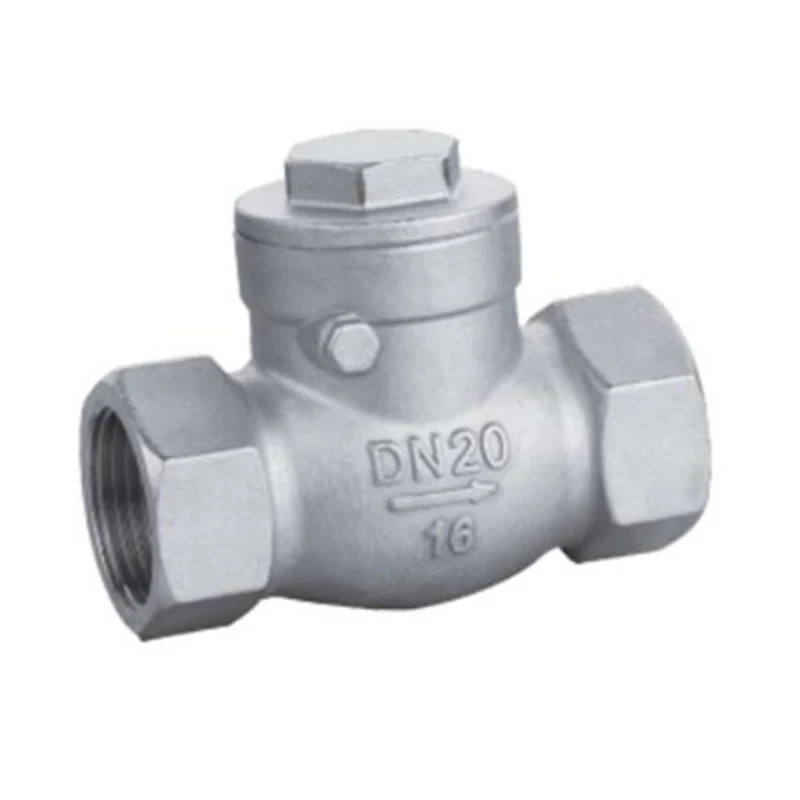
When engineers specify flow control components for extreme thermal environments, the single most critical question often is: What is the maximum working temperature for a high temperature stainless steel swing check valve? The answer is not a fixed number—it depends on material grade, pressure class, gasket type, and service medium. At Tianhong, we design and test our high temperature stainless steel swing check valve series to perform reliably across a broad thermal spectrum, but understanding the real limits requires a deep dive into metallurgy, sealing technology, and industry standards.
The Baseline Temperature Ceiling
For a standard high temperature stainless steel swing check valve constructed from ASTM A351 CF8M (cast 316 stainless steel), the maximum continuous working temperature in non-oxidizing environments is typically 815°C (1,500°F) when operating at low pressures (≤ 150 psi). However, once pressure rises to 300 psi, the maximum temperature drops to approximately 538°C (1,000°F) due to the reduction in material creep strength at elevated temperatures.
Tianhong offers upgraded grades—such as CF10M with higher nickel content—that push the upper limit to 870°C (1,600°F) for specific high-temperature gas applications, provided that the disc and seat materials are also upgraded accordingly.
Temperature vs. Pressure – The De-Rating Curve
Every high temperature stainless steel swing check valve follows an inverse pressure-temperature rating per ASME B16.34. The table below illustrates typical de-rating for a 2-inch, Class 150 Tianhong valve with 316SS body and Stellite-faced disc:
| Temperature (°C) | Maximum Allowable Pressure (psi) | Applicable Standard |
|---|---|---|
| 38 (ambient) | 275 | ASME B16.34 |
| 200 | 230 | ASME B16.34 |
| 400 | 180 | ASME B16.34 |
| 538 | 125 | ASME B16.34 |
| 650 | 80 | ASME B16.34 (derated) |
| 815 | 40 (non-shock) | Tianhong verified data |
Above 650°C, oxidation resistance becomes as important as mechanical strength. Tianhong applies a proprietary passivation treatment to extend surface stability.
The Real Limiters – Not Just the Body
Three components actually define the maximum working temperature of any high temperature stainless steel swing check valve:
-
Seat/Seal Material – PTFE seats fail above 260°C. For high-temperature service, Tianhong uses graphite-impregnated spiral wound gaskets or all-metal seat rings (SS410 hardened) rated to 815°C continuous.
-
Disc Hinge Pin – Thermal expansion can seize the pin. Tianhong drills precision clearance holes and uses Inconel 718 pins for applications exceeding 700°C.
-
Spring (if equipped) – Auxiliary spring-loaded discs lose tension above 540°C. Tianhong offers spring-less swing designs for ultra-high temperatures, relying on gravity and flow velocity alone.
Short-Term vs. Continuous Service
A high temperature stainless steel swing check valve may withstand 925°C (1,700°F) for brief upset conditions (≤ 30 minutes) without permanent deformation, provided the pressure is reduced to 20% of rated cold working pressure. However, continuous operation above 815°C accelerates grain boundary carbide precipitation, leading to reduced impact toughness. Tianhong recommends 310S or Incoloy 800H for sustained service above 800°C—these are available as custom options on our product line.
High Temperature Stainless Steel Swing Check Valve – FAQ
Q1: Can a standard high temperature stainless steel swing check valve handle superheated steam at 600°C and 200 psi continuously?
A1: Yes, but only if the valve uses a flexible graphite seal and a hard-faced disc (Stellite 6 or equivalent). At 600°C and 200 psi, a standard 316SS body with PTFE seat will fail within hours due to seat extrusion. Tianhong explicitly rates our T-series swing check valves for 600°C superheated steam at 200 psi with a metal-to-metal seat design, and we validate each lot with helium leak tests at operating temperature. The disc must be free-floating (no spring) to avoid thermal relaxation. We also recommend a bypass line for warm-up to prevent thermal shock cracking.
Q2: What happens if I exceed the maximum working temperature of my high temperature stainless steel swing check valve by 50°C for a short period?
A2: Exceeding the rated maximum by 50°C for less than 2 hours typically results in accelerated oxidation on the disc face and minor loss of hardness in the hinge pin. The valve will likely still function, but the seal integrity may degrade permanently—leakage rates can increase from 0.1% to over 2% of flow after cooling. For Tianhong valves, our testing shows that a 50°C over-temperature event (e.g., 865°C instead of 815°C) reduces the remaining creep life of the body by roughly 40%. We strongly advise a post-event inspection: measure disc rotation torque and perform a seat leakage test. If torque increases by more than 15%, replace the hinge pin and inspect the seat ring for galling.
Q3: Does the maximum working temperature change if the medium is oxidizing (air) vs. reducing (hydrogen/nitrogen)?
A3: Dramatically. In an oxidizing atmosphere (air or oxygen-bearing flue gas), the maximum continuous temperature for a 316SS high temperature stainless steel swing check valve drops from 815°C to 705°C because oxidation scaling becomes exponential above 700°C—scale spallation can wedge between the disc and seat, causing jamming. In a reducing atmosphere (e.g., pure nitrogen or hydrogen), the same Tianhong valve can run safely at 815°C with minimal scaling, but you must consider hydrogen embrittlement of the stainless steel above 550°C. For hydrogen service above 600°C, Tianhong recommends upgrading to duplex stainless steel or Alloy 625 discs, and we provide certified material test reports (MTRs) with each high-temperature order to verify trace element limits.
Industry Standards & Certification
All Tianhong high temperature stainless steel swing check valves are manufactured under ISO 9001:2015 and PED 2014/68/EU compliance. For temperatures above 538°C, we provide NACE MR0175 optional certification and API 6D fire-safe testing upon request. Our in-house foundry controls melt chemistry to ensure ferrite content below 8% , which prevents sigma phase embrittlement during long-term high-temperature exposure.
Practical Selection Checklist
When choosing your high temperature stainless steel swing check valve, always verify:
-
Max. continuous temp vs. peak upset temp (with duration)
-
Pressure class (150, 300, or 600) – higher class = lower max temp per ASME
-
Gasket/seat type – metal > graphite > PTFE
-
Orientation – horizontal vs. vertical (affects disc closing speed and thermal sag)
Tianhong provides free thermal de-rating calculations for your specific process conditions—simply share your P&ID and operating envelope.
Final Recommendation
For most industrial applications (refineries, power plants, chemical furnaces), the practical maximum working temperature for a standard high temperature stainless steel swing check valve is 538°C at 300 psi, or 815°C at low pressure (< 50 psi) with metal seats. For anything beyond these limits, consult Tianhong engineering—we offer custom alloy upgrades, non-standard face-to-face dimensions, and accelerated life-cycle testing to match your exact thermal profile.
Ready to specify the right high temperature stainless steel swing check valve for your extreme-duty loop?
Contact Tianhong today – our thermal engineering team will respond within 24 hours with a detailed temperature/pressure matrix, material recommendation, and a competitive quote. Let us help you keep your flow safe, stable, and scalable—at any temperature.