

What Is the Maximum Temperature and Pressure Rating for a Stainless Steel Socket-weld Gate Valve
2026-06-11
When selecting industrial valves for high-stress environments, engineers frequently ask: What is the maximum temperature and pressure rating for a stainless steel Socket-weld Gate Valve? At Dafugui, we provide precision-engineered Socket-weld Gate Valve solutions that comply with ASME B16.34 standards. The answer depends on the grade of stainless steel—typically 304 or 316—and the applicable pressure class (150, 300, 600, or 1500). Below, we break down the ratings, advantages, and common questions to help you specify the right valve for your piping system.
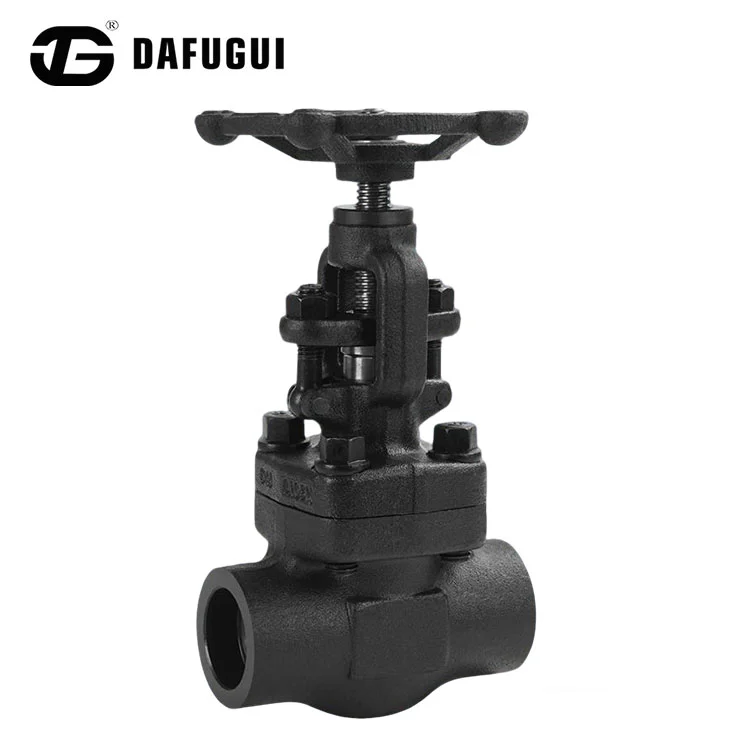
Pressure-Temperature Ratings per ASME B16.34
For a stainless steel Socket-weld Gate Valve, the maximum allowable working pressure decreases as temperature increases. The following table shows standard ratings for Dafugui CF8M (316 stainless steel) valves:
| Pressure Class | Max Pressure @ 100°F (38°C) | Max Temp (Continuous) | Max Pressure @ 600°F (316°C) |
|---|---|---|---|
| 150 | 285 psi | 400°F (204°C) | 230 psi |
| 300 | 740 psi | 650°F (343°C) | 530 psi |
| 600 | 1480 psi | 800°F (427°C) | 1050 psi |
| 1500 | 3705 psi | 800°F (427°C) | 2775 psi |
Note: For Class 150 valves in 304 stainless steel, the maximum temperature is typically limited to 400°F due to gasket and seat material constraints. Dafugui recommends Class 600 or higher for steam applications above 500°F.
Why Socket-Weld Design Affects Ratings
The Socket-weld Gate Valve design offers higher pressure containment than threaded valves because the pipe is inserted into a recessed socket and fillet-welded. This eliminates leak paths and provides superior mechanical strength. However, thermal cycling can induce stress at the weld joint. Dafugui valves undergo solution annealing and non-destructive testing to ensure ratings are maintained up to the limits shown above.
Advantages of Stainless Steel Construction
-
Corrosion resistance – Ideal for chemical, petrochemical, and marine environments.
-
High-temperature stability – Grade 316 (CF8M) resists carbide precipitation up to 800°F.
-
Low maintenance – No thread galling or flange gasket replacement.
Socket-weld Gate Valve FAQ – Common Questions
Q1: Can a stainless steel Socket-weld Gate Valve be used for superheated steam at 650°F and 600 psi?
A: Yes, but only if the valve is at least Class 300 and constructed from 316 stainless steel (CF8M). A Class 150 valve is not rated for 650°F or 600 psi. According to ASME B16.34, a Class 300 CF8M Socket-weld Gate Valve has a maximum pressure of approximately 530 psi at 650°F. For 600 psi at that temperature, a Class 600 valve is required. Dafugui recommends checking the pressure-temperature table for your specific model, as seat materials (e.g., Stellite vs. PTFE) also affect the limit. Always de-rate for cyclic service.
Q2: What happens if I exceed the maximum temperature rating of a Socket-weld Gate Valve?
A: Exceeding the temperature rating causes several failure modes. First, the stainless steel may undergo sensitization (between 800°F and 1500°F for 304 grade), leading to intergranular corrosion. Second, the socket weld can develop creep rupture over time. Third, non-metallic seats (if fitted) will melt or deform, causing leakage. Dafugui has documented cases where overheating caused the gate to seize inside the body. Therefore, always stay at least 50°F below the listed maximum. For applications above 800°F, consider a special high-temperature alloy like Inconel instead of standard stainless steel.
Q3: How do I verify the pressure rating of a used Socket-weld Gate Valve from Dafugui?
A: Check the body marking. All Dafugui Socket-weld Gate Valve products have permanent stamping showing: material (e.g., CF8M), pressure class (150/300/600/1500), and a heat number. Cross-reference these with our online certificate or contact our technical team. If markings are worn, you can perform a hydrostatic test at 1.5x the expected working pressure, but do not exceed the original cold working pressure. For critical systems, Dafugui recommends replacement rather than relying on an undocumented used valve. We also provide free traceability reports for any valve originally purchased after 2015.
Best Practices for Installation & Operation
-
Use a qualified welder following ASME B31.1 or B31.3.
-
Ensure a 1.5–2 mm gap between the pipe end and the socket bottom to allow thermal expansion.
-
Never use a stainless steel Socket-weld Gate Valve for temperatures below -20°F without impact-tested material.
Conclusion
The maximum temperature for a stainless steel Socket-weld Gate Valve ranges from 400°F (Class 150) to 800°F (Class 600+), with corresponding pressure limits defined by ASME B16.34. Choosing the correct class and grade—especially CF8M from Dafugui—ensures safe, long-term operation in steam, chemical, and high-pressure applications.
For a detailed quote or engineering support on your next Socket-weld Gate Valve project, contact us today at Dafugui. Our team provides free pressure-temperature calculations, material certificates, and same-day technical responses. Reach out via our website or email [email protected] to secure the right valve for your system.