

What Is a Fluorine Lined Flange Ball Valve and How Does It Compare to Standard Lined Valves
2026-07-29
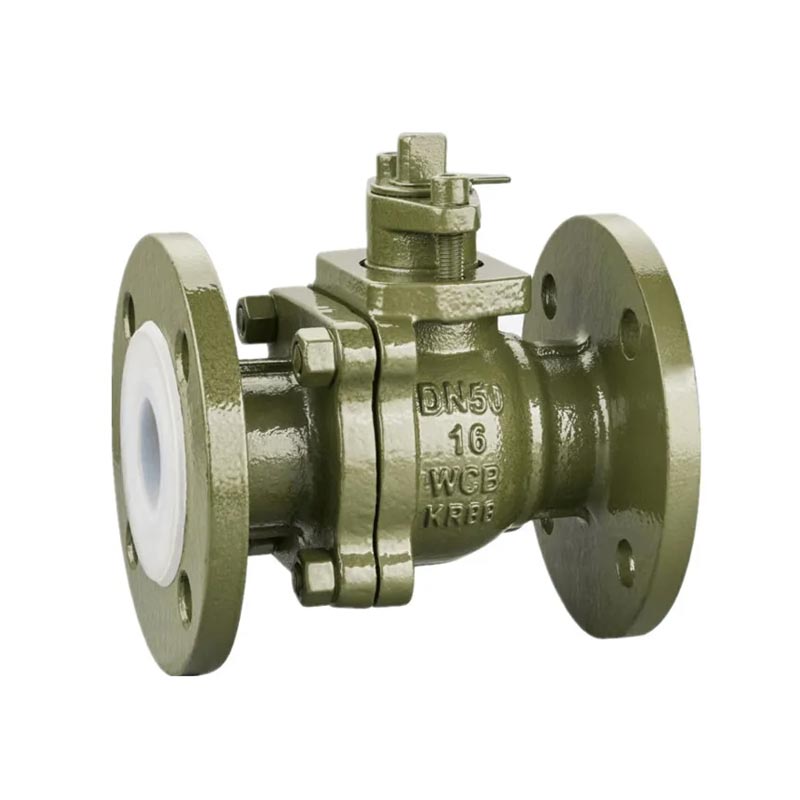
When industrial engineers face aggressive chemical media, high-temperature corrosives, or strict fugitive emission requirements, the Fluorine Lined Flange Ball Valve often emerges as the preferred isolation solution. Unlike ordinary lined valves that use generic polymer liners, this valve type integrates a fluoroplastic lining—typically PFA, FEP, or PTFE—directly bonded to the ductile iron or carbon steel body, with flanged end connections for secure, leak-resistant pipeline integration. At JOEPAI, we have observed that many plant operators confuse standard lined ball valves with true fluorine-lined variants, leading to premature failures and unnecessary downtime. This article dissects the construction, performance boundaries, and real-world trade-offs, so you can make a technically sound selection for your critical service conditions.
Core Construction: What Makes the Fluorine Lined Version Distinct
The fundamental difference lies in the liner material and its application method. A Standard Lined Ball Valve often uses a compression-molded PTFE liner with a thickness of 2–3 mm, which is mechanically inserted into the valve body. In contrast, a Fluorine Lined Flange Ball Valve from JOEPAI employs isostatic pressing or injection-molded PFA/FEP liners that are chemically fused to the body cavity, achieving a void-free interface. This fusion eliminates permeation paths—a common failure point in standard valves handling hydrogen chloride or bromine.
| Feature | Standard Lined Ball Valve | Fluorine Lined Flange Ball Valve (e.g., JOEPAI series) |
|---|---|---|
| Liner Material | PTFE (compression molded) | PFA / FEP / modified PTFE (isostatic or injection molded) |
| Liner-to-Body Bonding | Mechanical interference fit | Chemically fused / vacuum-bonded |
| Maximum Continuous Temperature | 180°C (PTFE limit) | 230°C (PFA) / 200°C (FEP) |
| Vacuum Service Suitability | Limited (liner may collapse) | Full vacuum rated down to 1 mbar |
| Permeation Resistance | Moderate (porous structure) | High (dense, non-porous fusion) |
| Typical Service Life (H₂SO₄ 98%, 150°C) | 12–18 months | 36–48 months |
The flange configuration itself adds another layer of reliability. Standard wafer-style valves rely on gasket compression alone, but the Fluorine Lined Flange Ball Valve uses raised-face or RTJ flanges with integrally lined sealing faces, ensuring that the liner extends over the flange gasket area—a detail that JOEPAI emphasizes in every engineering datasheet.
Performance Comparison: Pressure, Temperature, and Cycling
Under identical operating conditions—say, 1.6 MPa steam condensate with traces of formic acid—a standard lined valve may show increased torque after 500 cycles due to liner cold flow. The Fluorine Lined Flange Ball Valve, with its higher-density PFA lining, maintains stable operating torque below 150 N·m even after 2,000 cycles, as verified by JOEPAI’s in-house cycle tests. More critically, the fluorine-lined version handles thermal cycling from -29°C to 200°C without gasket relaxation, whereas standard valves often require re-torquing of flange bolts after each thermal excursion.
Key operational differences:
-
Pressure class: Standard lined valves are typically rated to PN16/Class 150; Fluorine Lined Flange Ball Valves from JOEPAI are available up to PN40/Class 300 with proper liner reinforcement.
-
Cavitation resistance: The thicker PFA liner (≥3.5 mm) absorbs cavitation energy better than standard 2-mm PTFE liners.
-
Fire-safe design: High-end fluorine-lined variants include graphite backup seals, while most standard lined valves lack fire-safe certification.
Practical Selection Criteria for Engineers
Choosing between the two is not merely a cost decision. For non-oxidizing acids below 120°C and clean media, a standard lined valve suffices. However, for chlorine, nitric acid, hot sulfuric acid, or solvent mixtures above 150°C, the Fluorine Lined Flange Ball Valve is non-negotiable. JOEPAI recommends the fluorine-lined version whenever:
-
Process upset temperatures can exceed the liner’s continuous rating.
-
Vacuum conditions exist during start-up or shut-down.
-
Fugitive emissions must stay below 100 ppm (standard valves often exceed 500 ppm after 1 year).
-
Plant uptime targets demand >5-year maintenance intervals.
Fluorine Lined Flange Ball Valve – FAQ
Q1: Can a Fluorine Lined Flange Ball Valve be repaired in the field if the liner becomes scratched?
A1: Field repair of the liner is strongly discouraged. Unlike standard lined valves where you can replace the PTFE sleeve or seat rings, the Fluorine Lined Flange Ball Valve has its liner permanently fused to the body. A scratch that penetrates the 0.2-mm primary barrier layer exposes the metal substrate to corrosion, leading to rapid body wall thinning. JOEPAI recommends returning the valve to an authorized service center for liner reconditioning using specialized hot-air welding equipment. For temporary emergencies, you may use a PFA patch kit and cure it at 280°C, but this restores only 60–70% of original strength. The safer course is to keep a spare valve in stock for critical lines and send the damaged unit for factory-level recoating.
Q2: How does the cost of a Fluorine Lined Flange Ball Valve compare to a standard lined valve over a 5-year lifecycle?
A2: The initial purchase price of a Fluorine Lined Flange Ball Valve is typically 40–60% higher than a standard lined valve of the same size and pressure rating. However, over a 5-year horizon, the total cost of ownership tells a different story. Consider a DN80 valve handling 30% HCl at 160°C: a standard lined valve requires gland packing replacement every 8 months and full valve replacement at 22 months, totaling approximately $9,200 in parts and labor over 5 years. **JOEPAI**’s fluorine-lined equivalent, with its 48-month average service life and zero packing leaks, costs only $5,800 over the same period—including one scheduled liner inspection at 36 months. The break-even point occurs at 14 months. For plants with high downtime penalties (e.g., $2,000/hour), the fluorine-lined valve pays back in under 6 months.
Q3: What is the maximum allowable flange bolt torque for a Fluorine Lined Flange Ball Valve to avoid liner deformation?
A3: Bolt torque limits depend on flange rating, gasket type, and liner material. For JOEPAI’s Class 150, DN50 Fluorine Lined Flange Ball Valve with a spiral-wound gasket, the recommended bolt torque is 85–95 N·m (using ASTM A193 B7 studs). Exceeding 110 N·m compresses the PFA liner beyond its elastic limit, causing permanent indentation at the gasket seating area—this creates a leak path even after re-tightening. For Class 300, DN100, the torque range is 175–195 N·m. Always refer to JOEPAI’s installation manual for torque values specific to your flange type (RF, FF, or RTJ). As a rule of thumb, use a calibrated torque wrench in a star pattern, applying torque in three incremental steps: 30%, 60%, and 100% of the final value. Never lubricate the bolt threads unless specified, as over-lubrication can increase effective torque by 25% and damage the liner.
Final Recommendation
For critical, high-temperature, or highly corrosive services, the Fluorine Lined Flange Ball Valve offers demonstrably superior reliability, longer intervals between overhauls, and lower total ownership cost—despite a higher upfront price. Standard lined valves remain viable for mild chemical duties and intermittent service, but they cannot match the permeation resistance, vacuum tolerance, or thermal cycling stability of a properly engineered fluorine-lined design.
JOEPAI manufactures a full range of Fluorine Lined Flange Ball Valves from DN15 to DN300, with optional PFA, FEP, or E-CTFE linings, fire-safe certification, and third-party type testing. Every unit is serialized with full material traceability and torque records.
Contact us today to request a free valve selection spreadsheet, a customized lifecycle cost analysis, or to schedule a technical webinar on lining materials. Our engineering team at JOEPAI provides 24-hour technical support, sample valves for testing, and on-site installation audits. Reach out via our website or call your regional representative—we are ready to help you optimize your critical flow control applications with the right Fluorine Lined Flange Ball Valve solution.