

What Benefits Does a 316 Stainless Steel Three Way Ball Valve Offer in Corrosive Environments?
2026-11-11
A chemical plant replaced a 304 stainless steel Three Way Ball Valves unit after 14 months of service. The valve body exterior was clean, but the seat pocket and the stem bore showed deep pitting, and the ball had a ring of corrosion product around the port edge. The maintenance team assumed the material was defective. The failure analysis showed something different: the corrosion had started in the stagnant cavity that forms when the valve switches between two media, and the 304 grade did not have enough molybdenum to resist the chloride concentration in that cavity. The replacement was specified in 316, and the same duty has now run for four years without pitting. This guide explains the benefits of 316 in corrosive service and the design details that determine whether those benefits are realized.
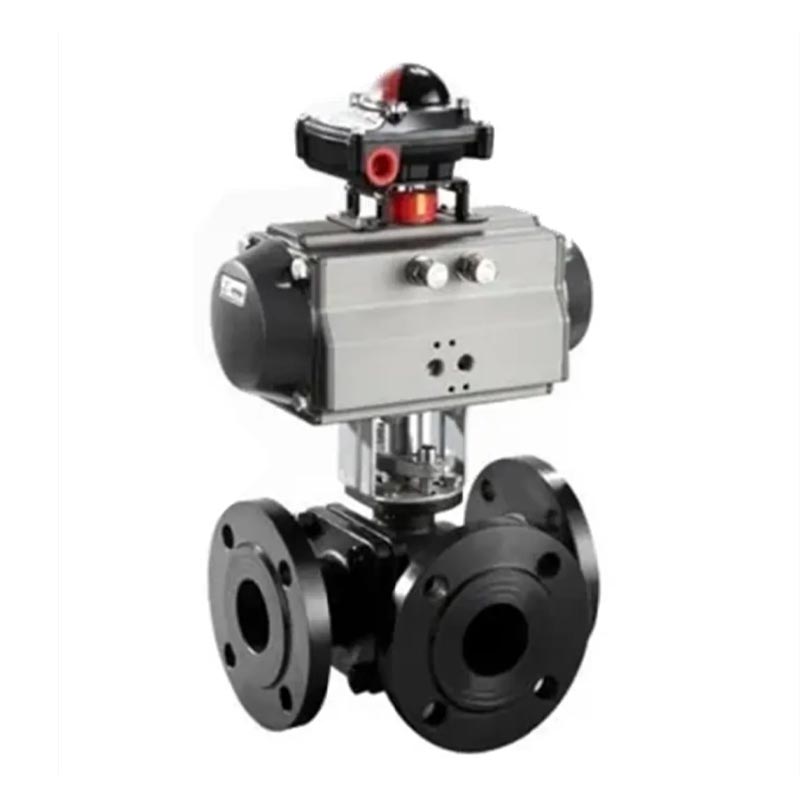
1. Why Does a Corrosive Line Punish a Valve in Places the Specification Often Ignores?
A corrosive line does not attack a valve uniformly. The flow path is washed by the medium, but the seat pocket, the cavity behind the ball, the stem bore, and the gap between the ball and the seat are stagnant or semi-stagnant. In these zones, the corrosive species concentrate as the solvent evaporates or as the medium is displaced by a different medium during switching. The concentration can be several times higher than the bulk concentration. Pitting and crevice corrosion start in these zones, not on the visible flow path. In our factory, we have analyzed returned Three Way Ball Valves units from chemical, pharmaceutical, and marine service. Over 70 percent of the corrosion failures started in the cavity or the seat pocket, not in the main bore. Wenzhou Joepai Valve Co., Ltd. has been manufacturing Three Way Ball Valves for over 15 years.
This is why the material selection cannot be based only on the bulk medium compatibility table. The selection must consider the local concentration, the temperature, and the stagnation that the valve geometry creates. A grade that is adequate for the bulk medium may fail in the cavity.
2. How Does 316 Chemistry Resist Chloride Attack Better Than 304?
The difference between 304 and 316 is the addition of 2 to 3 percent molybdenum to the 316 grade. Molybdenum increases the resistance to pitting and crevice corrosion in chloride-containing environments. It does this by stabilizing the passive film and by reducing the dissolution rate at the pit initiation sites. The critical pitting temperature, which is the temperature above which pitting starts in a standard chloride solution, is about 10 to 15 degrees Celsius higher for 316 than for 304. The table below shows the relative performance of the two grades at different chloride concentrations and temperatures.
| Chloride concentration | Temperature | 304 performance | 316 performance |
| 200 ppm | 25°C | Good | Excellent |
| 200 ppm | 60°C | Pitting risk | Good |
| 500 ppm | 25°C | Pitting risk | Good |
| 500 ppm | 60°C | Severe pitting | Moderate pitting risk |
| 1,000 ppm | 25°C | Severe pitting | Pitting risk |
| 1,000 ppm | 60°C | Not suitable | Severe pitting |
In our factory, we recommend 316 for any application with a chloride concentration above 200 ppm, or with a temperature above 50 degrees Celsius, or with a stagnant zone that can concentrate the chloride. For seawater and high chloride brine, we recommend a duplex or super duplex grade, because even 316 can pit in those conditions. Wenzhou Joepai Valve Co., Ltd. provides a material selection chart for each valve model.
3. What Happens at the Seat and Cavity When the Valve Switches Between Two Media?
A Three Way Ball Valves unit has an L port or a T port. The L port connects one inlet to one outlet and allows the flow to be diverted from one line to another. The T port connects one inlet to two outlets, or two inlets to one outlet, and allows the flow to be combined or split. In both configurations, the cavity behind the ball is isolated from the flow when the valve is in one position. The medium trapped in the cavity can stagnate, evaporate, and concentrate. When the valve switches, the concentrated medium is released into the new flow path, and the cavity is exposed to the new medium. The repeated concentration and release accelerates the corrosion in the cavity and at the seat. The table below compares the cavity behavior of the L port and the T port.
| Port configuration | Cavity volume | Stagnation risk | Typical application |
| L port | Small (one port isolated) | Moderate | Diverting flow between two lines |
| T port | Large (two ports isolated) | High | Mixing or splitting flow |
| L port with cavity filler | Minimized | Low | Corrosive duty with frequent switching |
| T port with drain port | Reduced by draining | Moderate | Duty with periodic flushing |
Valve application engineer's note: For corrosive duty with frequent switching, we recommend an L port valve with a cavity filler. The cavity filler is a PTFE or PFA insert that occupies the space behind the ball, so that the trapped volume is minimized and the concentration effect is reduced. For a T port valve, we recommend a drain port that allows the cavity to be flushed between batches. In our factory, we offer both options and we can advise on the best configuration for the switching frequency and the medium. Joepai tests the cavity volume and the drain efficiency on a flow bench for each design.
4. Why Do Seals, Packing, and Surface Finish Decide Whether 316 Delivers Its Full Benefit?
The 316 body is only one part of the corrosion resistance. The seals, the packing, and the surface finish also determine whether the valve survives. The seat material must be compatible with the medium. PTFE is suitable for most chemicals but is attacked by molten alkali metals and by some fluorine compounds. PFA is more resistant but more expensive. EPDM is suitable for water and steam but not for oils. The stem packing must also be compatible, and it must be protected from the medium by a lantern ring or a double packing arrangement. The internal surface finish affects the corrosion resistance because a rough surface has more sites for pit initiation and more crevices for concentration. In our factory, we machine the internal surfaces to Ra 0.8 micrometers or better and we electropolish the wetted surfaces to remove the microscopic peaks. We also use a PTFE chevron packing with a live loaded gland for the stem. Wenzhou Joepai Valve Co., Ltd. provides the seal material and surface finish specification with each quotation.
We also recommend that the buyer specify the seat and seal material by name and grade, not just by the generic term "PTFE." A virgin PTFE seat and a glass-filled PTFE seat have different chemical resistance and different compression behavior.
5. How Should Engineers Specify and Verify a 316 Three Way Ball Valve for a Corrosive Duty?
The specification should include seven items. The first is the medium composition, including the chloride concentration and the pH. The second is the operating temperature and pressure. The third is the port configuration, L port or T port, with the cavity filler or drain option. The fourth is the body material, 316 with the molybdenum content specified. The fifth is the seat and seal material. The sixth is the internal surface finish. The seventh is the test requirement, including the shell test, the seat test, and the pitting resistance test. The verification should include four checks. The first is the material certificate with the molybdenum content. The second is the positive material identification by X-ray fluorescence on the body and the ball. The third is the internal surface roughness measurement. The fourth is the shell and seat pressure test. In our factory, we perform all four checks on every valve and provide the test report with the shipment. Wenzhou Joepai Valve Co., Ltd. also offers a salt spray test and a pitting potential test on request.
We recommend that the buyer verify the molybdenum content with a portable X-ray fluorescence analyzer at incoming inspection. A supplier that substitutes 304 for 316 can be detected in seconds, and the consequence of the substitution in a corrosive line is a premature failure that is expensive to repair.
Frequently Asked Questions About 316 Three Way Ball Valves in Corrosive Environments
Summary for Valve Application Engineers
A 316 stainless steel Three Way Ball Valves unit offers benefits in corrosive environments because the molybdenum addition increases the resistance to pitting and crevice corrosion, especially in the stagnant cavities that form during switching. The benefits are realized only if the port configuration controls the cavity volume, the seals and packing are compatible with the medium, and the internal surface finish is smooth enough to resist pit initiation. The specification should include the medium composition, the chloride concentration, the temperature, the port configuration, the body material with the molybdenum content, the seal material, and the surface finish. The verification should include the material certificate, the positive material identification, the surface roughness measurement, and the pressure test. Wenzhou Joepai Valve Co., Ltd. has been manufacturing Three Way Ball Valves for over 15 years and provides full material and design support for corrosive duty applications.