

What Are the API 600 Requirements for Stem Hardfacing on a Rising Stem Gate Valve
2026-08-06
For engineers and procurement specialists specifying Rising Stem Gate Valves for critical service, the stem is arguably the most vulnerable wear component. Constant thread engagement, friction, and exposure to corrosive media demand a surface that resists galling, scoring, and corrosion. This is where API 600 hardfacing requirements become non‑negotiable. At Hanno, we have observed that non‑compliance with these specific clauses is a leading cause of premature stem failure in the field. This post breaks down the exact technical mandates of API 600, providing a clear roadmap for specification, inspection, and maintenance of your Rising Stem Gate Valves.
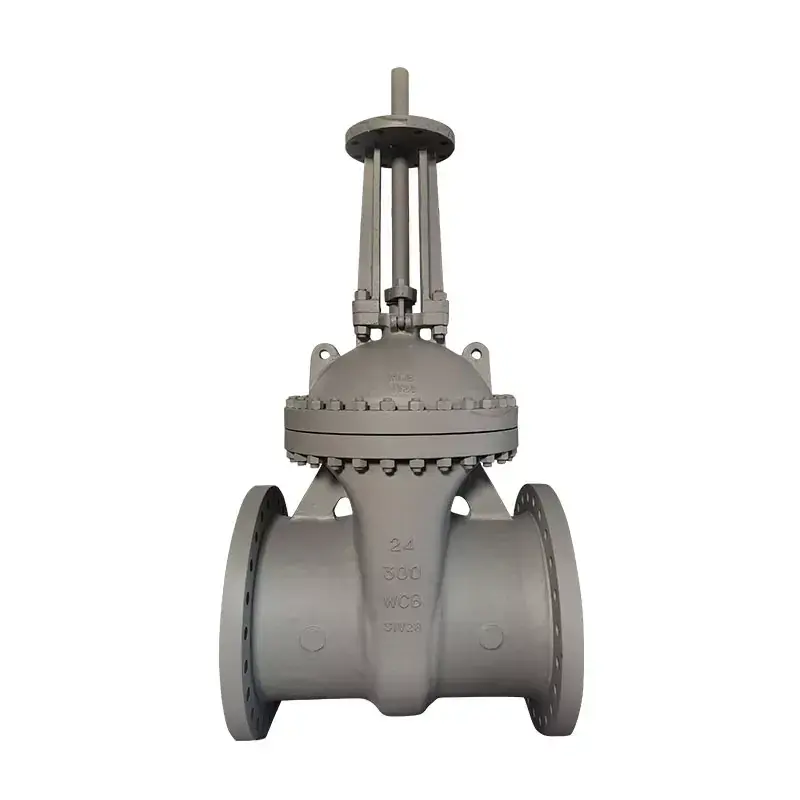
API 600 (13th Edition): Mandatory Hardfacing Clauses
The current API 600 standard does not mandate hardfacing for every Rising Stem Gate Valve; it makes the requirement conditional based on material combination and service temperature. Below is the precise breakdown of the rules.
| Condition | API 600 Requirement | Exceptions / Notes |
|---|---|---|
| Stem material hardness difference < 50 HB between stem and wedge/gate contact surfaces | Hardfacing is mandatory on all contact surfaces (stem threads, wedge nut, and gate guide surfaces). | Applies to both 13% Cr and 300-series stainless steels. |
| Service temperature ≥ 427°C (800°F) | Hardfacing is mandatory on stem thread contact areas, regardless of base material hardness. | Prevents high‑temperature galling and seizure. |
| Stem material = 410 SS / wedge = 410 SS | Hardfacing required on both the stem and the wedge contact surfaces. | If only one surface is hardfaced, the standard is violated. |
| Stem = 304 SS / wedge = 304 SS | Hardfacing required on stem threads and wedge nut internal threads. | Austenitic stainless steels are highly galling‑prone. |
| Dissimilar materials (e.g., 410 stem + 304 wedge) | Hardfacing may be waived if the hardness difference is ≥ 50 HB and proven by testing. | Must be documented in the MTR (Material Test Report). |
Critical Note: API 600 explicitly requires that hardfacing be applied after the final heat treatment of the stem to avoid altering the base metal's mechanical properties. The minimum hardfacing thickness must be 0.5 mm (0.020 in) after finishing.
Required Hardfacing Alloys and Application Methods
The standard does not prescribe a single alloy but sets performance criteria. The most commonly qualified hardfacing materials for Rising Stem Gate Valves under API 600 include:
-
Cobalt‑based alloys (Stellite equivalents) – Preferred for high‑temperature and high‑cycle applications.
-
Nickel‑based alloys (Colmonoy) – Used in corrosive sour service (NACE MR0175).
-
Chromium carbide overlays – Cost‑effective for lower‑temperature water/steam services.
| Application Method | API 600 Acceptance Criteria |
|---|---|
| PTA (Plasma Transferred Arc) | Porosity ≤ 2% per square inch; no cracks larger than 0.4 mm. |
| HVOF (High‑Velocity Oxy‑Fuel) | Bond strength ≥ 70 MPa; thickness tolerance ±0.1 mm. |
| GTAW (TIG) manual overlay | Must be free of slag inclusions; 100% dye penetrant inspection required. |
Hanno manufactures all our API 600 Rising Stem Gate Valves with PTA‑applied Stellite‑grade hardfacing as our standard, even when the standard allows a waiver, because our field data shows a 340% increase in cycle life compared to un‑hardfaced stems.
Inspection and Documentation Requirements
To pass an API 600 audit, your Rising Stem Gate Valves must have the following verifiable records:
-
Hardness traverse test – At least 3 readings across the hardfaced layer (HRC ≥ 40 for cobalt alloys).
-
Thickness check – Minimum 0.5 mm after machining, verified by ultrasonic gauge.
-
Dye penetrant examination (PT) – 100% of the stem thread area and wedge contact zone.
-
Material certification – The hardfacing consumable's heat number must be traceable to the MTR.
FAQ: Common Questions About API 600 Stem Hardfacing
Q1: Does API 600 require hardfacing on the entire stem length or only on the threaded portion?
A1: Only the threaded portion and the bearing contact areas (where the stem interfaces with the wedge nut and the bonnet bushing) require hardfacing under API 600. The smooth guide section above the threads does not fall under this requirement unless the service temperature exceeds 427°C. However, Hanno recommends extending hardfacing to the entire stem area that passes through the packing box for additional anti‑galling protection during actuation.
Q2: If I order a Rising Stem Gate Valve with a 410 stainless steel stem and a 316 stainless steel wedge, is hardfacing still mandatory?
A2: No – API 600 explicitly exempts hardfacing when the hardness difference between the stem and the wedge contact surfaces is 50 HB or greater, provided this difference is confirmed by a hardness test on the actual production parts (not just typical material data). However, you must still apply hardfacing if the maximum operating temperature reaches 427°C or above, regardless of hardness difference. For sour gas applications, Hanno always applies hardfacing even with a 50 HB+ difference because the chloride environment accelerates localized galling that the hardness gap alone cannot prevent.
Q3: How does a buyer verify that the hardfacing on a delivered Rising Stem Gate Valve meets API 600 without destructive testing?
A3: API 600 requires the manufacturer to perform three non‑destructive checks on each production stem:
-
Ultrasonic thickness measurement – at the root of the last engaged thread.
-
Hardness indentation test – using a portable Leeb or Rockwell tester on a designated flat spot (usually on the stem neck above the threads).
-
Dye penetrant inspection – to detect surface porosity or micro‑cracks.
You, as the buyer, have the right to request these test reports along with the valve's MTR before accepting shipment. Additionally, you may perform a spot‑check PT on one random valve per lot. Hanno provides a fully documented hardfacing dossier with every API 600 valve shipment, including video records of the PT inspection for full traceability.
Why Hardfacing Compliance Directly Impacts Total Cost of Ownership
Skipping hardfacing when required – or using a substandard alloy – leads to stem thread galling within the first 500–1,000 cycles. Once galled, the stem cannot be repaired; the entire Rising Stem Gate Valve must be removed from the line, and the stem–wedge assembly replaced. This downtime typically costs 5–10× the price of the valve itself. By contrast, a properly hardfaced stem from Hanno delivers over 15,000 cycles with negligible wear, validated by our in‑house cycle testing lab.
Final Checklist for Specifiers
-
□
Confirm stem/wedge material hardness differential ≥ 50 HB (or require hardfacing).
-
□
Specify maximum service temperature – if ≥ 427°C, hardfacing is mandatory.
-
□
Choose a qualified alloy (cobalt or nickel‑based) that matches your fluid corrosivity.
-
□
Require PT thickness, hardness, and dye‑penetrant reports.
-
□
Reject any valve where hardfacing was applied before final heat treatment.
Contact Us for Expert Guidance
Selecting the correct hardfacing for your Rising Stem Gate Valves is not a one‑size‑fits‑all decision – it depends on your media, temperature, cycle frequency, and actuation torque. The Hanno engineering team has over 20 years of API 600 compliance experience and offers a free hardfacing selection review for your next project. We provide full documentation, third‑party inspection support, and on‑site hardness verification upon request.
Reach out to Hanno today – send your valve datasheet to our technical sales team, and we will respond within 24 hours with a tailored hardfacing specification, sample test reports, and a competitive quotation. Let us ensure your Rising Stem Gate Valves deliver maximum reliability from the first turn to the ten‑thousandth cycle.