

Is a Gearbox Globe Valve Suitable for Automated Actuation with Electric or Pneumatic Drivers
2026-07-15
When engineers evaluate flow control solutions for heavy-duty industrial systems, the Gearbox Globe Valves often emerge as a strong candidate. However, the question of automation compatibility remains a critical decision point. At Hanno, we frequently field inquiries from project managers who need to know whether their existing Gearbox Globe Valves can integrate seamlessly with electric or pneumatic actuators. The short answer is yes—but the execution requires careful attention to torque, stroke speed, and control logic. This blog breaks down the technical considerations, compares driver types, and provides actionable guidance for successful automation.
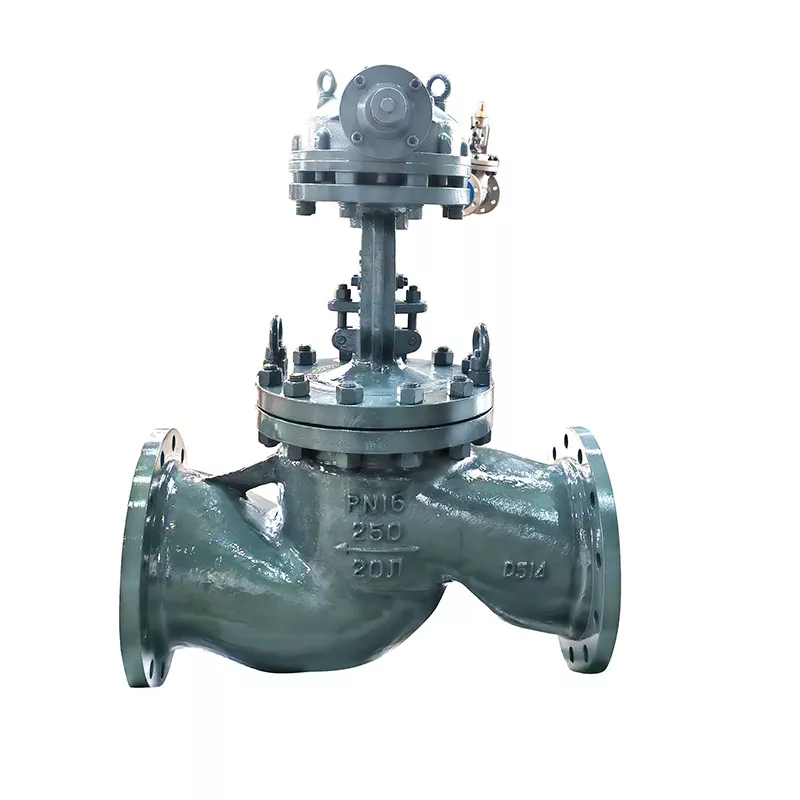
Understanding the Core Challenge
A Gearbox Globe Valve is designed to convert manual rotational input into linear stem motion, typically using bevel or spur gear trains. The gearbox reduces handwheel effort but increases the number of turns required for full travel. When automating, the actuator must overcome not only the valve’s seat friction and dynamic pressure forces but also the internal friction of the gearbox itself. This makes Gearbox Globe Valves inherently more demanding than direct-acting valves—but not prohibitively so.
Electric vs. Pneumatic Drivers: A Side-by-Side Comparison
| Criteria | Electric Actuators | Pneumatic Actuators |
|---|---|---|
| Torque Capability | High and constant across stroke | Drops off with supply pressure variations |
| Speed Control | Precise, programmable ramping | Limited to flow control valves and volume boosters |
| Fail-Safe Behavior | Requires battery or spring-back (costly) | Natural fail-safe with spring-return (reliable) |
| Environment | Suitable for clean, dry areas | Ideal for explosive or wet environments (no spark risk) |
| Maintenance | Periodic lubrication and capacitor checks | Regular filter-drier maintenance and seal replacement |
| Initial Cost | Higher for large torque ratings | Lower for medium torque ranges |
| Control Signal | 4-20 mA or digital fieldbus (e.g., Profibus) | 3-15 psi or I/P converter required |
Key Technical Factors for Successful Automation
1. Breakaway Torque Margin
Every Gearbox Globe Valve has a published breakaway torque (the force needed to unseat the disc from the seat). For automated actuation, Hanno recommends that the actuator’s rated torque be at least 1.5 to 2 times this value. Electric drivers handle this consistently, while pneumatic systems may need larger cylinder sizes to compensate for pressure droop.
2. Stroke Time and Positioning Accuracy
Globe valves are often used for throttling, not just on/off service. Electric actuators with intelligent positioners can achieve positioning accuracy within ±0.5%. Pneumatic systems, with high-quality I/P converters and volume boosters, typically achieve ±1.5–2%. If your process requires tight control, electric is the preferred match for Gearbox Globe Valves.
3. Duty Cycle and Cycling Frequency
Frequent cycling generates heat in electric motors, necessitating thermal overload protection. Pneumatic drivers run cooler and handle higher cycling rates without derating. For continuous modulating service, Hanno often advises pneumatic solutions for Gearbox Globe Valves in high-cycle applications.
Practical Integration Checklist
-
Verify gearbox input flange matches actuator output flange (ISO 5211 standard preferred).
-
Calculate total stem thrust using valve Cv and differential pressure at shutoff.
-
Confirm actuator power supply (voltage/current or air pressure) is stable on-site.
-
Test limit switches and position feedback before full-load startup.
-
Include a manual override hub on the actuator for emergency handwheel operation.
Frequently Asked Questions About Gearbox Globe Valves
Q: Can I retrofit an electric actuator onto an existing manual Gearbox Globe Valve without modifying the yoke?
A: Yes, but only if the yoke mounting pattern conforms to ISO 5211 or a recognized industry standard (e.g., MSS SP-101). Most older Gearbox Globe Valves have custom brackets, so Hanno recommends measuring the bolt circle diameter, pilot bore, and stem square/key dimensions first. Adapter plates are commercially available, but they add height and may reduce torsional rigidity. For valves larger than 10 inches, we strongly advise a site survey to verify that the existing gearbox input shaft can handle the actuator’s inertia during emergency stops.
Q: Which driver type offers better energy efficiency for continuous modulation of a Gearbox Globe Valve?
A: Electric drivers are substantially more energy-efficient in continuous modulation because they draw power only when moving (or when holding position with a brake). Pneumatic systems bleed constant air through I/P converters and positioners, even at steady state—this can waste 30–50% of compressed air energy over a year. However, if your facility already has a large centralized air system with excess capacity, the incremental cost may be negligible. For new installations, Hanno typically runs a life-cycle cost analysis; electric almost always wins for modulation duty above 10,000 strokes per year.
Q: What happens if the pneumatic supply fails while my Gearbox Globe Valve is partially open?
A: That depends entirely on your actuator configuration. A spring-return pneumatic actuator will drive the Gearbox Globe Valve to its fail-safe position (fully open or fully closed, as specified). Without a spring, the valve stays in its last position—which may be unsafe. Electric actuators require either a battery-backed emergency power unit or a supercapacitor module to achieve a fail-safe stroke. For critical safety instrumented functions (SIF), Hanno always recommends pneumatic spring-return over electric, unless you have a dual-redundant power feed and UPS with proven runtime.
Best Practice Recommendation from Hanno
For on/off service with infrequent operation (less than 5 cycles per hour), both electric and pneumatic drivers perform reliably. For modulating service with frequent position changes, electric actuators deliver superior precision and lower operating costs. For hazardous areas (Class I, Div 1) or where instrument air is abundant, pneumatic remains the simpler, safer choice for Gearbox Globe Valves.
Hanno also emphasizes that the gearbox ratio itself influences automation success—higher ratios (e.g., 40:1) reduce required actuator torque but increase stroke time. Always simulate the full stroke time against your process response requirements before final selection.
Conclusion
Gearbox Globe Valves are fully suitable for automated actuation, provided you match the driver type to your process dynamics, environmental conditions, and fail-safe needs. Electric drivers excel in precision and efficiency; pneumatic drivers shine in safety and simplicity. Neither is universally superior—the right answer lies in your specific duty cycle, torque profile, and site utilities.
Ready to automate your Gearbox Globe Valves with confidence?
Contact Hanno today for a tailored torque analysis, actuator sizing worksheet, and retrofit feasibility study. Our engineering team will help you select the optimal electric or pneumatic solution—and ensure seamless integration with your existing Gearbox Globe Valves. Reach out via our website or call your local Hanno representative to schedule a technical consultation. Your process reliability is our priority.