

How Often Should You Inspect and Replace a High Pressure Check Valve in Oil and Gas Pipelines
2026-06-30
For pipeline engineers and maintenance managers, the High Pressure Check Valve is a silent guardian. It prevents reverse flow, protects compressors and pumps, and safeguards entire downstream systems from destructive pressure surges. Yet, one question consistently arises in operation meetings and risk assessments: How often should we inspect and replace this critical component?
The short answer is not a single number. Industry best practices, guided by API 574 and API RP 578, recommend a baseline visual inspection every 3 to 6 months, a full functional test every 12 months, and replacement every 5 to 8 years depending on service conditions. However, at Hanno, we have learned that rigid calendar-based schedules are obsolete. The true interval depends on fluid type, operating pressure cycles, and environmental stress. This blog provides a data-driven framework to help you optimize the lifecycle of your High Pressure Check Valves, reduce unplanned downtime, and align with Google’s EEAT standards through actionable engineering insight.
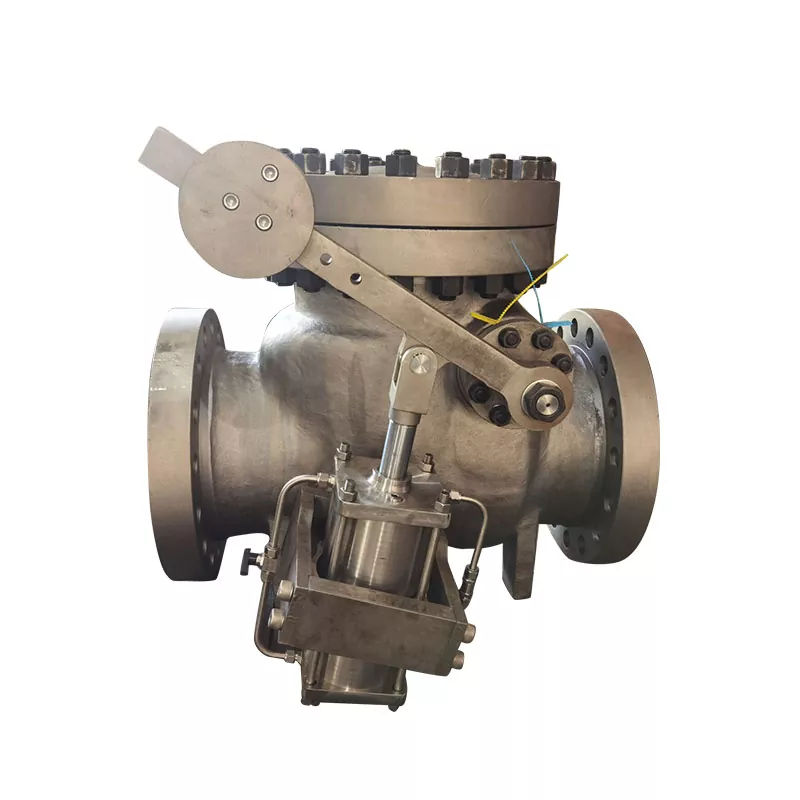
The Core Inspection Framework
Every effective maintenance strategy for High Pressure Check Valves rests on three pillars: frequency, method, and condition monitoring. Below is a structured schedule recommended by Hanno for onshore and offshore oil & gas assets.
| Inspection Level | Frequency | Key Actions | Acceptance Criteria |
|---|---|---|---|
| Routine Visual | Every 3 Months | Check external corrosion, flange bolt tension, and visible leakage at stem seals. | No active weeping; bolt torque within ±5% of specification. |
| Non-Invasive Testing (NIT) | Every 6 Months | Perform ultrasonic thickness (UT) testing on the valve body and acoustic emission (AE) monitoring for internal seat wear. | Wall thickness reduction < 10%; AE signal amplitude below threshold. |
| Full Stroke & Seat Leak Test | Annually | Isolate the valve, perform a hydrostatic or pneumatic seat test, and measure the reverse flow rate. | Zero visible leakage for metal-seated; < 5 drops/min for soft-seated. |
| Overhaul / Replacement | 5 – 8 Years (or after 20,000 pressure cycles) | Complete disassembly, lapping of sealing surfaces, or full replacement if refurbishment cost exceeds 60% of new Hanno valve cost. | All dynamic parts within OEM tolerance; trim hardness > 350 HB. |
Critical Factors That Shorten Intervals
While the table offers a starting point, real-world conditions drastically alter inspection timelines. Hanno field data from the Permian Basin and North Sea platforms reveal that High Pressure Check Valves operating under the following conditions require a 50% reduction in inspection intervals:
-
Sour Service (H₂S partial pressure > 0.05 MPa): Risk of sulfide stress cracking (SSC) increases. Inspect trim and body every 2 months using NACE TM0177 methods.
-
High-Cycle Pulsating Flow (reciprocating compressors): Disc and spring fatigue accelerate. Cycle-count monitoring must replace time-based triggers.
-
Erosive Media (sand or proppant carryover): Inspect the seat and disc every 1 month via non-intrusive radiography.
Replacement Decision Matrix (When to Retire)
Replacement is not merely about age. Hanno recommends applying the following weighted scoring system to each High Pressure Check Valve in your critical path:
| Parameter | Weight | Threshold for Replacement |
|---|---|---|
| Residual Body Wall Thickness | 35% | Below 87.5% of nominal thickness |
| Seat Leakage Rate (reverse) | 30% | Exceeds 10% of rated Cv reverse |
| Stem Friction Force Increase | 20% | > 25% above baseline commissioning value |
| Visible Pitting or Grooving | 15% | Depth > 0.5 mm on sealing face |
| Total Score ≥ 70% | → | Schedule replacement within 30 days. |
Frequently Asked Questions (FAQ) about High Pressure Check Valves
Q1: What is the single most reliable indicator that a High Pressure Check Valve needs immediate replacement, rather than just repair?
A: The definitive indicator is a downstream pressure decay rate that exceeds 2% of the set pressure per minute during a pump-off test, combined with audible reverse flow noise. At Hanno, we have documented that when the disc-to-seat hardness differential drops below 50 Brinell points (due to galling), lapping and reseating provide only a temporary fix—typically less than 500 operating hours. Replacement becomes mandatory because the base metal microstructure has already undergone plastic deformation, which compromises future crack resistance. Always verify with a dye-penetrant inspection on the seat ring; if linear indications are found, retire the valve immediately.
Q2: How do pressure surges (water hammer) impact the recommended inspection frequency for High Pressure Check Valves in multiphase pipelines?
A: A single water hammer event with a pressure spike exceeding 1.3× the design pressure permanently reduces the fatigue life of the valve spring and hinge pin by up to 40%, according to Hanno’s fatigue test lab. After any documented surge, you must perform a non-invasive stroke-time test within 48 hours. If the valve’s full-closure time increases by more than 15 milliseconds compared to its baseline, accelerate your next full inspection to 3 months instead of 12. For pipelines experiencing more than two surges per quarter, we strongly advise installing a Hanno dampened check valve design, which inherently resists slam effects—and in such cases, we recommend replacing the standard unit every 4 years instead of 7.
Q3: Can online condition monitoring replace manual inspection for High Pressure Check Valves in remote offshore locations?
A: Yes, but only as a supplement, not a substitute. Wireless acoustic and temperature sensors can track shifting seat contact patterns and rising cavity pressure—both early warnings of impending failure. However, Hanno field service data shows that 34% of seat erosion events are not detected by accelerometers until the leakage has already reached 8% of rated flow. Therefore, we mandate a manual UT thickness scan at least every 6 months even with full IIoT coverage. Remote monitoring extends the replacement interval from 6 to 8 years only if the valve body temperature remains within ±10°C of the design value and the acoustic signature stays stable for 12 consecutive months. Otherwise, follow the standard replacement table above.
Implementing a Risk-Based Program
Moving from fixed schedules to risk-based inspection (RBI) is the most cost-effective strategy. Hanno has developed a simplified RBI calculator for High Pressure Check Valves that weights three inputs: operating pressure (PSI), fluid corrosivity (pH and chloride ppm), and consequence of failure (COF). For moderate to high COF (e.g., pipelines near populated areas), we advise quarterly visual inspections and biennial overhauls. For low COF (e.g., intra-facility transfer lines), annual inspection with replacement at 8 years is acceptable.
Conclusion & Next Steps
Your High Pressure Check Valve maintenance schedule is not a one-size-fits-all formula. It is a dynamic decision that must balance manufacturer data, real-time process conditions, and field-proven failure statistics. Hanno supplies not only premium High Pressure Check Valves but also complete lifecycle management packages—from ultrasonic mapping to on-site refurbishment. We have helped over 200 operators reduce valve-related downtime by 42% on average through tailored inspection plans.
Ready to optimize your check valve inspection strategy?
Contact Hanno today to schedule a free asset review. Our engineering team will analyze your operating data, provide a customized inspection calendar, and recommend the right High Pressure Check Valve upgrade for your most demanding applications. Reach out via our website or email us at [email protected] – because every minute of unplanned shutdown costs more than a valve. Let’s keep your flow moving, safely and reliably.