

How Often Should You Inspect and Maintain a Stainless Steel Flanged Check Valve in Seawater Service
2026-06-29
Seawater is one of the most corrosive natural environments for industrial flow control equipment. For operators managing desalination plants, offshore platforms, or marine pumping systems, the Stainless Steel Flanged Check Valve is a critical component that prevents backflow and protects pumps from reverse rotation. However, seawater’s high chloride content, combined with flow velocity and temperature variations, accelerates wear on the valve disc, hinge pin, and sealing faces. At Huadu, we have engineered Stainless Steel Flanged Check Valve solutions for over two decades, and we consistently advise clients that a fixed calendar schedule is less effective than a risk‑based, condition‑monitored approach. So, how often should you truly inspect and maintain this valve in seawater duty? The short answer: visual checks every 3 months, internal inspections every 6 months, and major overhauls every 2 years or 4,000 operating hours—whichever comes first. This article provides a professional, data‑driven maintenance roadmap aligned with API 598 and ASTM G48 standards, ensuring your Stainless Steel Flanged Check Valve delivers maximum service life without unexpected downtime.
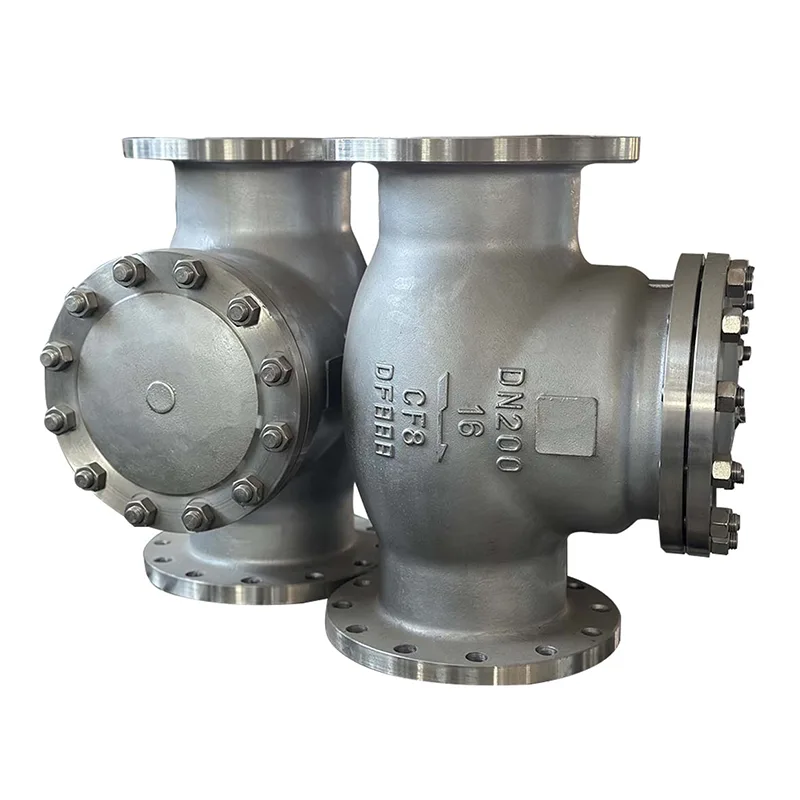
Why Seawater Demands a Stricter Maintenance Regime
Unlike fresh water or treated hydrocarbon fluids, seawater introduces three distinct threats to a Stainless Steel Flanged Check Valve:
-
Chloride-induced pitting and crevice corrosion – even 316L stainless steel can suffer at temperatures above 40°C if the passive layer breaks down.
-
Erosion‑corrosion – suspended sand and marine organisms accelerate material loss on the disc and seat.
-
Galvanic coupling – when flanged connections use dissimilar metals, the valve body can become anodic.
Therefore, the inspection frequency must be shorter than that for onshore, non‑corrosive services. Huadu recommends the following tiered schedule based on operating conditions:
| Service Condition | Visual / External Inspection | Internal Trim Inspection | Full Overhaul (Seals + Springs + Hinge) |
|---|---|---|---|
| Continuous seawater (>8 hrs/day) | Every 1 month | Every 4 months | Every 18 months |
| Intermittent seawater (<4 hrs/day) | Every 3 months | Every 6 months | Every 24 months |
| Standby / Emergency service | Every 6 months | Every 12 months | Every 36 months |
| High‑temperature (>50°C) or high‑velocity (>5 m/s) | Every 2 weeks | Every 2 months | Every 12 months |
What Does a Professional Inspection Include?
A thorough inspection goes far beyond a visual glance. For a Stainless Steel Flanged Check Valve in seawater, Huadu engineers perform the following checklist during each internal inspection:
-
Disc movement test – lift and release the disc to check for sticking, scoring, or abnormal noise.
-
Seat face examination – use a dye penetrant to detect microfractures or pitting on the sealing surface.
-
Hinge pin wear measurement – compare against factory tolerance (typically ≤0.05 mm radial play).
-
Spring fatigue assessment – measure closing force with a digital gauge; replace if force drops by >15%.
-
Flange gasket condition – inspect for extrusion, chloride attack, and re‑torque flange bolts to specified values.
All findings must be documented with photos and measurement logs. Huadu provides a standardized inspection form with every Stainless Steel Flanged Check Valve shipment, helping maintenance teams track degradation trends over time.
3 Frequently Asked Questions About Stainless Steel Flanged Check Valve Maintenance in Seawater
Q1: Can I extend the inspection interval by upgrading from 316L to super‑duplex stainless steel for my Stainless Steel Flanged Check Valve?
A1: Yes, upgrading to super‑duplex (e.g., UNS S32750) significantly improves pitting resistance equivalent (PRE) from ~28 to >40, which can safely extend internal inspection intervals by 30‑50% in moderate seawater conditions. However, the extension is not automatic—you must first validate the actual chloride level, pH, and operating temperature over a full seasonal cycle. Huadu offers a free service‑life calculator that correlates material grade with recommended inspection frequency. Even with super‑duplex, we never advise exceeding 24 months for a full internal tear‑down, because microbiologically influenced corrosion (MIC) can still occur under stagnant conditions, regardless of alloy chemistry. Always pair material upgrades with weekly disc‑stroke exercises to prevent biofouling adhesion.
Q2: What are the clearest warning signs that my Stainless Steel Flanged Check Valve needs immediate maintenance before the scheduled date?
A2: Four red flags demand unscheduled intervention: (1) audible chattering during flow—this indicates the disc is oscillating due to insufficient backpressure or a weakened spring; (2) visible rust streaks on the flange exterior—these suggest crevice corrosion under the gasket, which can lead to flange face leakage within days; (3) pressure drop spikes across the valve exceeding 0.5 bar above baseline—this points to partial disc obstruction or seat scaling; and (4) failure to close fully after pump shutdown—this allows reverse flow that damages impellers. If any of these occur, immediately isolate the line, remove the Stainless Steel Flanged Check Valve, and perform a wet‑magnetic particle inspection on the hinge area. Huadu stocks emergency replacement trim kits for all our valve sizes (DN50‑DN600) to reduce downtime to under 4 hours.
Q3: How should I adjust my maintenance plan seasonally for a Stainless Steel Flanged Check Valve installed in tropical seawater versus cold‑water environments?
A3: Seasonal adjustment is critical. In tropical waters (ambient >30°C), chloride aggressiveness doubles with every 10°C rise—so we recommend shortening all intervals in the table above by 25% during summer months. Additionally, increase visual inspections to bi‑weekly to check for accelerated pitting on the flange bolt threads. In cold‑water environments (<10°C), the primary concern shifts to increased viscosity and higher closing slam forces; therefore, focus on hinge pin lubrication and dampening mechanism checks every 3 months. For installations that experience freezing conditions, never leave the valve flooded—drain the line or use trace heating, because ice expansion can distort the seat geometry permanently. Huadu offers climate‑specific maintenance add‑on kits, including anti‑corrosion thread compound and low‑temperature lubricants, tailored to your operating region.
Best Practices to Extend Valve Lifespan
Beyond scheduled inspections, Huadu recommends four proactive measures that reduce the total cost of ownership for your Stainless Steel Flanged Check Valve:
-
Install a strainer upstream (40‑mesh minimum) to capture shell fragments and sand particles.
-
Flush the line with fresh water after each seawater pumping cycle, if process design permits.
-
Apply a ceramic‑epoxy coating to the flange face exterior (not on the gasket sealing area) to block chloride ingress.
-
Record closing time during each overhaul—any increase beyond 2 seconds indicates damper or spring degradation.
These actions, combined with our recommended schedule, consistently achieve a 12‑15 year service life for Stainless Steel Flanged Check Valve in offshore applications, compared to the industry average of 7‑9 years.
Summary Inspection & Maintenance Quick‑Reference Table
| Task | Tool / Method | Frequency | Acceptance Criterion |
|---|---|---|---|
| External visual (corrosion, leakage) | Magnifying glass & torch | 1‑3 months | No pitting >0.2 mm depth |
| Disc lift & drop test | Manual lever or bypass line | 3‑6 months | Full travel without binding |
| Seat sealing check | Hydrostatic test (1.5× MWP) | 6‑12 months | Zero visible drip for 5 min |
| Hinge pin diameter measurement | Micrometer (0.01 mm precision) | 12‑18 months | Wear ≤0.05 mm from new |
| Spring force validation | Digital push‑pull gauge | 18‑24 months | Force ≥85% of factory value |
| Full disassembly & gasket renewal | Torque wrench + new fasteners | 18‑36 months | All soft parts replaced |
Conclusion & Contact Us
A disciplined, condition‑based maintenance program is the only reliable way to protect your Stainless Steel Flanged Check Valve from the aggressive nature of seawater. Waiting for visible failure almost always results in costly pump damage, unplanned shutdowns, and flange re‑machining expenses that far exceed the cost of regular overhauls. At Huadu, we do not just supply premium Stainless Steel Flanged Check Valve products—we partner with your maintenance team to develop a customized inspection schedule, provide remote diagnostic support, and ship genuine spare parts within 24 hours.
Contact Us today to request our free seawater‑service maintenance template or to speak directly with one of our senior valve engineers. Whether you need a replacement trim kit, a retrofitted dampening system, or a full valve upgrade to super‑duplex, Huadu delivers reliability that withstands the harshest marine conditions. Reach out via our website live chat, email at [email protected], or call our 24/7 technical hotline. Let us help you keep your Stainless Steel Flanged Check Valve—and your entire process—flowing safely, year after year.