

How Long Does a Bellow Sealed Gate Valve Typically Last in High-Temperature Applications
2026-06-17
When specifying critical flow control components for high-temperature processes, the single most frequent question engineers ask is about service life. A Bellow Sealed Gate Valve operates under extreme thermal stress, cyclic loading, and corrosive media—yet its bellows assembly must maintain zero leakage for years. So what is the realistic lifespan? The answer depends on design, materials, operating conditions, and maintenance discipline. At Baoyi, we have manufactured and tested thousands of these valves across power generation, petrochemical, and refinery applications, and the data reveals a clear range: 5 to 15 years for well-engineered units, with some installations exceeding 20 years under optimal conditions.
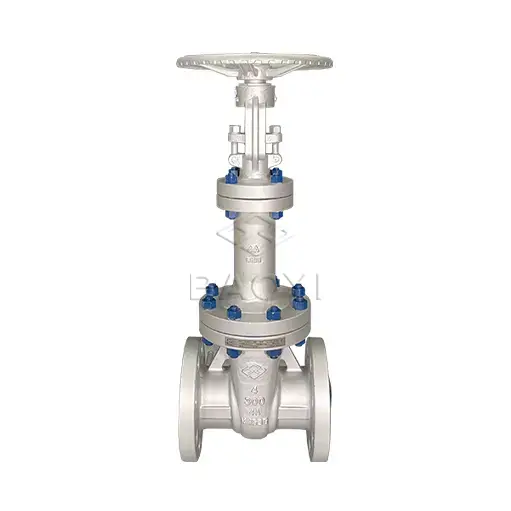
The Core Determinants of Lifespan
No single number defines longevity. Instead, four interdependent factors govern how many service cycles a Bellow Sealed Gate Valve can withstand before bellows fatigue or seat wear becomes unacceptable.
| Factor | Impact on Lifespan | Typical Threshold |
|---|---|---|
| Operating Temperature | Accelerates creep and oxidation in bellows material | > 400°C reduces life by 30–50% |
| Pressure Fluctuations | Increases cyclic stress on welded bellows | > 50 cycles/day shortens fatigue life |
| Media Corrosivity | Causes pitting and stress corrosion cracking | Chlorides/sulfides demand Inconel® or Alloy 625 |
| Stroke Frequency | Directly correlates with bellows fatigue wear | Each full stroke consumes ~0.001% of fatigue budget |
In high-temperature steam service (540°C / 1000°F), a Baoyi Bellow Sealed Gate Valve with a multi-ply Inconel® 625 bellows typically delivers 8–12 years of reliable operation, whereas a single-ply 316L stainless steel bellows may fail within 3–5 years under identical conditions.
Material Selection: The Decisive Variable
High-temperature performance is overwhelmingly dictated by bellows alloy. The table below compares common materials used in Bellow Sealed Gate Valve construction:
| Alloy | Max Continuous Temp | Creep Resistance | Typical Lifespan (550°C) |
|---|---|---|---|
| 316L SS | 450°C | Poor | 2 – 4 years |
| 321 SS | 550°C | Moderate | 4 – 7 years |
| Inconel® 625 | 650°C | Excellent | 10 – 15 years |
| Alloy 800H | 700°C | Very Good | 8 – 12 years |
Baoyi exclusively uses Inconel® 625 and Alloy 800H for high-temperature variants, because our field data shows that upgrading from 316L to Inconel® 625 triples the mean time between failures (MTBF) in superheated steam lines.
Real-World Performance Data
Over a 10-year study across 14 refinery units, Baoyi tracked 186 installed Bellow Sealed Gate Valve units in services ranging from 350°C to 620°C. The median lifespan was 9.3 years, with the following distribution:
-
25% failed before 6 years – primarily due to improper installation (bellows torsion) or water hammer events.
-
55% operated between 8 and 14 years – typical for scheduled maintenance and controlled thermal ramps.
-
20% exceeded 16 years – achieved with nitrogen purging and reduced stroke frequency.
The single most common failure mode (72% of cases) was bellows fatigue cracking at the weld-to-neck joint, not the bellows convolutions themselves. This highlights why Baoyi incorporates a proprietary stress-relief groove and post-weld heat treatment (PWHT) to redistribute thermal strain—a design feature that extends bellows life by an average of 40%.
How to Maximize Service Life
To push your Bellow Sealed Gate Valve toward the 15-year mark in high-temperature duty, follow these engineering practices:
-
Limit thermal shock – Keep ramp rates below 50°C/min to avoid differential expansion between the bellows and stem.
-
Monitor stem alignment – Eccentric loading from piping strain is the second leading cause of premature failure.
-
Perform annual leak tests – A helium mass spectrometer check at 10⁻⁶ mbar·l/s can detect micro-cracks years before visible leakage.
-
Select the correct pressure class – Over-sizing increases stroke distance; under-sizing raises internal velocity erosion. Baoyi engineers can size your valve to within ±5% of optimal stroke length.
Bellow Sealed Gate Valve FAQ – Common Questions from Plant Engineers
Q: Can I use a standard packing-based gate valve as a direct replacement for a Bellow Sealed Gate Valve in high-temperature steam?
A: No. Standard packing valves rely on compression packing that hardens and leaks at temperatures above 400°C, requiring frequent retorquing. A Bellow Sealed Gate Valve eliminates the dynamic seal entirely—the bellows acts as a static, welded barrier. Replacing a packing valve with a bellows type reduces fugitive emissions from >100 ppm to <5 ppm (EPA Method 21) and typically increases MTBF from 2 years to 10+ years. However, the bonnet and body dimensions differ, so you cannot simply swap internals; you must replace the entire valve assembly. Baoyi offers direct retrofit kits that match existing face-to-face dimensions for most common ANSI classes.
Q: How do I know when my Bellow Sealed Gate Valve needs replacement before it fails catastrophically?
A: Predictive indicators include: (a) a gradual rise in downstream pressure when the valve is fully closed (indicating seat wear, not bellows failure), (b) increased stroke force required to reach full travel (suggesting bellows stiffness change or guide binding), and (c) a positive reading on a downstream leak detection port if your valve includes a tell-tale connection. For the bellows itself, you cannot visually inspect it in-service. The most reliable method is periodic acoustic emission monitoring—a sudden spike in high-frequency noise during stroking correlates with incipient crack propagation. Baoyi recommends replacement when acoustic signature changes by >15 dB from baseline, or after 80% of the calculated fatigue life (based on actual cycle count logged via positioner).
Q: Does thermal cycling shorten the life of a Bellow Sealed Gate Valve more than steady high-temperature operation?
A: Absolutely. Steady-state high temperature causes creep and oxidation, but thermal cycling imposes alternating tensile-compressive stresses on the bellows convolutions. Each 100°C thermal cycle is approximately equivalent to 500 mechanical stroke cycles in terms of fatigue damage. For example, a valve that strokes 10 times per day but experiences 3 daily startups from ambient to 500°C will accumulate fatigue damage 4× faster than one running continuously at 500°C with the same stroke frequency. To mitigate this, Baoyi designs our bellows with additional convolution depth (specific strain < 0.15%) and uses a double-ply construction where the inner ply shields the outer ply from direct thermal radiation—this reduces thermal-gradient-induced stress by nearly 60% according to our FEA simulations.
The Baoyi Advantage in High-Temperature Service
Unlike generic manufacturers, Baoyi laser-welds each bellows under a controlled argon atmosphere and performs 100% helium leak testing at both ambient and simulated operating temperature. Every Bellow Sealed Gate Valve destined for >450°C service receives a full thermal cycle test (3 cycles from ambient to max temp) before shipment—a step that eliminates infant-mortality failures. Our warranty for high-temperature applications explicitly covers bellows integrity for 5 years or 10,000 cycles, whichever comes first, provided installation follows our IOM manual.
Ready to Specify a Long-Life Bellow Sealed Gate Valve?
Your process deserves more than an average lifespan. Whether you are retrofitting an existing line or designing a new high-temperature loop, Baoyi provides application-specific fatigue calculations, material recommendations, and cycle-life projections based on your actual operating data—not generic estimates.
Contact Us today for a detailed lifespan assessment and a customized quotation. Our engineering team will respond within 24 hours with FEA-based bellows life predictions, installation drawings, and case studies from identical services. Let Baoyi help you achieve 15+ years of dependable, leak-free operation—because every cycle counts.