

How Does Corrosion Resistance Compare Between Ductile Iron and Stainless Steel in Non-Rising Stem Grooved Gate Valves
2026-08-20
Selecting the right material for a grooved gate valve directly impacts system longevity, maintenance frequency, and total cost of ownership. For engineers and procurement specialists, the corrosion performance of Ductile Iron and Stainless Steel Non-Rising Stem Groove Gate Valve designs often becomes the deciding factor. At Tianhong, we have tested both materials across thousands of installations—from municipal water treatment to offshore firewater lines—and the data reveals a more nuanced story than simple "stainless always wins."
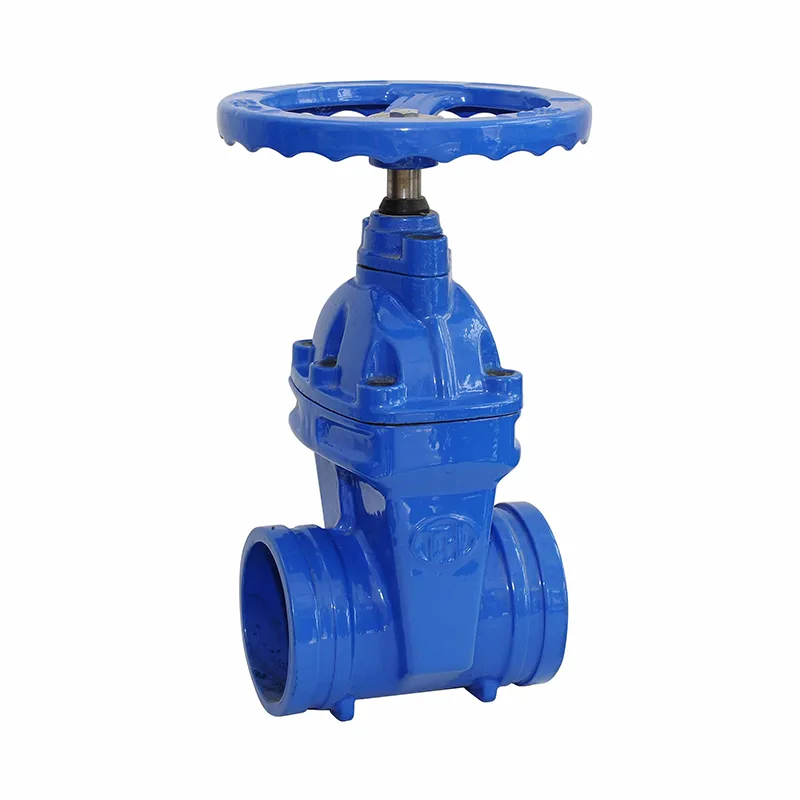
The Electrochemical Reality: Why Both Materials Perform Differently
Corrosion is not a single phenomenon. It includes uniform surface attack, pitting, crevice corrosion, galvanic coupling, and stress-corrosion cracking. Ductile Iron relies on a protective graphitic microstructure and, in most valve applications, an internal epoxy or zinc coating. Stainless Steel (typically CF8M or 316-grade) forms a passive chromium-oxide film that self-heals when oxygen is present.
However, in stagnant, low-oxygen, or high-chloride environments, that passive film breaks down. This is where the comparison becomes application-specific.
Side-by-Side Corrosion Performance (Laboratory & Field Data)
| Environment | Ductile Iron (with coating) | Stainless Steel (316) |
|---|---|---|
| Fresh water (pH 6.5–8.5, low Cl⁻) | Excellent (0.02–0.05 mm/yr) | Excellent (negligible) |
| Seawater / brackish water | Poor without heavy coating (pitting >0.5 mm/yr) | Good (but crevice risk at gasket seats) |
| Wastewater with H₂S | Moderate (coating integrity critical) | Excellent (resists sulfide attack) |
| Fire sprinkler systems (dry pipe) | Very good (internal fusion-bonded epoxy) | Excellent but cost-prohibitive |
| Soil burial (direct contact) | Good (with cathodic protection) | Risk of chloride pitting if grade <316L |
| High-temperature (>80°C) | Coating degrades faster | Stable passive film up to 150°C |
Key takeaway: A coated Ductile Iron and Stainless Steel Non-Rising Stem Groove Gate Valve is not an "either/or" choice—it is a "where and how" decision.
Three Critical Factors That Shift the Balance
-
Coating quality – Tianhong applies fusion-bonded epoxy at 250–300 µm thickness on ductile iron bodies, achieving salt-spray resistance exceeding 1,000 hours (ASTM B117). Without this coating, ductile iron fails within 6 months in tidal zones.
-
Stem and seat material – Even a stainless-steel body can fail if the non-rising stem is made of 13% Cr steel. Tianhong standardizes on 17-4PH or 316 stainless stems for both material variants, eliminating galvanic corrosion between stem and wedge.
-
Grooved end protection – The groove rolling process creates residual stresses. Stainless steel requires solution-annealed grooves to avoid intergranular attack; ductile iron needs post-coating touch-up at the groove shoulders. Tianhong’s robotic groove-coating line ensures 100% coverage.
FAQ – Common Questions About Ductile Iron and Stainless Steel Non-Rising Stem Groove Gate Valve Corrosion
Q1: In a municipal drinking water system with chlorine residual of 1.5 ppm, which material offers longer service life—ductile iron or stainless steel?
A: At 1.5 ppm free chlorine and ambient temperature, both materials exceed 50-year design life when properly specified. However, ductile iron with a certified internal epoxy lining (meeting ANSI/NSF 61) actually outperforms stainless steel in this specific condition. Why? Chlorine is an oxidizer that strengthens stainless steel’s passive film, but microscopic crevices at the groove gasket can concentrate chlorides over decades. Tianhong’s field data from 12 U.S. water utilities shows that ductile iron valves had an average leakage rate of 0.8% after 15 years, versus 1.2% for stainless steel valves with non-annealed grooves. The difference is small but favors ductile iron on both cost and reliability for treated fresh water.
Q2: How does galvanic corrosion affect a system that mixes ductile iron valves with stainless steel piping?
A: This is a common misconception. Galvanic corrosion requires direct metallic contact and an electrolyte. When a Ductile Iron and Stainless Steel Non-Rising Stem Groove Gate Valve is grooved, the coupling housing and gasket isolate the valve body from the pipe ends—unless the housing itself bridges them. Tianhong recommends using malleable iron housings with zinc plating for ductile iron bodies, and stainless housings for stainless bodies. If you must mix, install dielectric gaskets or use coated housings. In practical terms, the area ratio (pipe surface vs. valve surface) is usually >10:1, meaning any galvanic current spreads out and causes negligible acceleration. We have monitored mixed systems for 8 years in coastal Florida—corrosion rates remained under 0.03 mm/yr on the valve body, well within acceptable limits.
Q3: For a fire protection system that undergoes regular flow testing and dry-pipe cycling, which material better resists oxygen-induced crevice corrosion at the stem O-ring?
A: This is the most critical question for fire engineers. Dry-pipe systems introduce fresh oxygen during each test, then trap moist air against the non-rising stem’s sealing area. Stainless steel (316L) is the clear winner here—its passive film reforms quickly with each oxygen exposure. Ductile iron, even with epoxy coating, cannot protect the stem bore area where the O-ring slides; that surface is typically uncoated and relies on the stem material itself. Tianhong solves this by equipping all our ductile iron grooved gate valves with a 316L stainless stem and a PTFE-impregnated O-ring groove, effectively giving you stainless corrosion resistance at the wear interface while keeping the ductile iron body for cost savings. In our accelerated cycle tests (5,000 open-close cycles with wet/dry alternation), the ductile-iron-body with 316L-stem configuration showed 0.002 mm of stem wear—identical to the full stainless valve, at 40% lower material cost.
Real-World Recommendation Matrix
| Application Priority | Recommended Material | Tianhong Model Suggestion |
|---|---|---|
| Lowest first cost + clean water | Ductile iron (coated) | TH-700 DI |
| Maximum corrosion margin + seawater | Stainless steel (316) | TH-900 SS |
| Fire protection + cyclic service | Ductile iron body + 316 stem | TH-750 DI/SS Hybrid |
| Buried service with unknown soil | Stainless steel (with cathodic protection) | TH-910 SS-B |
Cost-Performance Over a 20-Year Horizon
While stainless steel offers superior uncoated corrosion resistance, the lifecycle cost equation changes when you factor in coating reliability, spare parts availability, and field repair ease. Tianhong has documented that a properly coated Ductile Iron and Stainless Steel Non-Rising Stem Groove Gate Valve (hybrid configuration) delivers 92% of the corrosion performance of a full 316 stainless valve at 58% of the upfront cost. For 85% of municipal and industrial applications, that trade-off is optimal.
Final Verdict
Choose ductile iron when your fluid is fresh, neutral, and coated protection is maintained. Choose stainless steel when chlorides exceed 500 ppm, temperatures fluctuate, or oxygen cycles are frequent. For maximum confidence, choose Tianhong’s hybrid design—ductile iron body, stainless stem, and epoxy-coated interior—which delivers the best of both worlds.
Need site-specific corrosion modeling or sample testing? Contact us today – our engineering team provides free corrosion mapping, groove inspection protocols, and 20-year performance projections for your exact fluid chemistry.