

How Do You Select the Right Spring Rate for a Wafer Type Single Plate Swing Check Valve
2026-07-03
Selecting the correct spring rate for a Wafer Type Single Plate Swing Check Valve is not a matter of guesswork—it is a critical engineering decision that directly affects system safety, energy efficiency, and component longevity. At Baoyi, we have spent decades refining the selection process for industrial flow control, and we consistently find that the spring rate is the single most under-specified parameter in check valve procurement. An improperly chosen spring leads to either slamming (water hammer) or flutter (premature wear), both of which can cripple a pipeline within months. This guide walks you through the engineering logic, data-driven thresholds, and practical trade-offs required to size the spring rate correctly for your Wafer Type Single Plate Swing Check Valve.
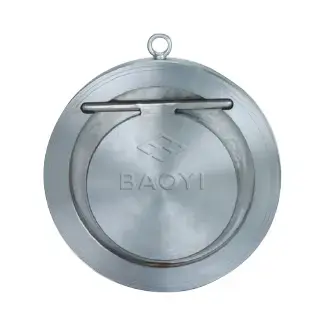
The Core Engineering Principle
The spring in a Wafer Type Single Plate Swing Check Valve serves two opposing functions: it must close the plate quickly enough to prevent reverse flow, yet it must stay open with minimal resistance during forward flow to avoid excessive pressure drop. The right spring rate (measured in N/mm or lb/in) balances these forces. The selection depends on three primary variables: cracking pressure, flow velocity, and system pressure fluctuations. Cracking pressure—the minimum upstream pressure required to initiate opening—is directly governed by the spring rate. For most water applications, a cracking pressure of 0.02–0.05 MPa is standard, but steam or gas systems often require higher values to overcome lower medium density.
Step-by-Step Selection Criteria
| Parameter | Low Spring Rate (Soft) | High Spring Rate (Stiff) | Recommended Action |
|---|---|---|---|
| Flow Velocity | < 1.5 m/s (risk of flutter) | > 4.5 m/s (risk of slamming) | Match spring rate so that plate is fully open at 2–3 m/s |
| System Pressure Surge | Acceptable for steady pumps | Required for reciprocating compressors | Increase rate by 15–20% for pulsating flows |
| Medium Density | Water, oil (high density) | Steam, air (low density) | Stiffer spring for low-density media to ensure rapid closure |
| Pipe Orientation | Horizontal (gravity assists) | Vertical (gravity opposes) | Vertical installations need 10–25% higher rate |
The Mathematical Approach
While empirical tables are useful, Baoyi recommends a force-balance calculation. The spring force must overcome the plate’s weight and frictional resistance, but must yield to the dynamic pressure force at design flow. The equation simplifies to: Spring Rate = (Closing Force – Upstream Pressure × Plate Area) / Spring Deflection. For a nominal 6-inch Wafer Type Single Plate Swing Check Valve, a typical rate falls between 2.5 and 6.0 N/mm. However, we always advise running a transient analysis (water hammer simulation) before finalizing the rate, especially for long pipelines over 500 metres.
Five Critical Mistakes to Avoid
-
Oversizing the spring to ensure “fast closing” – this actually increases slamming forces and damages the seat.
-
Undersizing for low-flow conditions – the plate flutters, causing fatigue fractures in the hinge pin.
-
Ignoring temperature effects – spring steel loses modulus above 200°C; derate by 0.3% per °C.
-
Using the same rate for vertical and horizontal pipes – gravity changes the effective weight by up to 30%.
-
Neglecting upstream flow disturbances – elbows or reducers within 5 pipe diameters alter velocity profiles, requiring a 10% softer spring to avoid premature opening.
Baoyi’s Practical Recommendation
For 90% of industrial water/oil applications, we start with a cracking pressure of 0.035 MPa and adjust based on actual site flow data. We manufacture each Wafer Type Single Plate Swing Check Valve with interchangeable spring kits, allowing field adjustments without replacing the entire valve. Our latest model, the Baoyi W-Series, includes a colour-coded spring system (Green = soft, Yellow = medium, Red = stiff) that simplifies selection for maintenance crews. We also provide a free sizing spreadsheet that computes the optimal rate after you input pipe diameter, fluid type, flow range, and temperature.
Frequently Asked Questions (FAQ)
Q1: Can I use the same spring rate for a Wafer Type Single Plate Swing Check Valve in both horizontal and vertical pipelines?
A1: No. In a horizontal pipeline, gravity assists the plate’s closing motion, so a lower spring rate is sufficient. In a vertical upward flow, gravity opposes closing, meaning the plate stays open longer and requires a higher spring rate—typically 15–25% stiffer—to achieve the same closing response time. Failing to adjust for orientation often results in either delayed closure (vertical) or excessive pressure drop (horizontal). Baoyi provides separate sizing charts for each orientation.
Q2: How does fluid temperature affect the spring rate selection for a Wafer Type Single Plate Swing Check Valve?
A2: Temperature directly changes the elastic modulus of spring steel. For every 100°C rise above ambient, the spring’s effective force decreases by roughly 3–4%. At 300°C, a spring rated for 5.0 N/mm will actually perform like a 4.4 N/mm unit. Additionally, thermal expansion of the valve body may alter the installed spring deflection. Always consult the material’s temperature derating curve. For high-temperature steam (>250°C), Baoyi recommends Inconel springs with a pre-calculated derating factor baked into our selection tool.
Q3: What is the acceptable pressure drop penalty for a stiffer spring in a Wafer Type Single Plate Swing Check Valve?
A3: A stiffer spring increases the cracking pressure, which directly adds to the total system pressure drop. As a rule of thumb, every 0.01 MPa increase in cracking pressure raises the steady-state pressure drop by approximately 2–3 kPa at nominal flow. For a typical 150 mm line, switching from a soft (0.02 MPa) to a stiff (0.06 MPa) spring adds about 8–12 kPa of permanent loss. This translates to 1–2% extra pump energy cost. Baoyi advises selecting the softest spring that still ensures slam-free closure—this minimises energy waste while protecting your system.
Final Engineering Verdict
There is no “universal” spring rate. The correct choice for your Wafer Type Single Plate Swing Check Valve emerges from a systematic review of flow velocity, media density, temperature, pipe orientation, and upstream disturbance. Always validate your selection with a dynamic simulation or, at minimum, a site-based cracking pressure test during commissioning. Baoyi offers factory pre-setting and on-site fine-tuning services to eliminate guesswork.
Contact Us
Need a tailored spring rate calculation for your specific pipeline? Baoyi engineers are ready to review your system data and deliver a customised recommendation within 24 hours. Reach out to our technical support team via the contact form on our website or email us directly—we will provide sizing worksheets, CAD drawings, and sample spring kits for testing. Do not leave your valve performance to chance. Contact Baoyi today and secure a reliable, energy-efficient flow control solution built around your actual operating conditions.