

How Do Operating Pressure and Temperature Affect Three Way Ball Valve Selection?
2026-11-17
A chemical plant engineer specifies a Three Way Ball Valves for a mixing and diversion duty at 25 bar and 120 degrees C. The valve is ordered with a standard PTFE seat, which is rated for 40 bar at ambient temperature. The valve passes the initial pressure test, but after three weeks of service the seat shows cold flow and the valve begins to bypass. The pressure and temperature were within the individual limits on the datasheet, but they were not within the combined limit for the seat material. This is the core problem in three way ball valve selection: pressure and temperature cannot be read as two independent numbers. They must be evaluated together against the seat material, the body rating, the ball port design, and the actuator torque. This guide explains how our engineering team evaluates the combined duty and what the buyer should verify before release.
1. Why Do Pressure and Temperature Change the Valve Body and Seat Choice Together?
The valve body and the seat are two different materials with two different failure modes. The body is a metal pressure boundary, and its rating is based on the material yield strength at the operating temperature. Carbon steel, stainless steel 316, and duplex stainless steel each have a different pressure temperature curve, and the allowable pressure drops as the temperature rises. The seat is a polymer or a metal sealing element, and its rating is based on the material softening point, the compression set, and the extrusion resistance. PTFE softens above 180 degrees C, and its extrusion resistance drops as the temperature rises. A valve that is rated for 40 bar at 20 degrees C may be limited to 25 bar at 120 degrees C with a PTFE seat, even though the body can still carry 40 bar. In our factory, we publish a combined pressure and temperature curve for each body and seat combination, not a single pressure number. Wenzhou Joepai Valve Co., Ltd. has been manufacturing Three Way Ball Valves for over 15 years.
The combined limit is the lower of the body limit and the seat limit at the operating temperature. A buyer who compares valves by the body pressure class alone will often select a valve that the seat cannot support at the process temperature. The correct comparison is the combined curve, and the correct specification is the maximum operating pressure at the maximum operating temperature, not the ambient pressure class.
2. How Does Pressure Rating Determine Port Configuration and Ball Design?
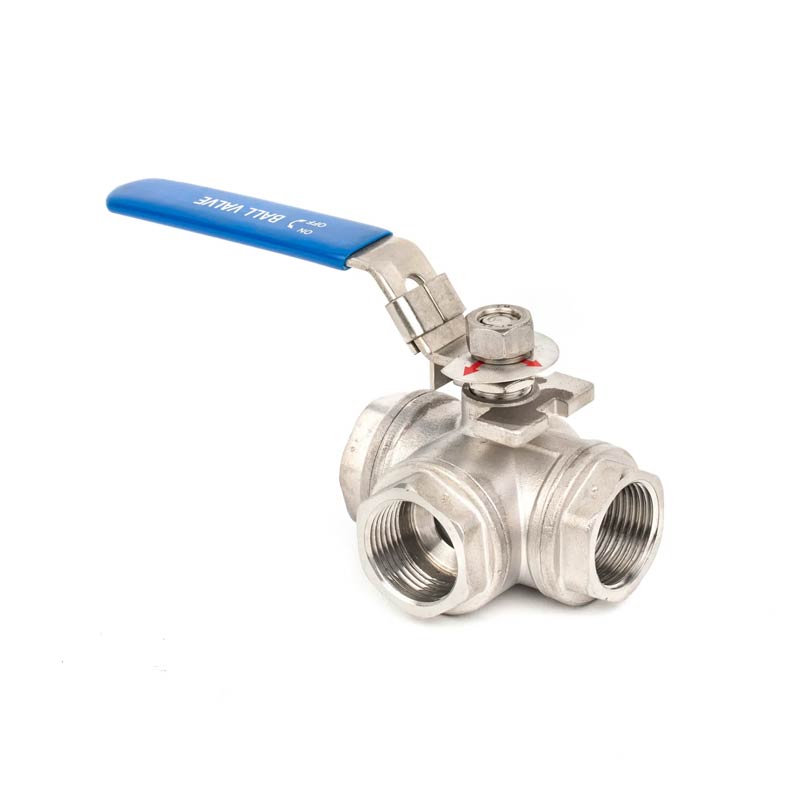
The port configuration of a Three Way Ball Valves determines the flow path and the pressure drop. An L port valve connects one inlet to one outlet and closes the third port, which is used for diversion. A T port valve connects one inlet to two outlets, or two inlets to one outlet, and is used for mixing or splitting. The pressure rating affects the ball and the seat support because the ball is subjected to a pressure load that tries to push it into the seat. At higher pressure, the seat must be supported by a metal backup ring, and the ball must be guided by a trunnion rather than by the seat alone. A floating ball design is suitable for smaller sizes and lower pressure, while a trunnion mounted design is required for larger sizes and higher pressure. The table below shows the port and ball design recommendation against the pressure level.
| Pressure level | Port configuration | Ball support | Seat support |
| Up to 16 bar | L port or T port | Floating ball | Soft seat with standard groove |
| 16 to 40 bar | L port or T port | Floating ball or trunnion | Soft seat with backup ring |
| 40 to 63 bar | L port or T port | Trunnion mounted | Reinforced seat or PEEK seat |
| Above 63 bar | L port or T port with metal seat | Trunnion mounted | Metal seat with lapped ball |
In our factory, the port configuration is selected from the process flow diagram, not from the pressure alone. The pressure then determines whether the ball can float or must be trunnion mounted, and whether the seat needs a backup ring. Our application engineers review the flow diagram and the pressure and temperature data before recommending the valve. A Three Way Ball Valves that is selected for the wrong port configuration will not perform the mixing or diversion function even if the pressure rating is correct.
3. What Happens to Sealing Performance When Temperature Moves Outside the Soft Seat Window?
The soft seat is the most temperature sensitive component in a Three Way Ball Valves. PTFE is the standard seat material for chemical and water service because it is chemically inert and has a low friction coefficient. Its continuous service limit is about 180 degrees C, and its pressure limit drops as the temperature approaches that limit. Reinforced PTFE extends the limit to about 200 degrees C, and PEEK extends it to about 250 degrees C. Above 250 degrees C, a metal seat is required, but a metal seat does not provide the same tight shutoff as a soft seat. The table below shows the seat material limits and the leakage class that can be expected.
| Seat material | Temperature range | Pressure limit at maximum temperature | Typical leakage class |
| PTFE | -29 to 180 degrees C | 16 to 25 bar | ANSI Class VI |
| Reinforced PTFE | -29 to 200 degrees C | 25 to 40 bar | ANSI Class VI |
| PEEK | -29 to 250 degrees C | 40 to 63 bar | ANSI Class V |
| Metal seat | -29 to 350 degrees C | 63 to 100 bar | ANSI Class IV |
Application engineer's note: The leakage class is part of the selection, not an afterthought. A metal seat valve that is selected for a high temperature duty will not provide the bubble tight shutoff of a soft seat valve, and the buyer may need to add a secondary isolation valve or accept a small bypass. In our factory, we ask for the acceptable leakage rate before recommending the seat material, because the temperature limit and the leakage requirement often conflict. Wenzhou Joepai Valve Co., Ltd. provides the seat material certificate and the leakage test result with each valve.
4. Why Do Actuator Torque and Flow Path Need to Be Recalculated at the Operating Conditions?
The actuator torque is not a constant. It increases with pressure because the seat friction increases, and it increases with temperature because the seat material softens and the ball and seat expand at different rates. A valve that requires 40 newton meters at ambient pressure may require 70 newton meters at the operating pressure and temperature. If the actuator is sized from the ambient torque, it will stall or it will move too slowly, and the valve will not complete the stroke. The flow path also changes with the port configuration and the pressure drop. An L port valve has a different pressure drop from a T port valve at the same flow rate, and the difference affects the pump duty and the control loop. In our factory, we calculate the actuator torque at the maximum pressure and temperature, and we add a safety factor of 1.5. We also calculate the pressure drop for the selected port configuration at the design flow rate. Joepai includes the torque calculation and the flow coefficient in the quotation so that the buyer can verify the actuator and the pump duty.
The torque calculation must also consider the flow direction. A three way valve can be used in a diverting mode or in a mixing mode, and the pressure acts on different parts of the ball in each mode. The torque in the mixing mode is often higher than the torque in the diverting mode because the pressure acts on two ports at the same time. Our application engineers confirm the mode before the actuator is selected, and they mark the mode on the valve tag.
5. How Should Buyers Specify and Verify a Three Way Ball Valve for Combined Pressure and Temperature Duty?
The specification should include the maximum operating pressure, the maximum operating temperature, the minimum operating temperature, the medium, the port configuration, the flow direction, the acceptable leakage class, and the actuator supply. The buyer should also request the combined pressure and temperature curve, the seat material certificate, the torque calculation at the operating conditions, and the flow coefficient. The verification should include a shell test at 1.5 times the design pressure, a seat test at 1.1 times the design pressure, and a functional test of the actuator at the design torque. In our factory, we perform these tests on every valve and provide the test record with the shipment. We also keep a retained sample of the seat material for each lot so that a leakage question can be traced to the material batch. A buyer who evaluates a Three Way Ball Valves only by the body pressure class will miss the seat limit, the torque limit, and the leakage class, and will often receive a valve that passes the factory test but fails in service.
Frequently Asked Questions About Pressure and Temperature in Three Way Ball Valve Selection
Operating pressure and temperature affect three way ball valve selection through the body rating, the seat material limit, the ball support, the actuator torque, and the leakage class. The correct selection is based on the combined pressure and temperature curve, not on the ambient pressure class. The buyer should specify the maximum pressure and temperature together, confirm the port configuration and flow direction, request the torque calculation at the operating conditions, and verify the leakage class. When these factors are evaluated together, the Three Way Ball Valves performs the mixing or diversion function without seat cold flow, actuator stall, or unexpected bypass.