

How Do Butterfly Valves Support Variable Flow Control in Pumped Storage Power Plants?
2026-10-26
A pumped storage plant operates the same hydraulic machine as a turbine during the day and as a pump at night. The water in the penstock reverses direction twice a day. The valve that controls this flow must seal in both directions, modulate the flow during load changes, and close quickly enough to protect the machine without generating a water hammer that damages the tunnel. The Butterfly Valve is the component that performs this function in most modern pumped storage plants. It is compact, fast-acting, and capable of bidirectional sealing when correctly specified. This guide explains how the butterfly valve supports variable flow control in pumped storage and how plant engineers should specify and verify it.
1. Why Does a Pumped Storage Plant Need Variable Flow Control at All?
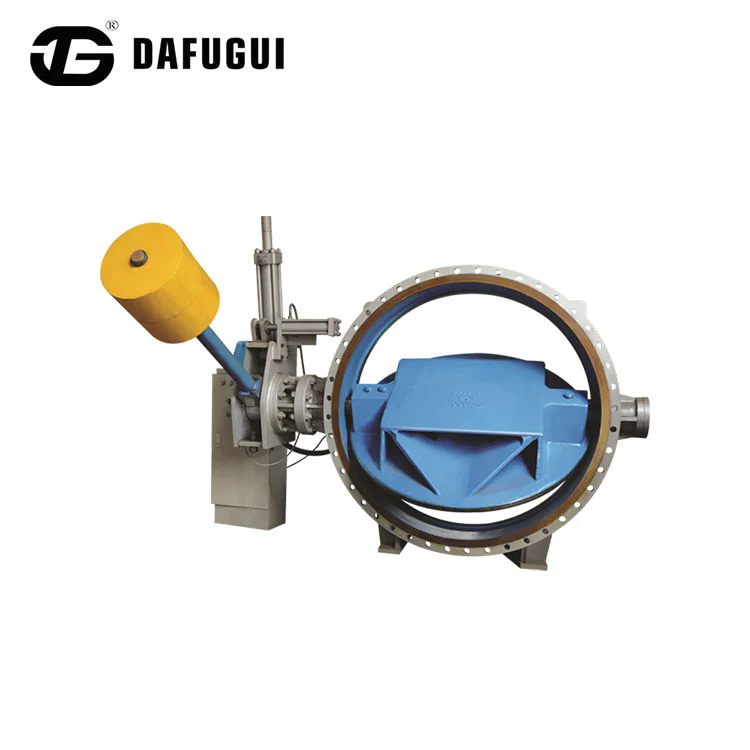
A pumped storage plant does not operate at a constant flow. The plant must start and stop the generating unit several times per day to follow the grid load. Each start and stop requires the flow to be increased or decreased gradually to avoid pressure surges. When the plant switches from generating to pumping, the flow must be stopped, the machine must be dewatered and reconfigured, and the flow must be restarted in the opposite direction. The Butterfly Valve provides the flow modulation during these transitions. In our factory, we manufacture Butterfly Valve units for high-head applications with bidirectional sealing and fast hydraulic actuators. Dafugui Pipe Valve Co., Ltd. has been manufacturing butterfly valves for over 15 years.
The variable flow control is also required for part-load operation. A pumped storage unit may be asked to generate at 60 or 80 percent of its rated output. The valve must modulate the flow to match the load without causing cavitation or vibration. A valve that only operates fully open or fully closed cannot provide this modulation, so the plant would lose its ability to follow the load.
2. How Does a Butterfly Valve Deliver Fast and Precise Flow Modulation in Both Directions?
The Butterfly Valve modulates flow by rotating a circular disc inside the pipe. The flow area is proportional to the angle of the disc. At 0 degrees, the disc is closed and the flow is zero. At 90 degrees, the disc is parallel to the flow and the flow is maximum. The relationship between the disc angle and the flow coefficient is not linear, which is why the actuator must be controlled by a positioner with a characterized cam. The table below shows the flow coefficient and the pressure drop at different disc angles for a 1,200 mm butterfly valve.
| Disc angle | Flow coefficient (Cv) | Pressure drop (% of fully open) | Typical operating condition |
| 0° (closed) | 0 | 100% | Shutdown |
| 20° | 18% of maximum | 85% | Start-up modulation |
| 45° | 48% of maximum | 45% | Part-load generation |
| 70° | 78% of maximum | 18% | Near full load |
| 90° (open) | 100% | 0% | Full load or pumping |
The bidirectional sealing is achieved by a double-offset or triple-offset disc design. In a double-offset design, the disc rotates around an axis that is offset from both the seat and the pipe centerline. This causes the disc to lift away from the seat before it rotates, which eliminates the rubbing that would damage the seat in a conventional design. In a triple-offset design, the seat is also inclined at an angle, which provides a metal-to-metal seal that is suitable for high pressure and high temperature. In our factory, we manufacture both double-offset and triple-offset Butterfly Valve units for pumped storage service.
3. What Role Does the Butterfly Valve Play During Pump-to-Turbine Mode Switching?
The mode switching sequence is the most critical operation in a pumped storage plant. The sequence has four steps. In the first step, the unit is stopped and the Butterfly Valve is closed. In the second step, the machine is dewatered by closing the inlet valve and opening the drain valve. In the third step, the machine is reconfigured from turbine mode to pump mode. In the fourth step, the inlet valve is opened and the Butterfly Valve is opened gradually to start the flow in the reverse direction. The valve must seal tightly during the dewatering step, and it must open smoothly during the restart. The table below shows the valve action sequence and the sealing requirement for each step.
| Step | Butterfly Valve action | Sealing requirement | Typical duration |
| Unit stop | Close from 90° to 0° | Bidirectional, zero leakage | 60 – 120 seconds |
| Dewatering | Hold closed | Zero leakage (to allow dewatering) | 10 – 20 minutes |
| Reconfiguration | Hold closed | Zero leakage | 5 – 10 minutes |
| Restart in reverse | Open from 0° to 90° gradually | Controlled opening, no water hammer | 120 – 180 seconds |
Plant engineer's note: The sealing requirement during dewatering is the most demanding. If the Butterfly Valve leaks even a small amount, the dewatering pump cannot keep up, and the machine cannot be reconfigured. In our factory, we test the bidirectional seal of every pumped storage butterfly valve at 1.5 times the design pressure. The leakage must be zero for a metal-seated valve and below the specification for a soft-seated valve. Dafugui Pipe Valve Co., Ltd. provides the seat leakage test report with each valve.
4. Why Does Cavitation and Water Hammer Make Valve Selection Critical in Pumped Storage?
Pumped storage plants operate at high heads, often 300 to 700 meters. The water in the penstock has a large amount of kinetic energy. When the Butterfly Valve closes quickly, the kinetic energy is converted into a pressure wave that travels up the penstock. This is the water hammer effect. The pressure wave can exceed the static pressure by 50 to 100 percent, which can rupture the penstock or damage the valve. The closing time must be long enough to limit the pressure rise, but short enough to protect the machine from overspeed. The cavitation occurs when the pressure downstream of the valve drops below the vapor pressure of the water. The vapor bubbles collapse and erode the valve seat and the downstream pipe. The table below shows the relationship between closing time, water hammer pressure, and cavitation risk.
| Closing time | Water hammer pressure rise | Cavitation risk | Recommended application |
| < 30 seconds | > 80% of static head | High | Not recommended |
| 30 – 60 seconds | 40 – 80% of static head | Moderate | Only with surge tank |
| 60 – 120 seconds | 20 – 40% of static head | Low | Standard pumped storage |
| > 120 seconds | < 20% of static head | Very low | High-head plants |
In our factory, we design the Butterfly Valve with a profiled disc and a streamlined seat to reduce the cavitation risk. We also provide the closing time calculation based on the penstock characteristics and the machine inertia. Dafugui Pipe Valve Co., Ltd. works with the plant designer to select the actuator and the closing profile that minimize both water hammer and cavitation.
5. How Should Plant Engineers Specify and Verify a Butterfly Valve for Pumped Storage Service?
The specification of a Butterfly Valve for pumped storage must include six parameters. The first is the nominal diameter, which is typically 800 to 2,500 mm. The second is the pressure rating, which must account for the static head plus the water hammer rise. The third is the bidirectional sealing requirement, including the allowable leakage rate. The fourth is the actuator type and the closing time. The fifth is the cavitation allowance, which determines the disc profile and the material. The sixth is the anti-corrosion coating, because the water may be raw river water or seawater in coastal plants. The verification should include a hydrostatic test, a bidirectional seat leakage test, a cavitation test, and an operating time test. In our factory, we perform all four tests before shipment and provide the test report with the valve.
We also recommend that the plant engineer verify the valve performance during the first year of operation. The seat leakage should be measured at each maintenance interval. If the leakage increases, the seat may need to be replaced. The actuator should be checked for smooth operation and accurate position feedback. Dafugui Pipe Valve Co., Ltd. provides a maintenance manual and a spare parts list with each valve. Our factory also offers on-site commissioning support for large pumped storage projects.
Frequently Asked Questions About Butterfly Valves in Pumped Storage Power Plants
Summary for Plant Engineers and Designers
The Butterfly Valve supports variable flow control in pumped storage power plants by providing fast and precise flow modulation in both directions. It plays a critical role during the pump-to-turbine mode switching, where tight bidirectional sealing is required to allow dewatering and reconfiguration. The valve design must address the risks of water hammer and cavitation, which are significant in high-head plants. The specification should include the diameter, pressure rating, bidirectional sealing requirement, actuator type and closing time, cavitation allowance, and anti-corrosion coating. The verification should include hydrostatic, seat leakage, cavitation, and operating time tests. Dafugui Pipe Valve Co., Ltd. has been manufacturing Butterfly Valve units for over 15 years and provides full specification and verification support for pumped storage projects.