

In pharmaceutical manufacturing, handling Highly Potent Active Pharmaceutical Ingredients (HPAPIs) requires exceptional control over dust emissions, operator exposure, and cross-contamination. Even a small amount of residual powder can affect product quality, compromise workplace safety, and increase cleaning costs. Traditional powder transfer methods may expose materials to the surrounding environment during equipment connection and disconnection. A Split Butterfly Valve provides a more controlled solution by enabling contained powder transfer between processing equipment while minimizing material exposure. For pharmaceutical manufacturers seeking safer and more reliable powder handling, this technology plays an important role in modern containment systems.
1. Why Is Dust Containment Critical in HPAPI Powder Transfer?
HPAPIs are widely used in the production of specialized pharmaceutical products. Due to their high potency, even trace quantities of airborne particles may present risks to operators and other products manufactured in the same facility.
Dust generation and cross-contamination commonly occur during material charging, discharging, equipment connection, and container replacement. These processes can create opportunities for powder leakage and unwanted environmental exposure.
Effective containment is therefore essential for three key reasons:
- Operator Protection: Minimizing exposure to potentially hazardous pharmaceutical powders during routine handling operations.
- Product Quality: Preventing residual particles from contaminating subsequent production batches.
- Regulatory Compliance: Supporting controlled manufacturing environments and contamination prevention procedures.
2. How Does a Split Butterfly Valve Work?
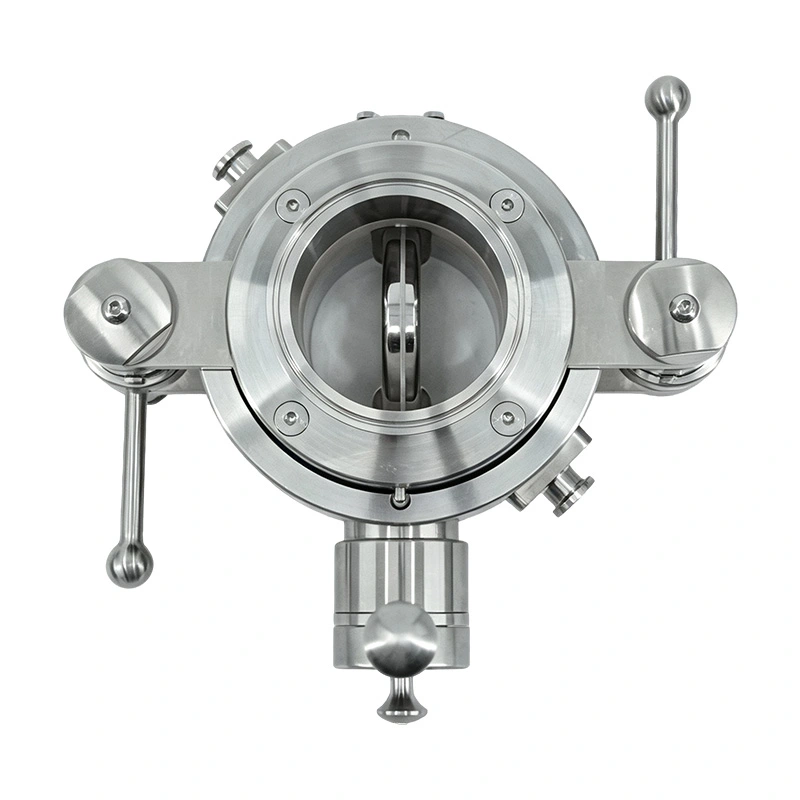
A Split Butterfly Valve is designed to connect two pieces of processing equipment while maintaining a contained transfer pathway. Unlike conventional butterfly valves, its structure consists of two separate halves: an active half and a passive half.
When the two valve halves are connected, their internal discs operate together to create an integrated opening for powder transfer. After the transfer process, both discs close before the two halves are disconnected. This arrangement helps retain residual powder within the valve assemblies and reduces direct exposure to the surrounding environment.
The basic operating process includes:
- Connection: The active and passive valve halves are securely docked together.
- Opening: The connected discs rotate to establish a contained transfer passage.
- Powder Transfer: Materials move between connected equipment through the controlled opening.
- Closing: Both discs return to their closed positions, containing residual powder.
- Disconnection: The two valve halves are separated while maintaining containment.
3. Key Benefits of Split Butterfly Valves in HPAPI Applications
3.1 Effective Dust Leakage Control
One of the main advantages of a Split Butterfly Valve is its ability to reduce powder release during equipment connection and disconnection. Its docking structure creates a contained interface, helping prevent airborne particles from escaping into the production environment. This is particularly valuable when transferring highly potent or fine pharmaceutical powders.
3.2 Reduced Cross-Contamination Risks
In multi-product pharmaceutical facilities, preventing contamination between different materials is a major production priority. By limiting contact between the transferred powder and the external environment, a Split Butterfly Valve helps reduce the possibility of unwanted material transfer. Proper cleaning procedures and validated containment processes further strengthen this protection.
3.3 Improved Operator Safety
Minimizing direct exposure during powder handling helps create a safer working environment. Operators can perform material transfer and equipment separation through a more controlled process, reducing dependence on open manual handling operations.
3.4 Better Production Efficiency
Split butterfly valve technology can simplify material transfer between reactors, isolators, intermediate bulk containers (IBCs), and other process equipment. Its controlled docking and transfer mechanism supports more standardized production procedures, potentially reducing cleaning interruptions and material handling losses.
4. Split Butterfly Valve vs. Conventional Powder Transfer Methods
Different powder transfer methods offer different levels of containment. The following comparison highlights why split butterfly valve technology is suitable for demanding pharmaceutical applications.
| Comparison | Conventional Open Transfer | Split Butterfly Valve |
|---|---|---|
| Dust Exposure | Higher potential exposure | Designed to minimize exposure |
| Cross-Contamination | Greater risk during handling | Reduced risk through contained transfer |
| Equipment Connection | May require open handling | Controlled docking mechanism |
| Operator Protection | Depends heavily on additional controls | Supports containment strategies |
| Cleaning Requirements | May involve extensive external cleaning | Can simplify contamination control procedures |
5. Important Considerations When Selecting a Split Butterfly Valve
Choosing the right valve requires more than considering its basic opening and closing functions. Pharmaceutical manufacturers should evaluate the following factors:
- Containment Performance: Confirm that the valve meets the required containment level for the specific HPAPI application.
- Material Compatibility: Select suitable contact materials and sealing components according to powder characteristics and cleaning agents.
- Cleaning and Maintenance: Consider cleaning accessibility, residue retention, and maintenance requirements.
- System Integration: Ensure compatibility with existing reactors, isolators, IBCs, and powder handling equipment.
- Operational Reliability: Evaluate docking stability, sealing performance, operating cycles, and long-term durability.
It is also important to verify containment performance through appropriate testing and validation. A valve should be evaluated as part of the complete powder handling system rather than as an isolated component.
6. AVM: Supporting Intelligent Equipment Solutions for Controlled Processing
AVM Extraordinary Intelligent Control Equipment Co., Ltd. focuses on intelligent control equipment and industrial process applications. In pharmaceutical powder handling, equipment selection should prioritize operational reliability, controlled material transfer, and contamination prevention.
For manufacturers working with HPAPIs, integrating appropriate split butterfly valve solutions into powder transfer systems can help improve process containment, reduce dust exposure, and support consistent production operations. By considering equipment compatibility, process requirements, and long-term performance, manufacturers can build more controlled and efficient material handling workflows.
7. Conclusion: Building Safer and Cleaner HPAPI Production Processes
Dust control and cross-contamination prevention are essential to pharmaceutical manufacturing, particularly when handling highly potent powders. A properly selected and validated Split Butterfly Valve helps address these challenges through contained docking, controlled powder transfer, and reduced material exposure during equipment separation.
For pharmaceutical companies looking to upgrade their powder handling processes, investing in reliable containment equipment is an important step toward safer operations and improved production quality.
Looking for intelligent equipment solutions for pharmaceutical powder handling? Contact AVM Extraordinary Intelligent Control Equipment Co., Ltd. to discuss your application requirements and explore suitable equipment solutions for safer, cleaner, and more efficient powder transfer.