

Can You Weld or Repair a Cracked Stainless Steel 304 Flanged Globe Valve Body On-Site
2026-06-26
When a cracked body is discovered on a Stainless Steel 304 Flanged Globe Valve in the middle of a production run, the immediate instinct is often to grab a welding torch and fix it on the spot. Time is money, and replacing a large-bore valve can mean days of downtime. However, the answer is not a simple "yes" or "no." This guide provides a professional, engineer-level assessment of on-site repair viability, backed by metallurgical facts and safety standards, while introducing how Huadu approaches such critical failures in industrial flow control.
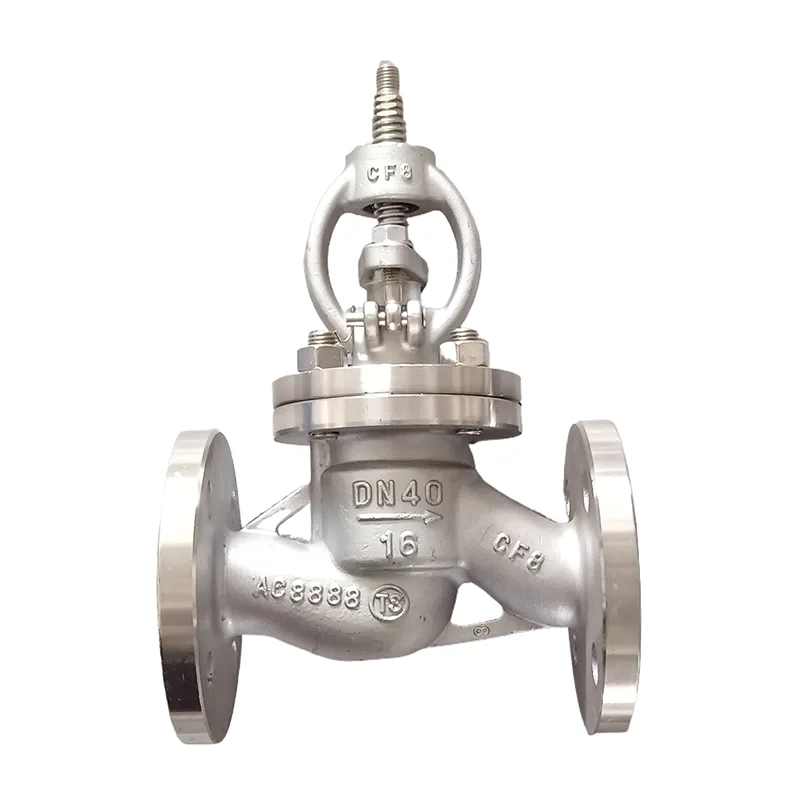
The Metallurgical Reality of 304 Stainless Steel
To understand repairability, we must first look at the material. Stainless Steel 304 Flanged Globe Valve bodies are cast from austenitic stainless steel. This grade is non-magnetic and gains its corrosion resistance from a thin chromium-oxide layer. However, it is also prone to sensitization—a phenomenon where chromium carbides precipitate at grain boundaries when the metal is heated between 800°F and 1500°F (427°C – 816°C).
On-site welding without post-weld heat treatment (PWHT) can actually create new cracks adjacent to the weld zone (heat-affected zone or HAZ) rather than sealing the original one. At Huadu, our field service protocols always begin with a risk matrix before any electrode touches the valve body.
Critical Assessment Criteria (Before You Strike an Arc)
| Assessment Factor | Criteria for "Repairable" | Criteria for "Replace" |
|---|---|---|
| Crack Location | Outer flange face or non-pressure-retaining bracket. | Bonnet joint, body-bonnet threads, or main pressure boundary wall. |
| Crack Length | Less than 10% of the nominal pipe size (NPS). | Exceeds 2 inches or propagates through the bore. |
| Wall Thickness | Remaining thickness > 80% of original schedule. | Severe wall loss due to pitting or erosion. |
| Service Medium | Water, air, or inert gases below 150°F. | Hydrocarbons, acids, or steam > 300°F. |
| Accessibility | 360° access for pre-heating and post-cooling. | Confined space or near flammable insulation. |
The Welding Procedure (If Approved)
If the assessment permits a repair, the process is strictly governed by ASME Section IX. For a Stainless Steel 304 Flanged Globe Valve, the correct approach involves:
-
Preparation: Grind out the crack to 100% removal using a dye-penetrant test to verify full extraction.
-
Electrode Selection: Use E308L-16 rods (low carbon to avoid intergranular corrosion).
-
Interpass Temperature: Strictly maintain below 350°F to prevent sensitization.
-
Post-Weld Cooling: Air cool slowly; never quench with water, as thermal shock will distort the flange face.
Critical Warning: On-site welding of the pressure-retaining shell voids the original factory hydro-test certification. Huadu recommends that any welded valve must be hydrostatically tested to 1.5x the working pressure on-site before reinstallation—a step often skipped in haste.
The Economics: Repair Cost vs. Replacement Cost
While a weld repair might cost $200–$500 in labor, the hidden costs are significant.
| Cost Factor | On-Site Weld Repair | New Replacement (Huadu Supply) |
|---|---|---|
| Direct Cost | $300–$800 (mobilization + NDT) | $450–$1,200 (depending on size) |
| Downtime | 6–12 hours (cooling + testing) | 2–4 hours (bolt-on replacement) |
| Risk of Failure | High (stress corrosion cracking later) | Zero (factory-certified) |
| Warranty | Voided (no manufacturer coverage) | Full 1-year operational warranty |
For critical steam or chemical lines, the long-term liability of a field-welded Stainless Steel 304 Flanged Globe Valve usually outweighs the upfront savings. Huadu consistently advises clients that flange-to-flange replacement is the safer, more cost-predictable strategy over a 5-year life cycle.
Professional Recommendation
Based on over 20 years of valve manufacturing and field data, Huadu classifies on-site welding as an emergency temporary measure, not a permanent solution. Acceptable cases are strictly limited to:
-
Non-pressure containing parts (e.g., mounting lugs, gear operator brackets).
-
Low-pressure water lines (below 150 PSI) with non-critical service.
-
Situations where a spare valve is not available and shutdown is impossible (with a mandatory replacement order placed immediately).
For all other scenarios, the cracked body is a signal of material fatigue or over-torquing. Installing a new Stainless Steel 304 Flanged Globe Valve from Huadu ensures you receive a virgin casting with full material traceability, radiography reports, and a bubble-tight shutoff.
Stainless Steel 304 Flanged Globe Valve FAQs
Q1: Can I use TIG (GTAW) welding to repair a crack on the flange face of my Stainless Steel 304 Flanged Globe Valve?
A: Yes, TIG welding with ER308L filler is actually the preferred method for flange face repairs because it offers superior control over heat input. However, you must grind the crack down to at least 1/8 inch below the surface and pre-heat the flange area to 200°F to remove moisture. After welding, the flange face must be re-machined to restore the gasket surface finish (Ra 3.2–6.3 µm). Crucially, you cannot weld over the bolt holes or within 1/2 inch of the bore edge, as this zone is subject to the highest hoop stress. If the crack penetrates the bolt circle, Huadu strongly recommends immediate replacement.
Q2: What non-destructive testing (NDT) methods are mandatory after welding a Stainless Steel 304 Flanged Globe Valve body?
A: At a minimum, you must perform three NDT steps. First, Dye Penetrant Testing (PT) to confirm that the crack is fully removed before welding. Second, Liquid Penetrant Testing again after grinding the weld cap smooth to ensure no surface porosity. Third, and most critically, a Hydrostatic Pressure Test at 1.5 times the maximum allowable working pressure (MAWP) for a duration of no less than 15 minutes. Do not rely on air testing alone, as air is compressible and will not reveal slow weepage through micro-fissures. For steam services, Huadu also mandates a Hardness Test (HRB) to ensure the HAZ hasn't exceeded 85 HRB, which indicates sensitization.
Q3: Will welding a cracked body void the ASME/API certification of my Stainless Steel 304 Flanged Globe Valve?
A: Absolutely. Any field welding performed outside of the original manufacturer's quality control system immediately voids the ASME B16.34 or API 600 certification. The valve is no longer considered a "code-stamped" component for pressure vessel compliance. Consequently, your insurance underwriter may refuse coverage for any incident involving that modified valve. If you proceed with welding, you must re-certify the valve via a third-party inspection agency, which often costs more than the valve itself. Huadu offers factory-replacement units with fresh certification tags, ensuring your plant remains fully compliant with OSHA and local boiler codes.
Final Verdict
The professional consensus is clear: while physically possible, welding a cracked body on a Stainless Steel 304 Flanged Globe Valve is seldom advisable for pressure-retaining integrity. The risks of sensitization, distortion, and certification loss make it a high-stakes gamble. Invest in a new, properly cast valve to guarantee safe, leak-free operation.
Contact Us – For expert consultation on emergency valve replacements or to source certified Stainless Steel 304 Flanged Globe Valve with rapid dispatch, reach out to the Huadu engineering support team today. We provide full dimensional inspection reports, material test certificates, and 24/7 technical support to keep your pipeline running safely.