

Can an L/T Port Three Way Flanged Ball Valve Be Used for Both Diversion and Mixing Without Modification
2026-06-22
This is one of the most frequently asked questions we receive from process engineers, procurement specialists, and plant maintenance managers. The short answer is no—but the full explanation requires a closer look at the internal geometry of the L/T Port Three Way Flanged Ball Valve. At JOEPAI, we have supplied thousands of these valves across oil & gas, chemical, and water treatment facilities, and we consistently see confusion around this very point. Understanding the distinction between diversion and mixing service is critical before you specify or install an L/T Port Three Way Flanged Ball Valve in your pipeline system.
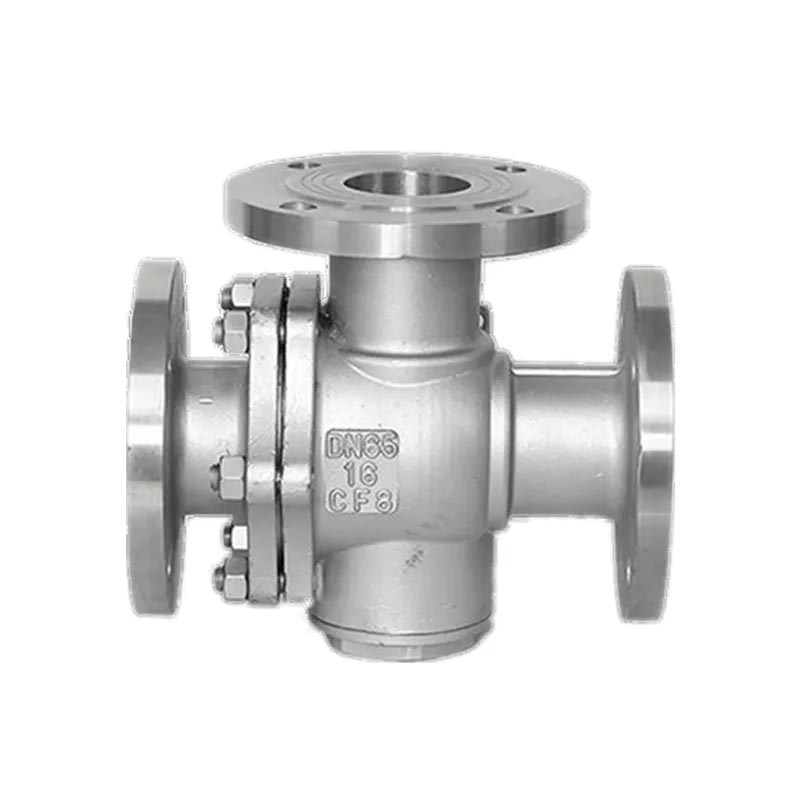
The Core Difference: L-Port vs. T-Port Geometry
The internal ball passage determines everything. While both designs share the same flanged end connections and three-way body configuration, their flow paths are fundamentally different.
| Feature | L-Port (L-Shaped Passage) | T-Port (T-Shaped Passage) |
|---|---|---|
| Flow Path Shape | 90° turn (two adjacent ports) | Straight-through with one branch (three ports interconnected) |
| Primary Function | Diversion – redirect flow from one inlet to one of two outlets | Mixing or Diverting – can combine two inlets into one outlet, or split one inlet into two outlets |
| Simultaneous Flow | No – only two ports are connected at any given rotation | Yes – all three ports can be interconnected at certain rotational positions |
| Typical Rotation Angles | 0°, 90°, 180° (only adjacent ports open) | 0°, 45°, 90° (progressive opening allows blending) |
| Standard Application | Shut-off and flow switching between two separate lines | Flow blending, temperature equalization, or pressure balancing |
Why Modification Is Required for Dual-Purpose Service
A standard L/T Port Three Way Flanged Ball Valve is manufactured with a fixed ball profile. If you order an L-port version, you receive a ball that physically cannot connect all three ports at once. Conversely, a T-port version allows three-way communication but suffers from poor shut-off characteristics on the branch port when used as a simple diverter.
To use one valve for both diversion and mixing without hardware modification, you would need:
-
A custom-profiled ball with variable port geometries (very expensive)
-
An external bypass loop with additional isolation valves (defeats the purpose)
-
A multi-turn actuator with position feedback to stop at intermediate angles (still does not change port connectivity)
At JOEPAI, we always advise clients to select the valve based on the primary duty and, if both functions are genuinely required, install two dedicated L/T Port Three Way Flanged Ball Valve units in parallel rather than attempting a single-valve compromise.
Real-World Performance Comparison
| Operating Scenario | L-Port Suitability | T-Port Suitability | Recommended Action |
|---|---|---|---|
| Diverting crude oil from line A to line B or C | Excellent (full shut-off) | Poor (leakage across branch) | Use L-port |
| Mixing hot and cold water to a target temperature | Not possible (only two ports open) | Excellent (proportional blending) | Use T-port |
| Alternating between mixing duty (day shift) and diverting duty (night shift) | Requires manual re-piping | Requires actuator reprogramming but ball still allows three-way flow | Not recommended – install two separate valves with isolation |
| Emergency shutdown with diversion capability | Good | Acceptable but higher seat wear | L-port preferred for safety integrity |
Frequently Asked Questions About L/T Port Three Way Flanged Ball Valve
FAQ 1: Can I convert an L-port valve to a T-port valve by changing the actuator?
**No. The actuator only rotates the ball; it does not alter the internal passage geometry. The ball itself has a fixed L-shaped or T-shaped bore that is machined during manufacturing. Changing the actuator will not open or close additional ports beyond what the ball physically allows. At JOEPAI, we have tested this misconception with dozens of customers—every attempt to "reprogram" an L-port into a T-port through rotation angles has failed because the metal passage simply does not exist inside the ball. You must order the correct ball configuration from the start.
FAQ 2: What happens if I use a T-port valve for diversion service without modification?
**You will experience significant seat leakage on the third port. In a T-port design, the ball cannot fully seal the branch port when the valve is positioned for straight-through flow because the T-shaped passage leaves a permanent opening to the third connection. This results in measurable bypass flow—often 1–3% of total capacity—which is unacceptable for custody transfer, safety isolation, or batch processing. Many plant operators have learned this the hard way. JOEPAI recommends a full-port L-design for any diversion application that requires bubble-tight shut-off per API 598.
FAQ 3: Is there a special "hybrid" ball design that does both diversion and mixing without modification?
**Yes, but only as a custom-engineered solution with significant cost and lead-time implications. A hybrid ball features an asymmetrical passage that can connect two ports in one rotation and three ports in another. However, these designs introduce higher torque requirements, reduced pressure ratings (often derated by 30%), and accelerated seat wear due to the non-standard port edges. JOEPAI has produced fewer than 50 such units in our entire history—each required 3D flow simulation, prototype testing, and customer sign-off on performance trade-offs. For 99% of industrial applications, we strongly advise against this approach. It is far more economical and reliable to install two standard L/T Port Three Way Flanged Ball Valve units with a simple manifold arrangement.
Best Practice Recommendation from JOEPAI
| Requirement | Recommended Solution | Why |
|---|---|---|
| Dedicated diversion | Single L-port L/T Port Three Way Flanged Ball Valve | Lowest cost, best shut-off, longest seat life |
| Dedicated mixing | Single T-port L/T Port Three Way Flanged Ball Valve | Optimal blending, stable control, easy actuation |
| Both functions needed (intermittent) | Two valves (one L, one T) with block-and-bleed isolation | Maintains integrity of each function; allows maintenance without plant shutdown |
| Both functions needed (continuous) | Two valves in parallel with automated switching | Redundancy and fail-safe operation; recommended by API and ISO standards |
Final Verdict
An L/T Port Three Way Flanged Ball Valve cannot perform both diversion and mixing duties without modification—unless you accept severe performance compromises or invest in a custom ball that is rarely justified economically. The internal port geometry is fixed at the factory, and no actuator change, control algorithm, or field adjustment can alter that physical reality.
At JOEPAI, we design our L/T Port Three Way Flanged Ball Valve product line with clear labeling, color-coded handles, and detailed cutaway drawings to help you make the right selection from day one. We have helped over 1,200 plants worldwide avoid costly misapplications by simply asking one question during the inquiry stage: "What is your primary flow function—divert or mix?"
Contact Us
Choosing the right L/T Port Three Way Flanged Ball Valve for your specific duty should never be a guessing game. If you are still uncertain about which configuration fits your process—or if you have a unique application that truly requires both functions—JOEPAI is ready to assist. Our application engineers provide free flow-path consultations, 3D model reviews, and on-site technical support across all major industrial regions. Reach out to us today through our website or email your P&ID sketches to our technical team. Let us help you specify, size, and source the exact L/T Port Three Way Flanged Ball Valve that delivers safety, efficiency, and longevity—without compromise. Contact JOEPAI now for a no-obligation assessment of your valve requirements. Your reliable flow control solution is just one message away.